


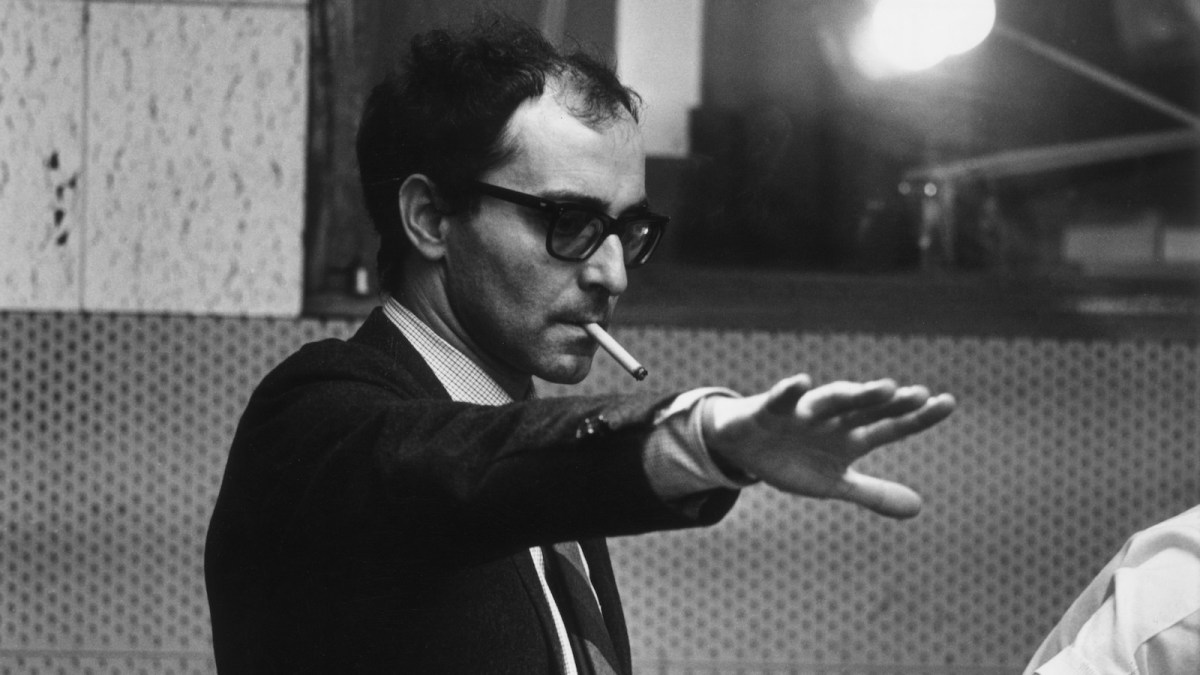

When the legendary French-Swiss director Jean-Luc Godard passed away yesterday, the world lost one of its greatest and most influential filmmakers – a master of cinema whose work revolutionized the narrative, continuity, sound, and camerawork of the cinema and helped spawn an entirely new generation of filmmakers.
Writing on Godard’s legacy on his website, critic Roger Ebert said of the director,
“Godard is a director of the very first rank; no other director in the 1960s has had more influence on the development of the feature-length film. Like Joyce in fiction or Beckett in theater, he is a pioneer whose present work is not acceptable to present audiences. But his influence on other directors is gradually creating and educating an audience that will, perhaps in the next generation, be able to look back at his films and see that this is where their cinema began.”
— Roger Ebert
Godard began his career as a critic for France’s influential film journal Cahiers du Cinéma, where he challenged new filmmakers to throw off the bonds of common film convention and pursue innovation. His writing — as well as his philosophy — heavily influenced by existentialism and socialism, would inform his eventual leap to his rightful place behind the camera. Together with fellow Cahiers du Cinéma writers Éric Rohmer, Jacques Rivette, and Claude Chabrol, Godard would spearhead the film movement which came to be known as the Nouvelle Vague, aka the French New Wave of film.
Here are six of the late director’s most celebrated and influential works.
Breathless
Arguably the “first shot” in the New Wave revolution, À bout de souffle or Breathless remains to this day one of the world’s most influential films. The movie — which features the brutally sexy Jean-Paul Belmondo and the winsome American actress Jean Seberg as its leads — tells the story of a nihilistic small-time crook and his girlfriend who grows ever more fearful of the meaninglessness of life. The film was visually bold for the time, relying on multiple jump cuts during the narrative, a technique never used to that degree before. The film was a smash and kicked off the New Wave, with Godard comparing its arrival to being like cavemen barging into the Palace of Versailles.
Alphaville
One of Godard’s very rare forays into the fantastic, Alphaville is a dystopian science fiction film yet relies on none of the special effects that define the genre. No futuristic sets were built and the film was shot solely in Paris, with occasional usage of the then-new modernist buildings in the city to portray a colder, alien, computer intelligence. A mash-up of Film Noir and Sci-Fi, the film features as its protagonist Lemmy Caution, an actual popular pulp detective film character of French contemporary cinema, played by actor Eddie Constantine, who had played Caution in a string of other movies.
Week End
What starts off as a murder plot by a pair of adulterers quickly becomes a surreal road trip that is equal parts Alice in Wonderland, The Road Warrior, and The Communist Manifesto in Weekend aka Week End. A traffic jam of Parisians becomes a nightmare of splayed corpses and butchered animals as Godard literally sets the French countryside on fire and the couple ends up — through their misadventures — joining a group of cannibalistic hippies. Brutal and unrelenting in its (often vulgar) criticism of capitalism and consumerism, Weekend remains Godard’s most controversial film.
Pierrot le Fou
Pierrot le Fou follows Jean-Paul Belmondo as Ferdinand Griffon, a disaffected member of the middle class who flees his job and married life and embarks on a madcap road trip with Marianne Renoir (played by Godard’s wife and muse Anna Karina) who is herself being pursued by the OAS, a far-right terrorist organization. The dividing line between Godard’s less political work and his radicalized later work, the film still criticizes mass-market culture with its garish use of color and commercial imagery.
A Woman is a Woman
This tribute to classic American movie musicals may have ended up being the director’s warmest effort. Godard combines seemingly incompatible elements of neorealism and musical theater both to offer homage and to skewer musical tropes, romance, and even the cinema itself. Anna Karina stars as Angela, an exotic dancer torn between her husband and his best friend (played by Belmondo) as she attempts to have a child. Godard manages to sweep the viewer up in a Technicolor musical before inevitably returning to the ground.
Contempt
Godard’s aptly name Contempt applied a critical razor to the film industry years before such black comedies like The Player and Barton Fink did. Michel Piccoli stars as a screenwriter torn between his artistically purist director, played by legendary German director Fritz Lang, and his vulgar and boorish producer, played by Jack Palance, while at the same time dealing with his wife Camille (Bridget Bardot) who has just told him she no longer loves him. Arguably Godard’s best film about human relations, it’s also regarded as one of the best movies about the filmmaking process ever made.






Published: Sep 14, 2022 11:13 am