


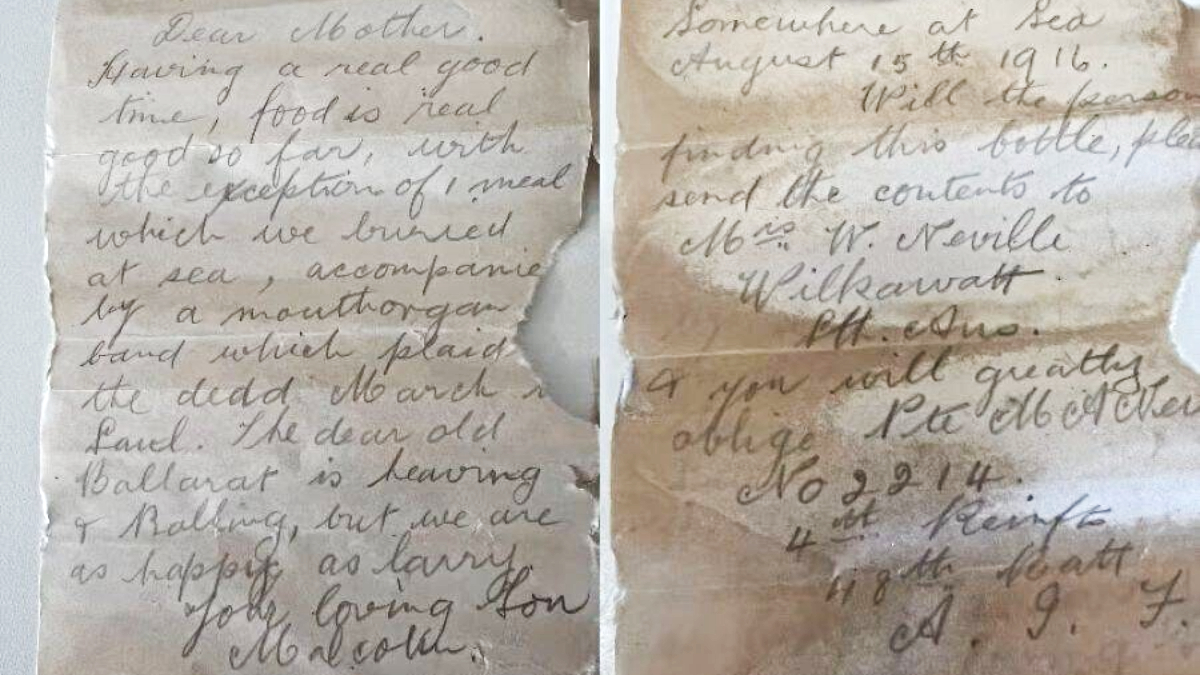

A routine cleanup of the beach turned miraculous for Debra Brown and her family when they stumbled upon a 109-year-old bottle. It contained pencil-in-bottle letters from two World War I soldiers that survived more than a century at sea.
On Oct. 9, 2025, the Brown family was clearing litter on Wharton Beach, a remote stretch of coast in southern Western Australia. Suddenly, Debra Brown’s daughter, Felicity, spotted a thick, clear glass bottle half-buried in the dunes. Inside were two folded pencil-written letters dating back to Aug. 15, 1916. The messages were finally opened a century after writing.
The letters were written by two privates on their way to the front. One was a 27-year-old Private Malcolm Alexander Neville, writing from aboard the troop ship HMAT A70 Ballarat. He addressed the two-page letter to his mother in South Australia, writing of life at sea. Neville described the ship as “heaving and rolling,” but added bluntly that “we are happy as Larry.”
He even joked that, “Food is real good so far, with the exception of one meal, which we buried at sea.” The letter was heartwarming and meant to be read by Neville’s mother. Sadly, it never reached her. Records show that Neville died after spending just two months on the Western Front. He was killed during the Battle of Bullecourt in France on April 11, 1917.
The second letter came from Private William Kirk Harley. His tone was neutral, almost as if he were bored. He simply wrote, “If you find this bottle, I hope you’re in as good spirits as we are at the moment.” Harley did not want the letter delivered to anyone and instead instructed the person who found it to keep it. Unlike Neville, Harley survived the war, returned home, and had a family of his own. He died later in 1934.
What makes the find even more incredible is the condition. The letter paper, though water-stained, remained legible. Once Debra Brown realized the names and origin of the soldiers, she used online records (and social media) to connect with descendants. Neville’s great-nephew responded, and Harley’s granddaughters got her message.
They called the incident “a miracle” and a moment of emotional reconnection with a grandfather many only knew in stories (via ABC). The letters have now become artifacts. They’re human voices from a century past, reflecting hope, humor, and the ordinary thoughts of soldiers heading into unimaginable battles. The pencil lines surprisingly outlasted wars, decades, and shifting coastlines to finally reach the human eye.









Published: Nov 10, 2025 08:22 am