


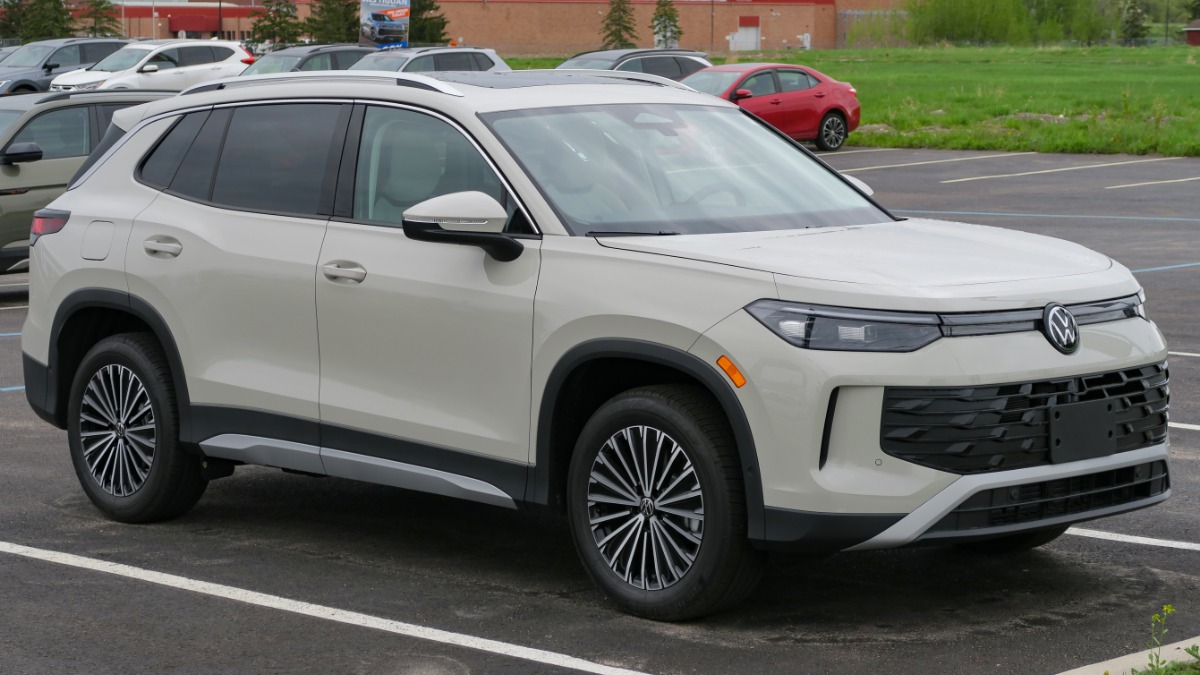

Content creator Kat Mackenzie recently shared a viral video of her 2022 Volkswagen Tiguan making a loud and unsettling noise that could be heard even with the car doors closed. The video has gathered over 348,000 views and shows Mackenzie opening the car door, only for the sound to get even louder.
According to Motor1, Mackenzie wrote about her experience, saying, “Has happened multiple times when I’m driving and sounds like it’s going to explode. VW says it’s not a safety issue & I’m so frustrated.” She also tagged the company directly, adding, “@Volkswagen help PLEASE!! My new Tiguan should not be having this many problems. Anyone have any experience w this? #lemon.”
Volkswagen has not publicly responded to her. One commenter on TikTok suggested, “This is the stereo speakers VW knows this happens in some vehicles and they’re not sure why there’s no confirmed fix for it- VW tech, to get it to stop short term disconnect the vehicle battery for a little while and then reconnect.”
Lemon laws exist to protect buyers when dealerships refuse to act
When a dealership or manufacturer ignores a serious defect, lemon laws can step in to protect the car owner. Most states define a “lemon” as a new car with a major defect that cannot be fixed after a reasonable number of repair attempts. This generally covers engine issues, transmission problems, electrical defects, or faulty steering and suspension.
Before lemon law protections apply, the manufacturer or dealer must be given a chance to fix the problem. The number of attempts considered “reasonable” varies by state. For example, California may consider as few as two repair attempts sufficient, while other states may require more. These defects also need to fall within the original warranty period or a mileage window, often between 12,000 and 24,000 miles.
If a dealership keeps dismissing complaints, a lemon law attorney can help review the case and negotiate with the dealer for a refund or replacement. Some states also offer arbitration through the attorney general’s office, which can be faster and cheaper than going to court.
Mackenzie’s situation is not unique; major automakers facing serious product and brand crises have shown how quickly consumer trust can erode when companies fail to respond to quality concerns.
Looking at the broader reliability picture, the Volkswagen Tiguan earns only average scores on most reliability ratings. RepairPal gives it a 3.0 out of 5.0 and ranks it 26th out of 26 compact SUVs, placing it at the very bottom of its class. The average annual repair cost for a Tiguan is $730, compared to $521 for compact SUVs in general and $652 for all vehicle models.
Commonly reported issues across Tiguan model years include transmission problems such as hard shifts, hesitation during acceleration, and clunking sounds. Some owners have reported engines stalling outright.
Brakes have also been a concern, with the National Highway Traffic Safety Administration logging multiple complaints about brakes being slow to engage or failing entirely. Electrical problems include lane assist malfunctions, adaptive cruise control failures, and electronics activating without the key in the ignition. Older models from 2009 to 2011 have had timing chain and tensioner wear that can lead to engine damage.
Tiguan owners also bring their vehicles in for unscheduled repairs an average of 0.9 times per year, compared to just 0.3 times for other compact SUVs and 0.4 times for all vehicle models. There is also a 12% chance that any given repair will be a major issue, which is in line with the broader average but still means a significant risk of costly repairs.
RepairPal calculates these ratings using millions of repair invoices combined with automotive statistics and predictive data. In other consumer news, Domino’s bold new brand identity shows how companies can take a very different approach, leaning into change rather than going quiet when customers are paying attention.





Published: Apr 9, 2026 04:40 am