


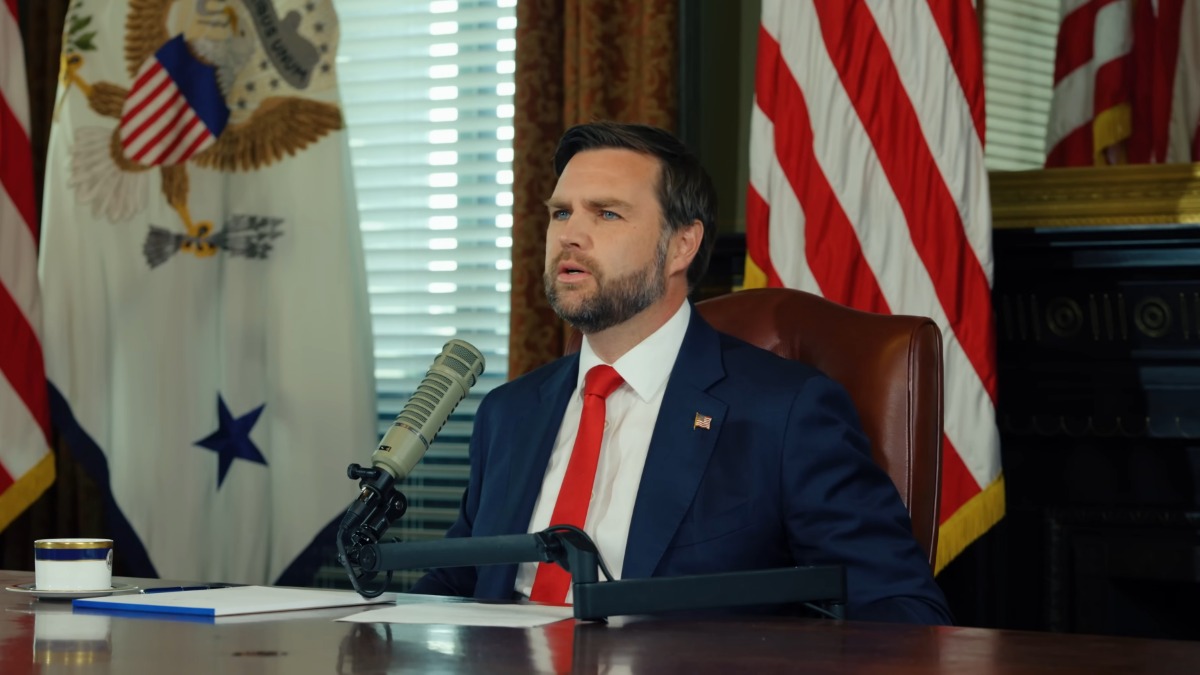

Vice President JD Vance made an unusual comparison this week when asked about U.S. negotiations with Iran over nuclear enrichment. The discussion somehow turned into a story about his wife, Usha Vance, and her right to skydive. Vance was speaking to reporters where he had been campaigning for Prime Minister Viktor Orbán.
Vance laid out Trump’s position clearly. “What the president has said is that we don’t want Iran to have the capacity to build a nuclear weapon,” Vance stated. He added, “The president has also said that we don’t want Iran enriching towards a nuclear weapon, and we want Iran to give up the nuclear fuel. Those are going to be our demands during the negotiation, and again, we’re going to see what the Iranians are going to give up.”
Vance was then pressed on accusations made by Iranian Parliament Speaker Mohammad Bagher Ghalibaf, who claimed the U.S. had already violated three terms of the ceasefire, one of which was Iran’s continued right to enrich uranium. According to Mediaite, after addressing some of Ghalibaf’s claims and questioning his grasp of English, Vance launched into his analogy.
The U.S. position on Iran’s nuclear enrichment remains firm going into Pakistan talks
“The second thing Ghalibaf said, which again I found fascinating, is he said, ‘We refuse to give up the right to enrichment,'” Vance recounted. He then explained his thinking: “And I thought to myself, you know what, my wife has the right to skydive, but she doesn’t jump out of an airplane because she and I have an agreement that she’s not going to do that because I don’t want my wife jumping out of an airplane.”
Vance used this to make his point clear: “We don’t really concern ourselves with what they claim they have the right to do. We concern ourselves what they actually do, and I think the president’s been very clear on the enrichment question. Our position on that has not changed.”
White House spokesperson Karoline Leavitt echoed this earlier in the day, stressing that the United States continues to reject any uranium enrichment inside Iran, according to Al Jazeera. She made clear that President Trump did not agree to a “wish list” submitted by Tehran. Leavitt said Iran’s initial 10-point ceasefire plan was “literally thrown in the garbage” by the United States.
That plan included demands for the U.S. to accept Iran’s right to enrich uranium, provide sanctions relief, and permanently end attacks on Iran. The stakes of these negotiations are high, with concerns growing about a potential nuclear catastrophe in the Middle East if talks break down.
Leavitt also reiterated, “The president’s red lines, namely the end of Iranian enrichment in Iran, have not changed.” Iran, for its part, consistently argues that it is not trying to develop nuclear weapons, and insists on enriching its own uranium as a national right for civilian energy purposes. The Trump administration, however, has been pushing for a complete dismantling of the Iranian nuclear program.
The upcoming negotiations, which Vance is set to lead for the U.S. team, are scheduled to take place in Pakistan on Saturday. The talks come after a two-week ceasefire was announced following more than 38 days of conflict, during which the U.S. had been conducting attacks and Iran had closed the Strait of Hormuz in retaliation.
The closure of that vital shipping lane caused energy prices to rise sharply, sending economic ripples across the globe. Under the ceasefire terms, the U.S. will halt its attacks, and Iran will reopen the Strait of Hormuz. Trump has described the last-minute deal as the start of a golden age for the Middle East, though significant disagreements remain heading into Saturday’s talks.









Published: Apr 9, 2026 08:20 am