


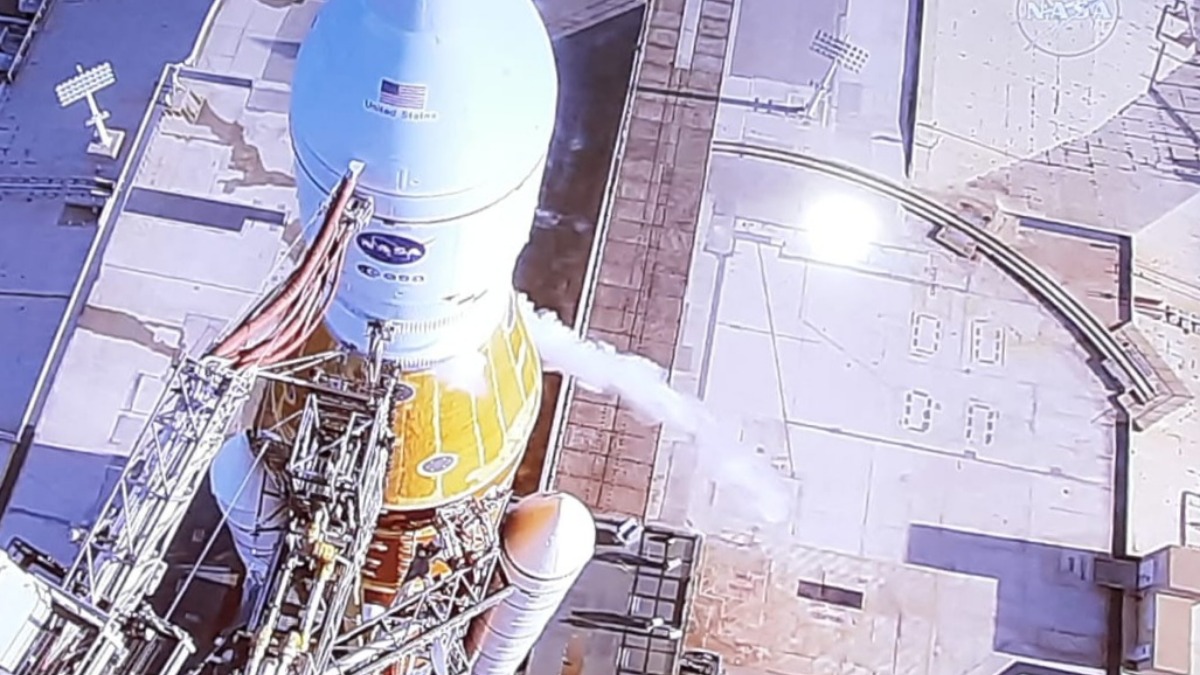

NASA’s Artemis II mission launched on April 1, 2026, carrying four astronauts on a roughly 10-day journey around the Moon. The crew includes NASA astronauts Reid Wiseman, Victor Glover, and Christina Koch, along with Canadian Space Agency astronaut Jeremy Hansen. The mission is a test flight of the Orion spacecraft, Integrity, and is the first crewed deep space flight since the Apollo era. Splashdown is scheduled for April 10 off the coast of San Diego.
The crew has had to deal with a number of unexpected problems aboard the capsule. These have ranged from a faulty toilet to a strange burning smell inside the spacecraft. But one of the more unusual concerns raised during the mission has nothing to do with hardware at all. It has to do with the astronauts themselves. Experts have warned that the gas astronauts pass naturally could be a genuine fire risk inside the Orion capsule.
“The gases that come out when you pass gas are flammable. That is a major problem,” CTV science and technology specialist Dan Riskin explained, according to Dexerto. “You’ve got methane, you’ve got hydrogen. Like, that’s the Hindenburg.”
So yes, farts are basically a space hazard
Research into this problem dates back to the 1960s, when scientists tried feeding astronauts a bland diet to reduce flatulence. The effort backfired. Studies found that gas volumes were actually larger at reduced spacecraft pressures.
The toilet situation has added another layer of difficulty to managing bodily functions aboard the spacecraft. The Universal Waste Management System, which is the Orion toilet, ran into trouble just about an hour after launch. Mission specialist Christina Koch had to troubleshoot and essentially reboot the system to get it working again. She later called herself the “space plumber” and said the toilet was “probably the most important piece of equipment on board.”
NASA officials said the issue was likely the system shutting off automatically because the pump was not primed with enough water. The launch itself was not without drama either, as NASA’s self-destruct system went dark just minutes before liftoff, though the agency pressed ahead anyway.
That was not the only toilet trouble. A few days into the mission, the lines used to vent urine into space became clogged and frozen. The fix involved rotating the entire spacecraft so that sunlight could hit the vents and melt the blockage. On Day 5, the toilet was declared no-go for use again, this time possibly due to a chemical reaction creating debris that clogged a filter.
To make matters worse, astronaut Jeremy Hansen also reported a strange burning smell coming from the hygiene bay. NASA investigated and ruled out the heaters and the toilet as the source. They concluded it was not dangerous, and no further reports of the smell came up after that.
The crew also had a few lighter moments during the trip, though not all of them were welcome, including a moment where the astronauts were caught visibly reacting to a Trump speech about Wayne Gretzky. The crew was not entirely without backup options. Collapsible Contingency Urinals were available as an alternative for storing urine. Still, experts say these are far from ideal solutions for long missions.
John Moores, an associate professor at York University, pointed out that future missions to Mars, which could last several months, will require far more reliable systems, reports CBC. “You don’t want to go to Mars with a toilet that’s not working for you,” he said. When the Orion capsule splashes down, NASA plans to retrieve the toilet for examination to understand what went wrong and improve the system for future missions.









Published: Apr 10, 2026 10:09 am