


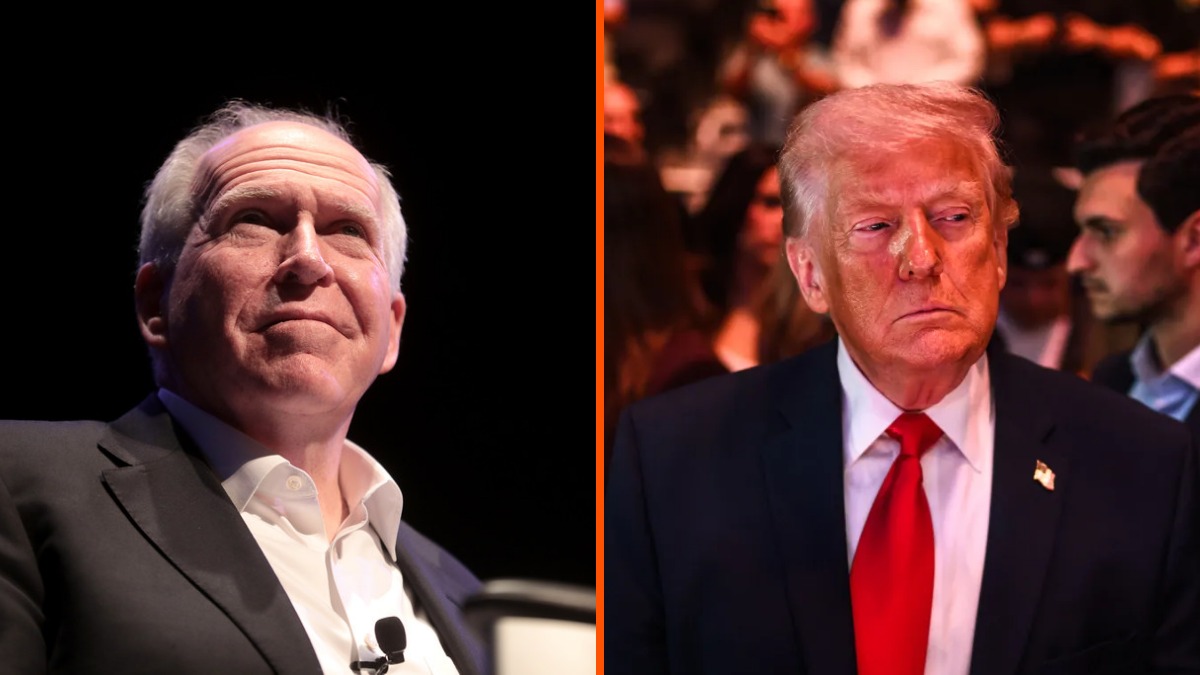

Former CIA Director John Brennan has stated that the 25th Amendment was written with Donald Trump in mind. It’s a sharp critique that arrives as tensions regarding the president’s approach to Iran continue to escalate. Brennan shared these thoughts during an appearance on a show hosted by MS NOW’s Ali Velshi.
Brennan specifically pointed toward the immense responsibility that the President shoulders:
“I think the 25th Amendment was written with Donald Trumps in mind, because allowing someone like this to continue to be the commander-in-chief and to control the tremendous capabilities of the U.S. military, including our nuclear weapons capability, which he seemed to allude to when he said he’s going to just eliminate an entire civilization.”
Brennan’s remarks are inspired by Trump’s war crime-adjacent rhetoric towards Iran, especially in the last week. He promised that hell would rain down on Tehran if they didn’t open the Strait of Hormuz. However, it was his threats to end a civilization that shocked everyone and drew international criticism.
Now, we have a blockade, which is very colonial or pirate-like of Trump
This situation has drawn significant backlash from members of Congress, with over 70 Democrats pushing for Trump to be removed from office. Even former allies like Marjorie Taylor Greene lashed out at him, invoking the 25th Amendment.
Not long after that insane threat, Trump, thankfully, announced a two-week ceasefire on Tuesday, but many lawmakers have pointed out that he explicitly threatened genocide. Brennan emphasized the gravity of the current climate, noting that we really are in “very, very troubling times.”
The legal mechanism being discussed by these Democrats is the 25th Amendment to the United States Constitution. According to Reuters, this amendment was ratified in 1967 following the assassination of President John F. Kennedy. Its primary purpose is to clarify the process of presidential succession, ensuring that the country always has a functioning president and vice president.
While Section 3 of the amendment has been used in the past when presidents knew they would be incapacitated for medical procedures, such as when Joe Biden underwent a colonoscopy in 2021, Section 4 remains untested. Section 4 covers the involuntary removal of a president and would require the vice president and a majority of the cabinet, or another body designated by Congress, to declare the president unable to perform their duties.
If a president were to contest such a decision, Congress would be required to assemble within 48 hours. Removing the president would then demand a two-thirds majority in both the Senate and the House of Representatives.
Experts like Scott Anderson, a senior fellow at the Brookings Institution, have suggested that such an attempt would likely fail without a massive defection from the president’s own party. Since Republicans currently hold slim majorities in both chambers of Congress, an effort to invoke the amendment would be an uphill struggle.
The political landscape is further complicated by the fact that the president maintains significant support among his base. Recent data indicate that approximately 82% of Republicans remain happy with his presidency, even amidst falling overall approval ratings. Democratic lawmakers are also weighing the potential political risks of such a move.
Some members of the party have expressed that focusing on impeachment or removal efforts might not be the most effective use of their time while attempting to focus on policy issues like job growth and inflation ahead of the upcoming midterms. Representative Madeleine Dean (D-Pa) noted that while she believes the president is guilty of a litany of high crimes and misdemeanors, she is not convinced that pushing for impeachment is the best path forward.
Predictably, the push for removal has been met with strong opposition from Republican leadership. House Speaker Mike Johnson criticized the Democratic approach, stating that they have no message or vision and are simply offering the American people an irrational hatred of the president.
As it stands, the debate continues to highlight the deep divisions in Washington regarding the limits of executive power and the appropriate response to the president’s recent actions on the international stage.









Published: Apr 14, 2026 08:36 am