


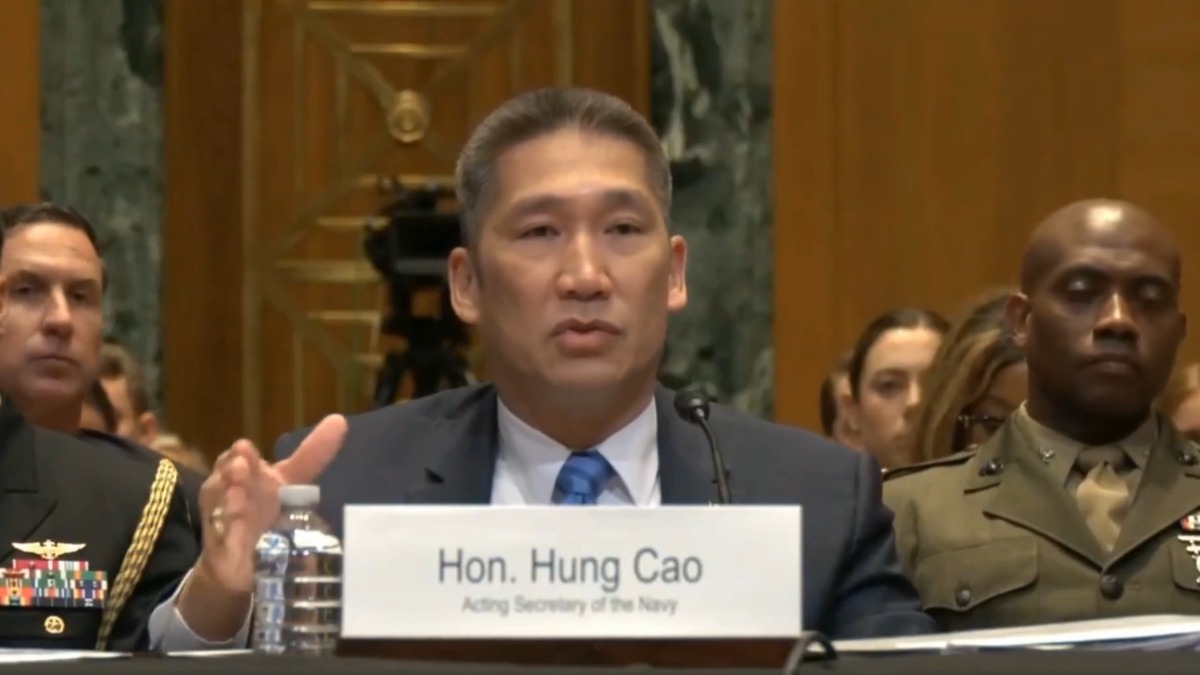

Acting Navy Secretary Hung Cao just dropped a major revelation during a Senate hearing, contradicting the Trump administration’s claims about arms sales to Taiwan and munitions stockpiles.
Cao told lawmakers the Pentagon paused a $14 billion weapons deal to ensure the U.S. has enough firepower for its ongoing war with Iran, which undercuts Trump’s claim that the delay was a strategic move to gain leverage with China.
The Senate Appropriations defense subcommittee hearing brought a lot of sharp questions about the administration’s priorities. When pressed by Senate Minority Leader Mitch McConnell about the “distressing” delay in the Taiwan arms sale, Cao responded, “We’re just making sure we have everything, but then the foreign military sales will continue when the administration deems necessary.”
The timing of Cao’s revelation couldn’t be more awkward for the White House. Just last week, Trump dodged public mentions of Taiwan during his trip to China. The island, which Beijing claims as its territory, has become a flashpoint in U.S.-China relations, with China ramping up military drills and warning against American arms sales. However, this munitions confusion is likely to complicate those diplomatic efforts.
It is also the downside to lying and deflection
Trump has framed the Taiwan arms sale as a “very good negotiating chip” in dealings with Beijing, telling Fox News he might approve the deal or he might not. “We’re going to see what happens,” he said, leaving the door open for leverage.
Cao’s testimony, however, paints a harsher truth. The U.S. has burned through thousands of missiles since the Iran war began, including nearly all of its long-range stealth cruise missiles and thousands of Tomahawks and Patriot interceptors.
The administration has repeatedly dismissed concerns about stockpiles, with Defense Secretary Pete Hegseth calling the issue “foolishly and unhelpfully overstated” during a House hearing last week. “We know exactly what we have. We have plenty of what we need,” Hegseth insisted.
That confidence isn’t shared by everyone in the defense community. Evan Sankey, an analyst at the Cato Institute, told The Hill the munitions shortage and Trump’s diplomatic goals with China might be “a happy coincidence” for the administration. “If you can delay the sale and/or delay delivery of the order and sort of help both of these issues at the same time, it makes sense,” he said.
Zack Cooper, a senior fellow at the American Enterprise Institute, went further, suggesting China is actively using its leverage to pressure the U.S. Cooper believes Beijing may have tied Xi’s September visit to Washington to a freeze on arms sales to Taiwan. He also warned that Defense Secretary Hegseth’s upcoming trip to China in July could hinge on the administration scaling back the $14 billion deal.
The U.S. has also delayed a shipment of Tomahawk missiles to Japan, pushing back deliveries of its 400-missile order until at least March 2028. South Korea has faced similar delays, though officials there have been reluctant to comment publicly.
Time reported that the production bottlenecks are severe, with some weapons taking years to replenish. Experts have pointed out that while the Pentagon has the money, they lack the time.
Not only is the US still using World War II production models, but each missile also takes more than 40 months to build. Additionally, as war tactics shift to swarm attacks by drones, experts argue that the Pentagon needs to invest in low-cost systems.
The Iran war has exposed deep vulnerabilities in the U.S. military’s ability to sustain prolonged conflicts. After all, the most critical munitions for a potential Taiwan conflict, like long-range missiles, are in short supply, which will necessitate getting closer to the enemy.
The ripple effects extend beyond Asia. Ukraine, already struggling with shortages of Patriot missiles and HIMARS rockets, is now competing with U.S. allies in the Gulf for limited supplies. Additionally, new weapons delays announced by the Pentagon will further strain Ukraine’s defenses.
Despite the administration’s assurances, lawmakers aren’t buying it. Sen. John Kennedy grilled Navy Chief of Operations Admiral Daryl Caudle during the same hearing, pressing him on why the U.S. wouldn’t simply approve the Taiwan sale to gain leverage over China.
“President Xi has telegraphed his anxiety, his insecurity … We want leverage, we want stability, not a war,” Kennedy argued. Caudle, however, refused to weigh in, calling the decision “very complex” and deferring to the administration.
Now, the question remains whether the administration’s munitions crunch will force a reckoning in how the U.S. prepares for future conflicts. With China looming as an “imminent” threat to Taiwan, as Hegseth warned in May 2025, the stakes couldn’t be higher.









Published: May 26, 2026 04:42 am