


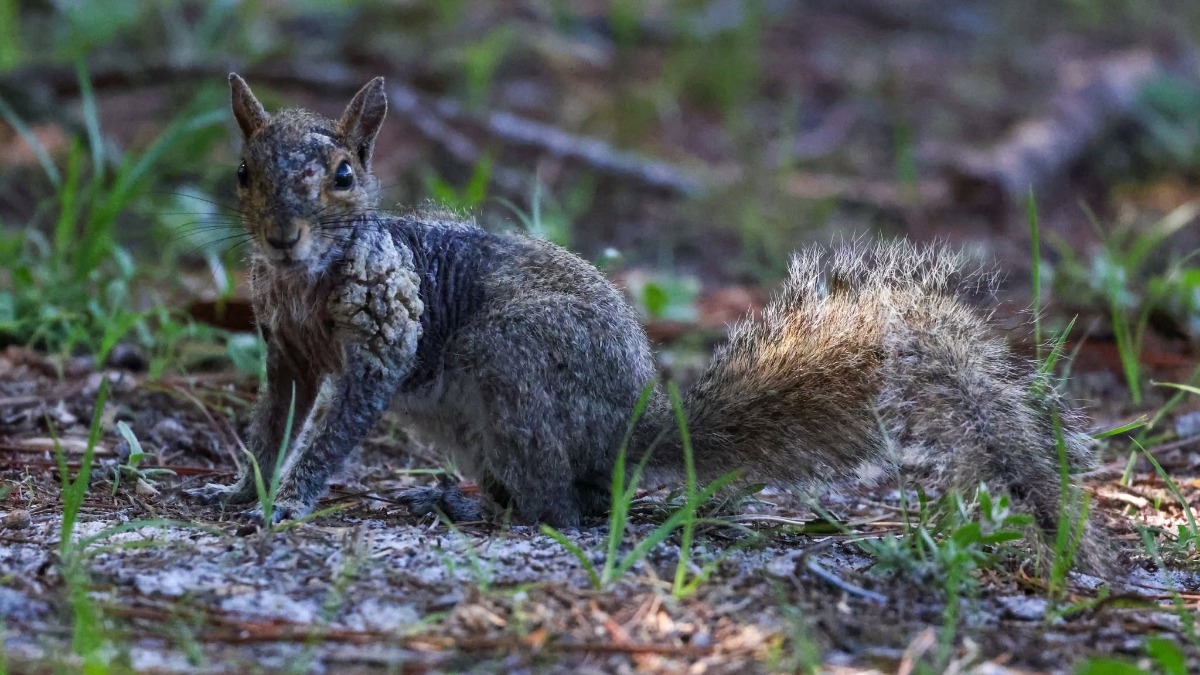

Lately, people all over the United States, from Florida to Michigan and North Carolina, have been sharing photos of their local squirrels covered in what looks like oozing, wart-like growths on social media. Some have looked so disfigured that folks have been referring to them as zombie squirrels, and according to the Daily Mail, these sightings have become more frequent throughout this month.
According to the outlet, a North Carolina resident took to Facebook on June 9 to express their concern, writing, “What is going on with the squirrels lately?! This is the third one I’ve seen looking like this, and it’s honestly freaking me out.” A report by the NY Post also confirms that these sightings are indeed occurring across several states, with residents capturing images of squirrels sporting patchy fur and reddish bumps.
The good news is that wildlife experts stated that there is no reason to panic. Per reports, the consensus among wildlife experts is that these squirrels are likely suffering from squirrel fibromatosis. This is a viral skin disease caused by the leporipoxvirus. It is important to note that this condition is distinct from squirrel pox, which is a different virus that primarily affects red squirrels and is more common in the United Kingdom.
Lepoipoxvirus transmits the same way as Herpes
The NY Post noted that this virus spreads through direct contact between healthy animals and the lesions or saliva of infected squirrels. The virus then results in hairless growths or tumors that can break open and leak clear fluid, which is exactly what makes these squirrels look so alarming.
The Daily Mail pointed to a facebook post by a Michigan resident that featured an image of a sick squirrel, and noted, “It’s a fascinating virus for the fact that it affects every squirrel so differently… some cases are more focal and affect only a part of the body (this has remained limited to her ears and head), and others are systemic and affect the whole body, which ultimately results in death in most cases.”
The outlet reported that in most situations, these growths will heal on their own. They typically resolve within four to eight weeks without any human intervention or medication. Of course, as was noted earlier, there are severe cases where the virus can affect internal organs and lead to death, but those instances are the exception rather than the rule.
According to wildlife experts, it is our own backyards that are reportedly causing the uptick in cases right now. Staple decorative elements like bird feeders unintentionally become hotspots for virus transmission.
During last year’s outbreak, The NY Post noted that Shevenell Webb from the Maine Department of Inland Fisheries and Wildlife explained the phenomenon to the Bangor Daily News, stating, “It’s like when you get a large concentration of people. If someone is sick and it’s something that spreads easily, others are going to catch it.”
When multiple squirrels congregate around a single bird feeder, they can leave behind saliva on the seeds. If one squirrel is already carrying the virus, it can easily pass it along to healthy ones that come to feed afterward. Webb then reportedly noted, “Like a lot of people, I love watching birds. Unfortunately, you can attract multiple [squirrels] to that feeder and risk exposure if one has the virus.”
The outlets advise that if you happen to spot one of these squirrels in your own yard, the best advice is to keep your distance. Even though the virus does not spread to humans, dogs, or birds, you should not try to touch or capture the animal. As Webb told the Bangor Daily News, “I would not recommend trying to capture a squirrel that has the virus. It is naturally occurring and will run its course in time.”
While this isn’t an illness that is dangerous to the larger populace, other viruses can spread to us. Last year, scientists were begging people to take the zombie deer seriously, after the Chronic Wasting Disease began afflicting herds around the nation. Recently, we saw the incredibly rare occurrence of rabies spreading to people through organ donation.







Published: Jun 26, 2026 11:57 am