


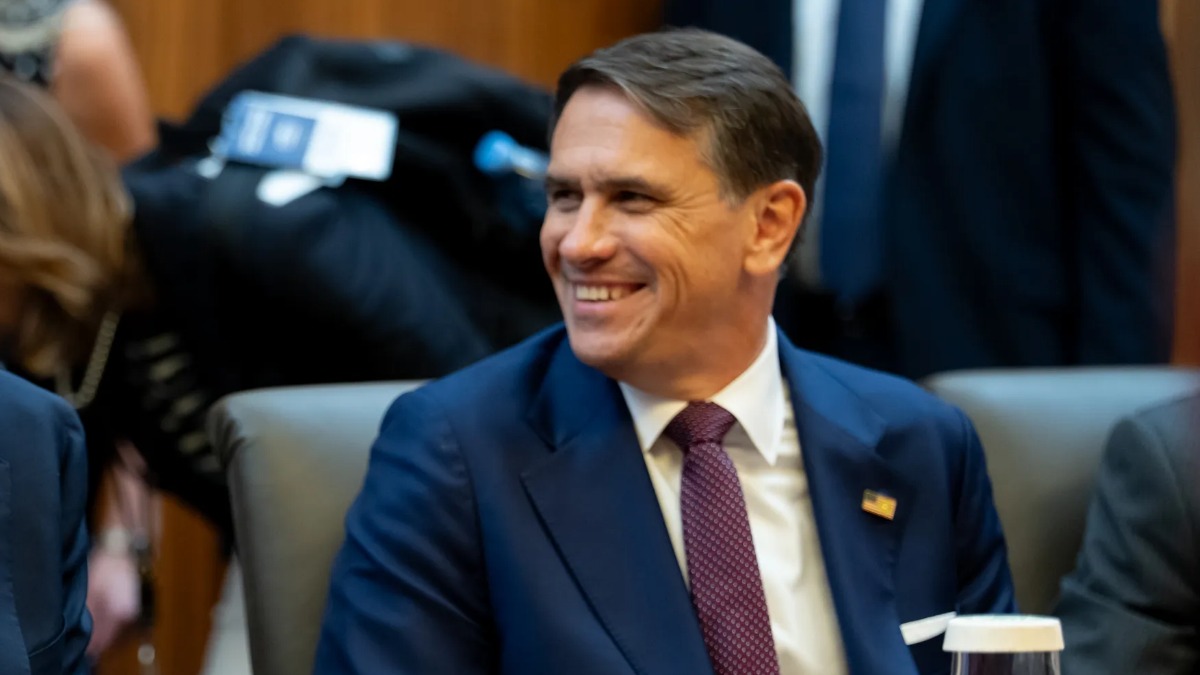

Todd Blanche, the acting attorney general and President Trump’s nominee for the Attorney General role at the Justice Department, took a significant step late Sunday to save his confirmation. By formally rescinding the president’s $1.8 billion anti-weaponization fund, Blanche has managed to clear a major hurdle that threatened to derail his path through the Senate Judiciary Committee.
According to CNN, Blanche’s move directly addressed concerns raised by key Republican senators. It’s a classic case of high-stakes political maneuvering, as Blanche attempts to balance the demands of the White House with the legislative requirements of the upper chamber. As reported by Axios, this shift in strategy is likely to secure the votes necessary for his nomination to advance to the full Senate floor.
“My team and I have met with committee members and Senators over the past several weeks and addressed any concerns or outstanding questions,” Blanche posted on X. “We have enjoyed good faith discussions, and as a result issue the following order and update with regard to the May IRS settlement.” The attached order stated, “The Attorney General’s May 18, 2026 Order establishing the Anti-Weaponization Fund (‘Fund’) is rescinded and shall have no force or effect.”
A fund that sparked a rift
Per CNN, the fund was created as part of a settlement agreement to resolve a lawsuit filed by Trump against the IRS. It was intended to provide taxpayer money to individuals who claimed they were victims of government weaponization, a group that would have included those involved in the January 6, 2021, US Capitol riot. The fund met a lot of resistance and even sparked a revolt within the GOP as many lawmakers stood against it.
While the democrats were very unhappy with Blanche’s confirmation hearing, he faced one surprising hurdle. According to the outlets, Republican Senators John Cornyn of Texas and Thom Tillis of North Carolin refused to support Blanche while the fund remained a possibility.
The course change seems to have worked. In a joint statement released Monday morning, Cornyn and Tillis reportedly noted they were “pleased” with the order and “look forward to voting to advance his nomination out of the Senate Judiciary Committee soon.” They described the result of their negotiations as a “legally enforceable document” that successfully terminates the fund and places tighter limits on tax audit protections.
Blanche’s Sunday order also clarified the scope of the immunity protections granted to the president and his family. CNN noted Blanche’s new documentation specifies that the measure “applies by its terms only retroactively” and is limited to “the named parties in the lawsuit” referenced in the original settlement. This addresses the specific fears held by Cornyn and other colleagues regarding how far these protections might extend to unnamed affiliates.
Despite this progress, the situation remains complex. The outlet reported that the settlement itself is a contract between the Justice Department and the president. However, the document released on Sunday was signed only by Blanche. It lacks the signatures of Trump or his personal legal team.
This reportedly leaves some ambiguity regarding whether the terms can be fully modified without the president’s direct, written consent. During his confirmation hearing, Blanche acknowledged that the settlement was indeed enforceable. Per CNN, he noted that Trump’s lawyers could technically claim the Justice Department breached the agreement by failing to operate the fund.
Trump had certainly complicated these negotiations. On Thursday, he threatened to pull Blanche’s nomination entirely, suggesting he might simply renominate Blanche after the current senators leave their positions next year.
Per CNN, he even suggested on Saturday that if the Senate didn’t confirm Blanche, he would push to get the anti-weaponization fund passed into law regardless. Trump told reporters on Air Force One that the fund “would be a reimbursement for the pain” that his supporters and allies suffered.
The pressure on Blanche was immense. He had to navigate the president’s threats while simultaneously securing the votes of senators who were clearly signaling that the fund was a dealbreaker. As noted by Axios, while the protections listed by Blanche are without precedent, they reflect the reality that the current administration is unlikely to pursue criminal investigations against the president anyway.
For now, the Judiciary Committee is scheduled to vote on Tuesday.









Published: Aug 3, 2026 01:40 pm