


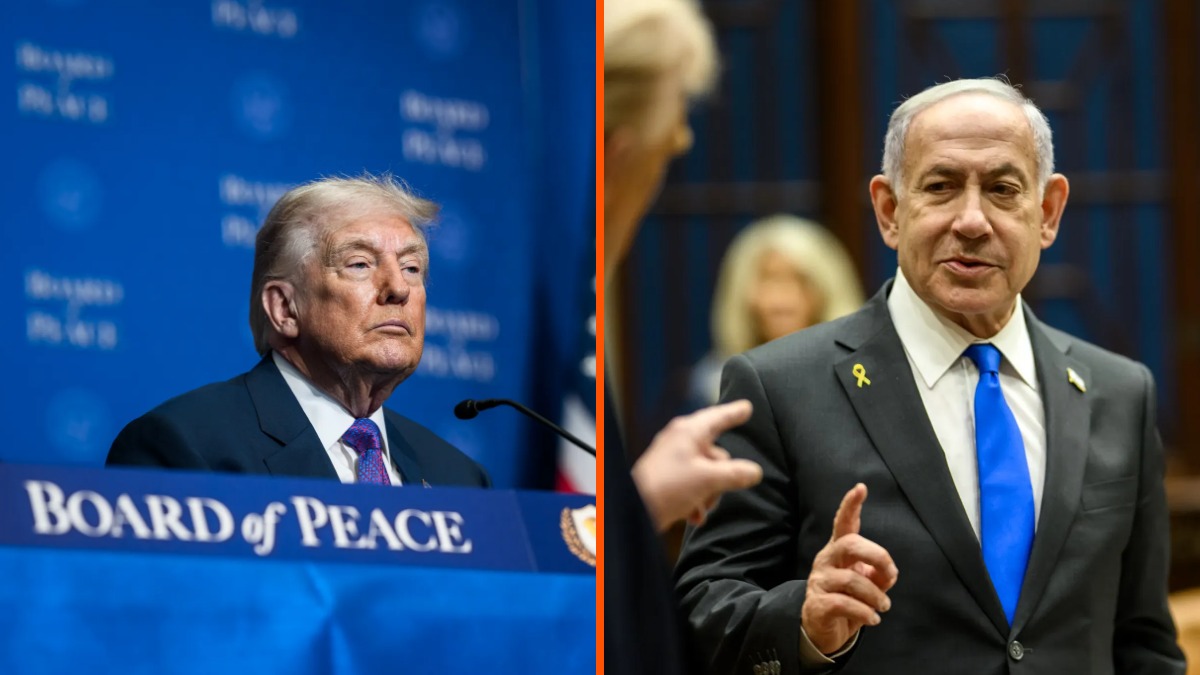

The landscape of the Gaza conflict shifted significantly this week as Israeli Prime Minister Benjamin Netanyahu officially rejected the latest peace initiative proposed by the United States and the Board of Peace. This development marks a major point of friction between the Israeli government and President Donald Trump, who has been pushing for a resolution to the ongoing violence.
According to CNN, the 15-point plan was announced by Trump on July 31. It was reportedly intended to serve as a roadmap for lasting peace in the territory. However, the Israeli government has signaled that it is far from ready to adopt the terms as they currently stand. Reuters reported that Netanyahu made his statements during televised remarks to his cabinet members, stating, “I want to be precise here: Israel rejects the 15-point document.”
He further clarified that the Israeli military would “not withdraw at all until Hamas is genuinely disarmed and will continue to thwart threats against our forces and citizens.” Reuters reported that the Prime Minister emphasized the nature of this requirement, noting that it means “heavy weaponry, lighter weaponry, all weaponry” must be addressed. He specifically characterized the necessary outcome as “genuine disarmament, not fictitious disarmament.”
The diplomatic back and forth
Per the outlets, Netanyahu acknowledged that his government is in active discussions with American officials regarding the proposal. He noted, “They have ideas, some of which are acceptable to us and some are not, and we know how to stand up to those things.” Per Reuters, he made similar remarks on social media earlier this week, where he indicated that while some U.S. concepts are workable, others are entirely unacceptable to his administration.
Reuters noted that the political pressure on Netanyahu is immense. With an election scheduled for October 27, the Prime Minister is navigating a difficult path between his key military backer, the United States, and the demands of his right-wing coalition. Far-right ministers have been vocal in their support for his hardline stance.
According to CNN, Finance Minister Bezalel Smotrich was particularly explicit in a statement, saying, “The (Israel Defense Forces) cannot retreat one millimeter in the Gaza Strip.” Smotrich added that no reconstruction process can begin until the complete dismantling and demobilization of Hamas occurs.
Hamas, meanwhile, is attempting to maintain its position within the framework of the previously negotiated ceasefire. CNN reported that Bassem Naim, a senior member of the Hamas politburo, took to X to address the situation.
He stated, “We expect the mediators and the American guarantor to pressure Netanyahu and his government to adhere to the roadmap and not obstruct the process for internal political and electoral reasons.” Naim also told Reuters that the group remains committed to the roadmap established with mediators in Cairo about ten days ago. It was a hard-won roadmap, considering that the negotiations had stalled because of the Iran war.
The central disagreement reportedly revolves around the timing of troop withdrawals and disarmament. Hamas has insisted that Israel must halt its strikes and pull back its forces before the group begins the process of turning over its weapons. Conversely, Israel maintains that no withdrawal will occur until the group has been fully disarmed.
Interestingly, Hamas has avoided the term disarmament. However, per the outlet, it has indicated it would be willing to store weapons under a U.S.-backed Palestinian technocrat administration supervised by the Board of Peace.
The humanitarian situation in the region remains dire. Since the conflict began following the October 7, 2023, attacks, much of Gaza has been reduced to ruins. Reuters reports that Israeli troops now control roughly two-thirds of Gaza, pushing more than 2 million residents into a shrinking strip of territory along the coast.
There was a brief surge in Israeli strikes following Trump’s initial announcement on July 31. However, the frequency of these attacks has reportedly declined since Monday, when Nikolay Mladenov, the Gaza envoy for the Board of Peace, met with Netanyahu. A source familiar with the situation indicated that Israel has agreed to act only against immediate threats and to cease the targeted assassinations that were occurring on a near-daily basis.
Despite the current friction, the relationship between Netanyahu and Trump has historically been very close. Last year, Netanyahu described the U.S. President as “the greatest friend that the state of Israel has ever had in the White House.” Trump has even suggested that Netanyahu should receive a pardon regarding his ongoing corruption charges.
Nevertheless, the Prime Minister continues to assert his independence. Referring to military actions in Gaza, Lebanon, and Iran, Netanyahu remarked, “Contrary to all those who preach to us, we do what must be done for Israel’s security and we can and will stand our ground even against our best friends when necessary.”








Published: Aug 9, 2026 01:45 pm