


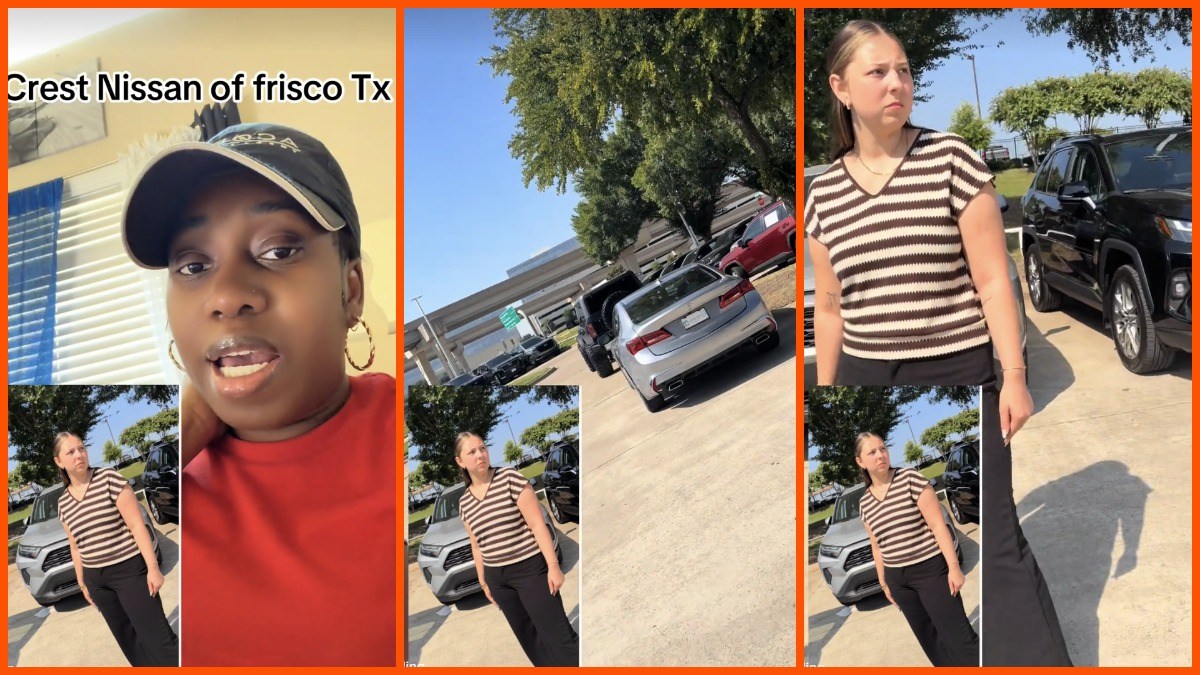

A TikToker named Lala (@ohh___lala) recently took to the platform to share a frustrating experience at Crest Nissan in Frisco, Texas. She had one goal: to make the saleswoman go viral on TikTok, and with 1.7 million views, she succeeded. Lala claims that on her visit, she was stereotyped and dismissed by a salesperson based entirely on her appearance.
Lala’s video started with her providing context. She alleged, “The young lady told me she didn’t have time to show me the car. She got too many customers. I couldn’t look at the inside of the car. Basically, if I didn’t have the 1500 down. She claimed that the saleswoman, whom she identified as Tawny, dismissed her, ”Cause I guess I didn’t look like I have money, um, so she didn’t wanna waste her time with me today.” It’s ironic because Lala had $7000 down. She just didn’t say it.
Once she was done with the setup, Lala cut to a clip of their interaction as they walk across the lot. It doesn’t show Tawny, but it captures most of the audio from their exchange. Tawny justifies not showing the car, stating, “It’s just cause unless they’re unlocked, we have to get the key out of the machine. We have to come out here with you, and we have to show you. And it wastes a lot of time, especially with me cause I have a lot of customers. I just, I don’t have that kind of time.”
Tawny doubles down
Lala pushed back, asking, “How is that a waste of time if we’re trying to buy a car?” In response, Tawny tells Lala, “If you’re looking to buy today. Yeah, but if you’re not looking to buy today. No, it’s a cause. People. So we get a lot of people… we call them tire kickers. They come out here, they spend a couple hours with you. No. And then they leave. That. It’s a, it’s a prevention. Cause I, I, I work with 20+ customers a day. I don’t have that kind of time. If that makes sense.”
Tawny then walks them over to a car, as Lala had already asked for this. However, as Tawny pulls the Jeep Grand Cherokee, Lala mentions to her companion that Tawny’s behavior didn’t sit right with her. So after a cursory look at the car, Lala eventually tells Tawny, “I don’t know. That just rubbed. Alright. That just kind of rubbed me the wrong way.” She then left, telling her companion, “We’ll find it somewhere else.”
Most of the commenters were very supportive of Lala. One user noted, “Some of the richest people I know dress in T-shirts and jeans.” Another remarked, “She acting like that over selling NISSANS???”
A third shared their experience with Tawny in a different instance, “I had the same experience with her … and went to a place down the street and got me a Cadillac SUV !! She is very unprofessional and makes you feel like your an inconvenience!!” In a similar case, a Barnes and Noble customer left after facing accusations of pocketing CDs.
It should be noted that even with the audio clip, this post features Lala’s perspective. It can’t be confirmed that this was Tawny’s reasoning and not dealership policy. However, Lala could describe the experience one way: “Customer service is trash. She’s horrible. She stereotypes you.”
Outside of this, there is a broader issue of discrimination that remains prevalent in the automotive industry. It’s a systemic problem where Black drivers and minority applicants face significant hurdles in transportation.
Per Vox, this discrimination stretches from the initial car-buying process to how people are treated on the road by law enforcement. Research from professors at Southern Methodist University found that minority applicants are 1.5 percentage points less likely to receive an auto loan than white counterparts, even when credit scores and income levels are similar. This often results in minority borrowers paying higher interest rates, costing them about $1.7 billion per year in aggregate.
Sadly, as Joanna Weiss, co-executive director of the Fines and Fees Justice Center, told Vox, “To function almost everywhere in this country, you must have a car, but it can also make you incredibly vulnerable.” Per the outlet, the system often makes it difficult for Black and low-income individuals to access that mobility without facing prejudice or predatory financial practices.
Vox reported that this vulnerability is compounded by the fact that Black drivers are more likely to be pulled over and searched. This often leads to a cycle of debt from tickets and fees that can eventually result in the suspension of a driver’s license.
Thus, in that journey, the Crest Nissan incident can be thought of as just the beginning. After all, the only way






Published: Sep 3, 2026 04:30 pm