


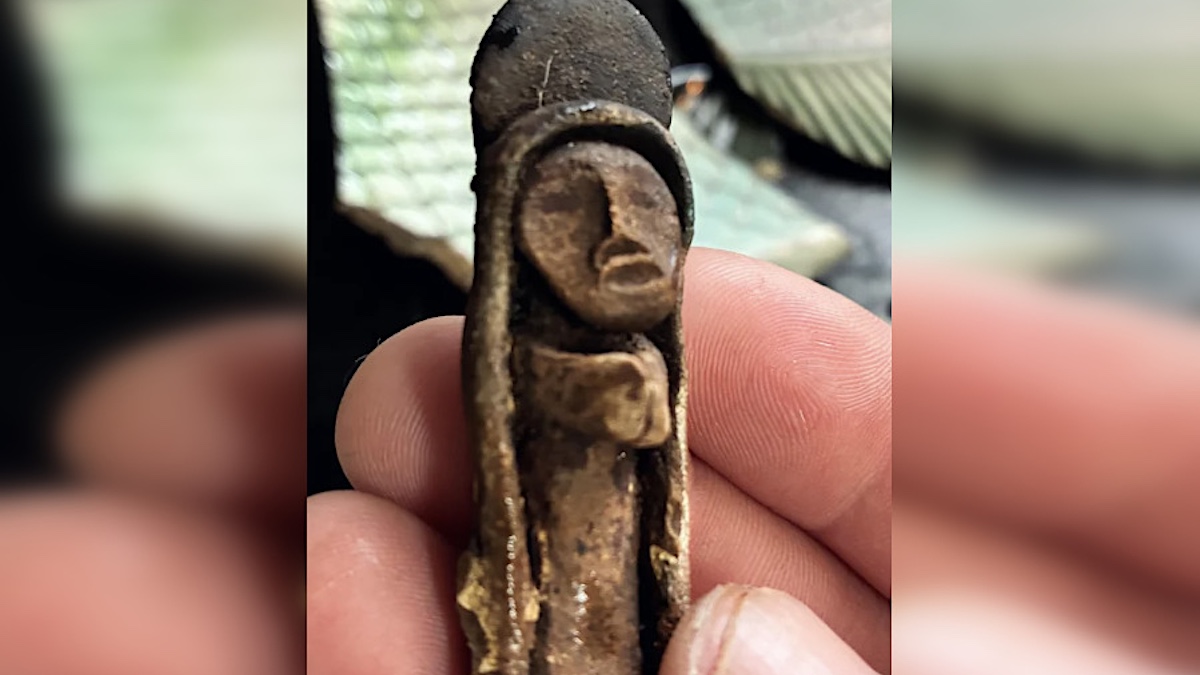

A mysterious object unearthed in a Louisiana backyard could have possible ties to slave‑era burial practices and African cultural influence in the region.
According to a Reddit post from Mammoth_Insurance786, the item was found buried about 10 inches deep beside a large tree on private property. Mammoth_Insurance786 posted photos of the object and asked for help identifying it. One comment said, “Nope, but you better go put that s— back where ya found it and ask for mercy,” later noting it does point toward West African origins.
Louisiana and African-American culture
One comment agreed it looks like a small African artifact that may have been used ritualistically to represent the burial of the dead, because at certain times, slaves were not allowed proper burial.
The comment added,
The style of it looks very African to me. Others have mentioned Native American but I do not recall Native American artifacts looking like this but I’m not an expert either! Particularly because it was from Louisiana where there was heavy influence of African culture that would be my guess.”
Another agreed it could be remnants of a slave grave-marker, noting, “It looks like separate pieces of a ceramic vessel, which would be fairly consistent with that practice.” One person said, “It might be worth contacting LSU’s [Louisiana State University’s] archaeology department.”
Louisiana’s landscape is rich with the remnants of centuries‑old burial sites, many of which are undocumented and unmarked. Plantation cemeteries where enslaved African Americans were interred were often relegated to marginal ground or dense woodlots, with few identifying markers.
Because slaves were prohibited from practices such as literacy and formal record‑keeping, burial sites were frequently left without gravestones or traditional headstones and have since been lost to vegetation and development. Documented research notes that plantation cemeteries for slaves are notoriously difficult to locate and often yield little above‑ground evidence.
Historians and anthropologists note that enslaved Africans in the Americas maintained cultural expressions that survived despite brutal conditions. In the context of cemeteries and burial practices, this includes the use of personal items as grave markers or as offerings, a tradition that was sometimes a blend of African belief systems and forced adaptation to American circumstances.
Archaeological study points to grave offerings such as broken pottery, glass objects, shells, and other items placed with the deceased, representing continuity of African symbolic tradition.
Under Louisiana law, items associated with unmarked burial sites — defined broadly to include “burial artifacts” — are protected; disturbing them without appropriate authority can violate state statute. Mammoth_Insurance786 did not confirm that he sought a professional appraisal for the object.








Published: Feb 20, 2026 04:08 pm