


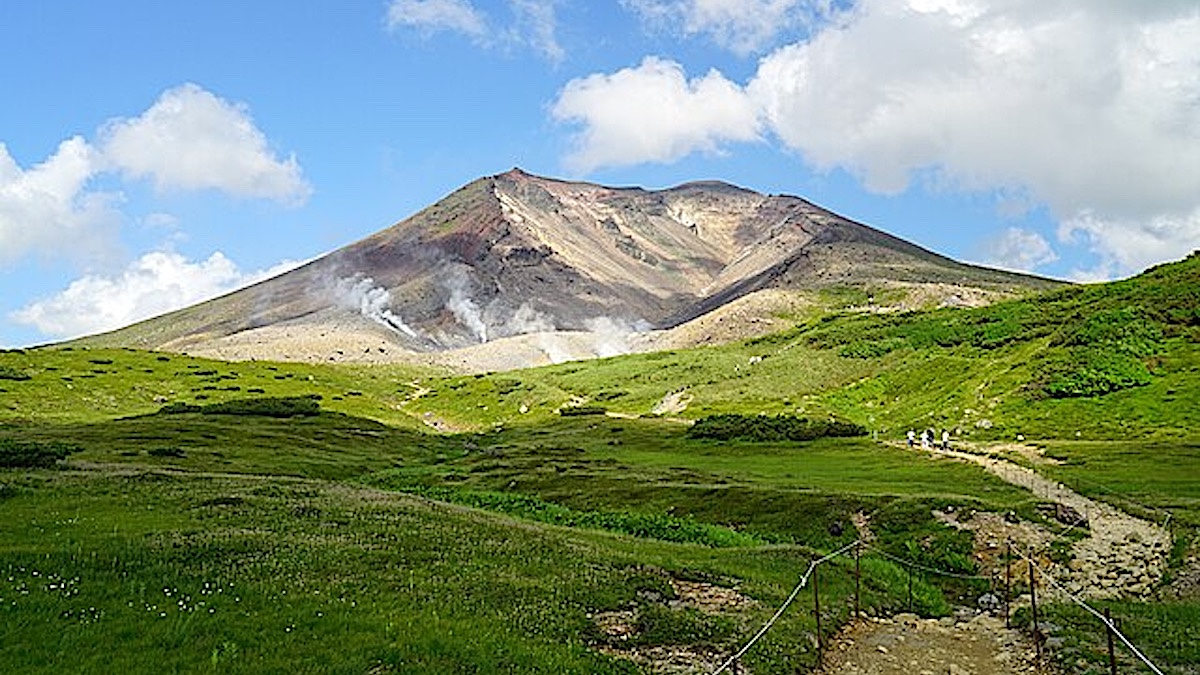

A Japanese mountain rescue in July 1989 turned into a famous cold case, known today as the Mount Asahidake SOS mystery. That year, searchers located two lost hikers after spotting a massive “SOS” sign built from birch logs.
The baffling part? The rescued men were adamant they had nothing to do with it, leaving investigators wondering: whose desperate plea they had just answered?
It all began when two men from Tokyo went hiking between Kurodake and Asahidake in Daisetsuzan National Park. They inadvertently strayed off route and became lost, descending toward the Chubetsugawa river valley.
Rescuers launched a search by helicopter and soon discovered a massive SOS sign made from birch logs, consisting of 19 trees, each about 16 feet long, stacked to form giant letters spelling out “SOS,” visible from the air.
The helicopter immediately headed toward that spot and located the two missing hikers just north of the giant letters. Once in contact, the two men were airlifted to safety. However, when questioned, the hikers denied any knowledge of the cry for help.
That stunned investigators. Assuming there was another missing person, rescue teams resumed their search the next day.
They recovered a skeleton
Not long afterward, searchers uncovered skeletal remains near the SOS sign, along with personal effects in a small hole just large enough to fit an adult. Items found included four cassette tapes, a tape recorder, two cameras, a notebook, a pair of men’s basketball shoes, a backpack, and a driver’s license belonging to Kenji Iwamura, a 25-year-old office worker from Aichi Prefecture who had gone missing in 1984.
Iwamura vanished in July 1984, after telling a lodge owner he planned to hike to Asahidake. When he failed to report to work a week later, his parents alerted authorities, but early searches turned up nothing. The tapes recovered included one recording of a man pleading for help, saying things like, “S-O-S, help me. I am stuck on a cliff and can’t move. S-O-S, help me,” plus tapes of anime theme songs.
At first, medical examiners identified the remains as female, between the ages of 20 and 40, puzzling investigators, given they had no record of a missing woman in that region.
But by February 1990, the bones were reexamined and reclassified as male, and it was presumed the remains belonged to Iwamura.
Did Iwamura really build the sign?
But was Iwamura the one who built the SOS sign, or did someone else? Crucially, searchers later examined aerial photographs taken in September 1987, and confirmed the SOS sign was already in place at least two years before the 1989 rescue.
For these reasons, many assume that Iwamura was the one who constructed the sign, but the consensus is uncertain. The uncertainty stems primarily from the fact that the skeleton was from a frail body, and experts doubted that such a person could have felled or hauled heavy logs to build the massive sign unaided.
Notably, no axe or cutting tool was ever found among Iwamura’s belongings or nearby debris. But some theorize that the logs used were already fallen and simply arranged, not freshly cut. Others speculate a second person might have assisted or even built the sign. Regardless of who built it, help came too late for Iwamura or for them. But it did, however, come in time to help the two hikers lost in 1989.





Published: Oct 17, 2025 07:45 pm