



Humanity has been scanning the cosmos for decades, hoping to find any sign that we’re not alone, but the answer has consistently been radio silence. Now, researchers at the SETI Institute are suggesting we might have simply been missing those messages all along.
According to USA Today, New research published by scientists at SETI in the Astrophysical Journal suggests this is definitely a possibility. If aliens are trying to make contact with us, commonplace space weather could be interfering with those radio signals.
For instance, if extraterrestrials are attempting a transmission from an exoplanet beyond our solar system, space weather could broaden and scatter an otherwise “ultra-narrow signal” intended just for Earth. When these technosignatures get spread across more frequencies, they become far less likely to be detected by traditional narrowband searches, according to SETI.
Time to adjust that dial
These kinds of distortions aren’t just caused by solar winds, but also by coronal mass ejections, which are powerful bursts of plasma and charged particles from a sun in other star systems. The researchers think this effect could be most common among planets orbiting low-mass M-dwarf stars.
These stars are not only potentially habitable, but they’re also incredibly common throughout our Milky Way galaxy. Grayce C. Brown, a research assistant at SETI and a co-author of the study, highlighted how quantifying stellar activity’s impact on narrowband signals can help us design searches that are better matched to what actually arrives at Earth, not just what might be transmitted.
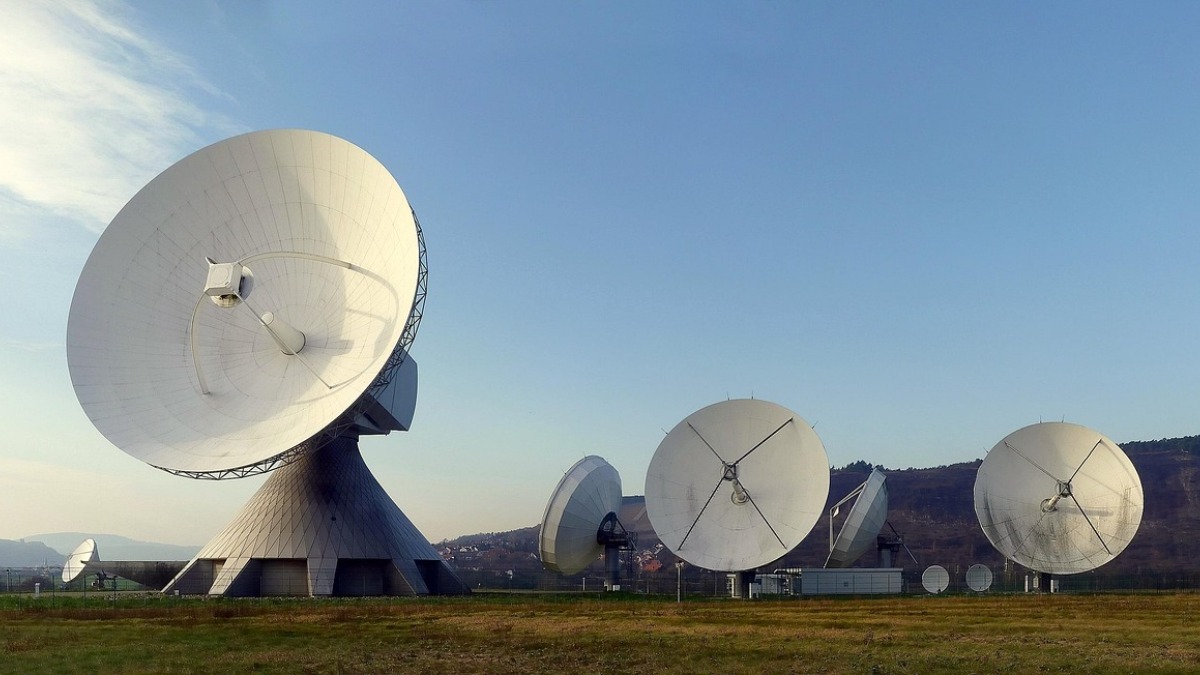
The Search for Extraterrestrial Intelligence (SETI) Institute has famously used radio telescopes for years, like the Allen Telescope Array in northern California, to search for signals in outer space that could originate from intelligent life beyond our world. In September, SETI began the complex task of searching for signs of advanced extraterrestrial civilizations in other distant galaxies, moving beyond our own Milky Way.
Using the Murchison Widefield Array (MWA) in Western Australia, researchers started hunting for “extragalactic” civilizations in over 2,880 galaxies. SETI also continues its ongoing search for signs of alien technology in the TRAPPIST-1 star system, which hosts several terrestrial planets similar to Earth.
Of course, a lot of people already believe aliens are here among us. Public interest in aliens and UFOs, now often referred to as unidentified anomalous phenomena (UAP), remains high across the United States. This heightened interest follows a series of high-profile Congressional hearings where military officers and other witnesses have testified about what they claim to have seen.
Even political figures have weighed in on the topic. Former President Barack Obama recently said “they’re real” in a podcast soundbite that quickly went viral. Though Obama later walked back the comment, President Trump accused him of revealing classified information before doing an about-face of his own, claiming he was ordering the Pentagon to release files on UAPs.
So, while the public speculates about what might already be here, SETI’s new research reminds us that sometimes the challenge isn’t just listening, but understanding what we’re hearing.









Published: Mar 13, 2026 11:23 am