


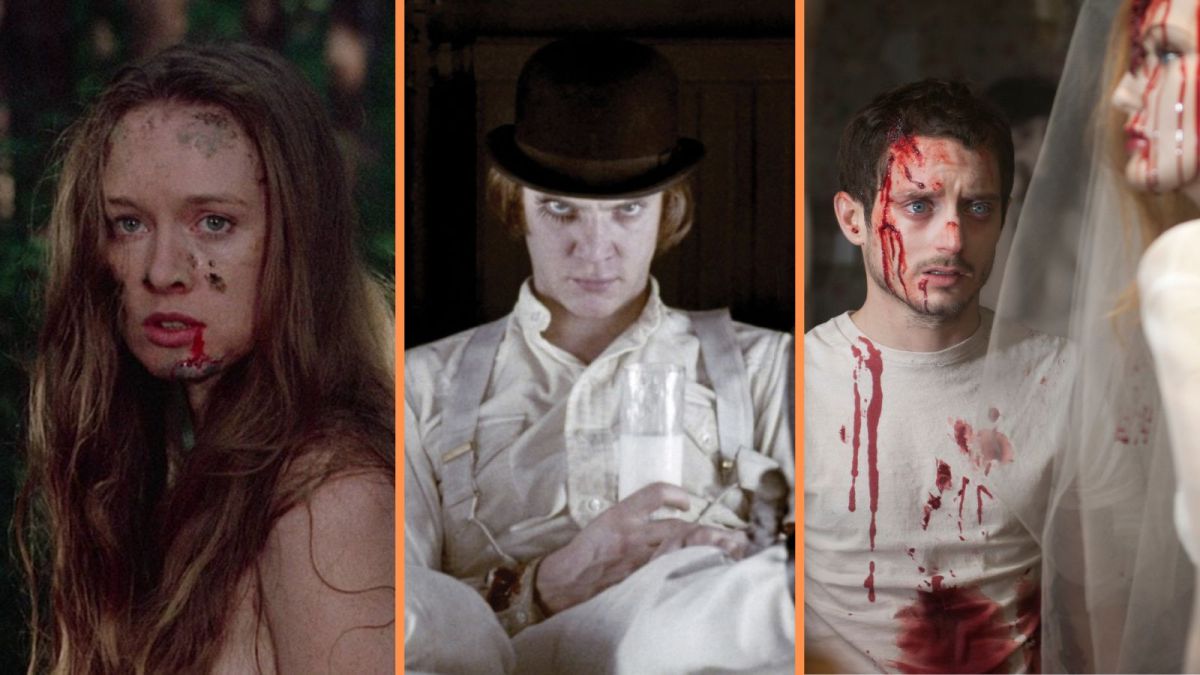
A film described as “banned” may have been refused classification, cut for release, restricted to particular screenings or withdrawn by its own filmmaker. Those outcomes can all keep a movie out of ordinary cinemas, but they do not mean the same thing.
The distinctions matter for notorious titles such as A Serbian Film and I Spit on Your Grave. Their reputations often travel further than the actual decisions, leaving the country, date, version and type of release out of the story.
These five cases show how different those histories can be. The selection includes the horror-adjacent A Clockwork Orange, a dystopian crime and science-fiction film whose British withdrawal is frequently mistaken for a censor’s ban. Each case below concerns a specific documented decision, rather than a claim that the film is prohibited everywhere today.
Content note: The films discussed contain sexual violence, abuse or disturbing violence. The descriptions below avoid graphic details.
What happened to each film?
| Film | Place and period | Documented outcome |
|---|---|---|
| I Spit on Your Grave (1978) | UK, 1980s onward | Video prosecutions and later cuts; never submitted to the BBFC for cinema classification |
| A Serbian Film (2010) | Australia, 2011; UK, 2010 | Refused classification in Australia; classified with cuts in the UK, affecting planned screenings |
| Antichrist (2009) | France, 2016–2017 | Exhibition visa annulled in a dispute over the age restriction |
| A Clockwork Orange (1971) | UK, 1973 onward | Withdrawn at Stanley Kubrick’s request after receiving an uncut classification |
| Maniac (2012) | New Zealand, 2013 | Restricted with exceptions for festivals and specified educational use |
1. I Spit on Your Grave (1978)
Meir Zarchi’s film follows Jennifer Hills, a writer played by Camille Keaton, who survives an assault and takes revenge on the men responsible. Its prolonged treatment of sexual violence became central to its censorship history.
The British story is often misstated. According to the BBFC’s case study, the film was never submitted for cinema classification. It became notorious through prosecutions of its video release during the “video nasties” period, rather than through the refusal of a submitted theatrical print.
When it was formally submitted for home-entertainment classification in 2001, the BBFC required seven minutes and two seconds of cuts before granting an 18 rating. Later reviews altered the permitted material, but did not simply approve the complete original version.
A 2022 submission is another potential source of confusion: the distributor removed material after receiving advice, then submitted that edited version for classification. Approval of a pre-cut submission does not mean the original uncut film was approved. The history depends on which version and release format are being discussed.
2. A Serbian Film (2010)
A Serbian Film follows a retired adult-film performer drawn into a production whose demands become increasingly abusive and violent. Its censorship history is documented, but broad claims about a universal ban obscure the differences between jurisdictions.
The Australian classification record lists a 2011 Refused Classification decision for the original version. That is a different outcome from receiving an adults-only rating.
In Britain, the film was classified with cuts. The BBFC’s account explains that Westminster Council required classification before a planned 2010 FrightFest screening, despite the festival’s usual arrangement for screening unclassified films to adults.
The same account describes unsuccessful attempts to arrange other public screenings of the uncut version, alongside a private, invitation-only Raindance event. Those exceptions are why “it was banned in Britain” is an inadequate description. A cut release, a blocked public screening and a permitted private event can all be part of the same film’s history.
3. Antichrist (2009)
Lars von Trier’s Antichrist follows a grieving couple, played by Willem Dafoe and Charlotte Gainsbourg, whose retreat into the woods becomes increasingly destructive. Its explicit treatment of sex and violence produced a lengthy classification dispute in France.
The crucial 2016 event was a court decision annulling the film’s exhibition visa. It was not a new, permanent declaration by the culture ministry that no adult could see the film.
In January 2017, the Conseil d’État upheld the annulment, finding that the film’s extreme scenes required a restriction barring viewers under 18, rather than the under-16 restriction attached to the challenged visa. It also distinguished that restriction from placing the film in France’s X-rated category.
The cancellation affected the authorization for public exhibition, which explains the “banned” headlines. The underlying disagreement, however, concerned the classification under which it could be shown. That is more precise than treating the case as an indefinite prohibition on the work itself.
4. A Clockwork Orange (1971)
Stanley Kubrick’s adaptation of Anthony Burgess’ novel follows Alex, a violent young offender subjected to an attempt to condition his behavior. Its place in this discussion comes from its disturbing material and notorious release history, rather than from being a conventional horror film.
The BBFC passed it uncut at X in 1971, when that classification restricted admission to adults. In 1973, Kubrick had it withdrawn from British circulation amid controversy and reported threats against him and his family.
The BBFC is explicit that it never rejected the film. Its long absence from British distribution resulted from the filmmaker’s decision, not a Board refusal.
After Kubrick’s death, the film received an uncut 18 classification in 1999, followed by an uncut video classification in 2000. The practical effect of a withdrawal can resemble a ban for audiences trying to buy a ticket, but the distinction identifies who made the decision and why the film remained unavailable.
5. Maniac (2012)
Franck Khalfoun’s remake casts Elijah Wood as Frank, a serial killer whose perspective dominates the film. That viewpoint was central to the controversy surrounding its release in New Zealand.
A July 2013 statement from the New Zealand International Film Festival described a classification that prevented a normal wider release while allowing specified exceptions. Those included festival screenings and use for study in tertiary media or film courses.
Festival screenings were therefore possible, even though ordinary distribution was restricted. Calling it completely banned from every New Zealand cinema erases the screenings that the classification expressly allowed.
The concern was not simply that the film contained a frightening killer. The decision focused on the combination of its violence and the viewer’s sustained alignment with the killer’s perspective. Whatever judgment a viewer makes about that reasoning, the historical outcome was a restricted release with exceptions.
Why a “banned movie” claim needs more detail
The useful questions are specific: Which authority acted? In which country? Was the decision about a theatrical screening, a home-video edition or one particular cut? Did it prevent all exhibition, or require an adult rating and changes?
Leaving out those details turns separate events into one vague reputation. A film may be available in an edited edition while its full version remains restricted. It may be shown at a festival despite being unavailable for normal distribution. It may even have received an uncut classification before its creator chose to withdraw it.
For other examples from the genre, our feature on the censorship histories of notorious horror films covers titles including The Texas Chain Saw Massacre and The Evil Dead. Across these cases, the most revealing part is usually the decision itself, not the word “banned” attached to the poster.



Published: Oct 11, 2022 06:28 am