


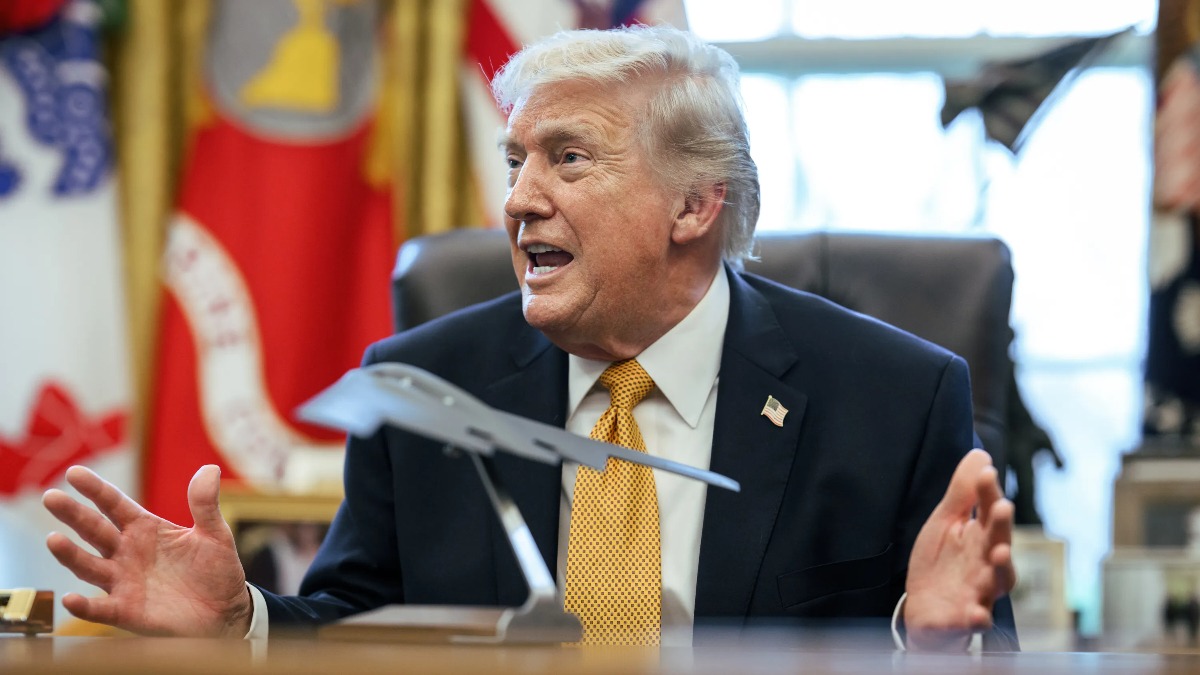

President Donald Trump says the U.S.–Iran war is “very close to being over.” During an interview for Mornings with Maria, he also said that another round of peace talks is likely to take place in Islamabad, Pakistan, within the next two days. “I think it’s close to over, yeah. I view it as very close to being over,” Trump said.
The optimistic tone comes after a two-week ceasefire agreement that saw the U.S. stop bombing Iran last week. However, Trump also instituted a naval blockade of all Iranian ports on Monday, marking a fresh escalation even as diplomatic efforts continue. Peace talks between U.S. officials and Iranian negotiators are expected to resume on Thursday, following stalled weekend discussions that also took place in Pakistan.
Vice President JD Vance and other senior White House officials were involved in those weekend negotiations, which focused on Iran’s nuclear program and its uranium enrichment plans. Vance said on Monday that “a lot of progress” was made, reports Fox Business. He also made clear that Iran holds the next move: “You ask what happens next, I think the Iranians are going to determine what happens next.” He added that “the ball is very much in their court.”
Trump’s stance on Iran reveals a push for permanent nuclear disarmament, not just a temporary pause
Despite saying the war is nearly over, Trump made it clear that the U.S. is not done. “If I pulled up stakes right now, it would take them 20 years to rebuild that country. And we’re not finished,” he said. He also believes the Iranians “want to make a deal very badly.”
Trump has consistently justified U.S. involvement in the conflict as necessary to stop Iran from getting a nuclear weapon. “I had to divert because if I didn’t do that, right now, you’d have Iran with a nuclear weapon,” he told Mornings with Maria. The U.S.-Iran war began on February 28 with coordinated strikes by the U.S. and Israel against Iran.
The initial operations reportedly killed Supreme Leader Ayatollah Ali Khamenei. The conflict has lasted about seven weeks and has resulted in the deaths of thirteen U.S. service members, along with thousands more across the Middle East.
Trump told the New York Post that additional peace talks “could be happening over next two days” in Pakistan’s capital. He initially suggested a second round of talks might happen somewhere in Europe, but later called back to say Islamabad was the more likely location. “You should stay there, really, because something could be happening over the next two days, and we’re more inclined to go there,” he said.
Trump praised Pakistan Field Marshal Gen. Asim Munir, crediting him for helping broker the recent Pakistan-India peace deal. “He’s fantastic, and therefore it’s more likely that we go back there,” Trump said. “I just think he’s a great guy, that guy. The field marshal. You know he ended the war with India, saved 30 million people.” Trump confirmed he will not personally participate in this next round of talks.
A major point of disagreement in the negotiations is Iran’s nuclear enrichment program. Reports say the U.S. asked Iran to suspend uranium enrichment for at least two decades during the weekend talks, but Trump rejected that idea.
While Vance was negotiating the Iran deal in Islamabad, Trump was back home publicly criticizing the media. On the Iranian side, retired Pakistani Lt. Gen. Muhammad Saeed, who has diplomatic experience with Iran, said Tehran has shown some “flexibility” on enrichment, but noted that “Iran has to be able to take something back to its people that doesn’t look like a surrender.”However, Iranian professor Mohammad Marandi, who was part of Tehran’s delegation in Islamabad, took a harder line. “A blockade won’t change Iran’s position,” he said flatly, adding that “ending enrichment will not be accepted.” For more on what Vance brought back from the Islamabad talks, the previous round ended without a deal.





Published: Apr 15, 2026 03:14 pm