


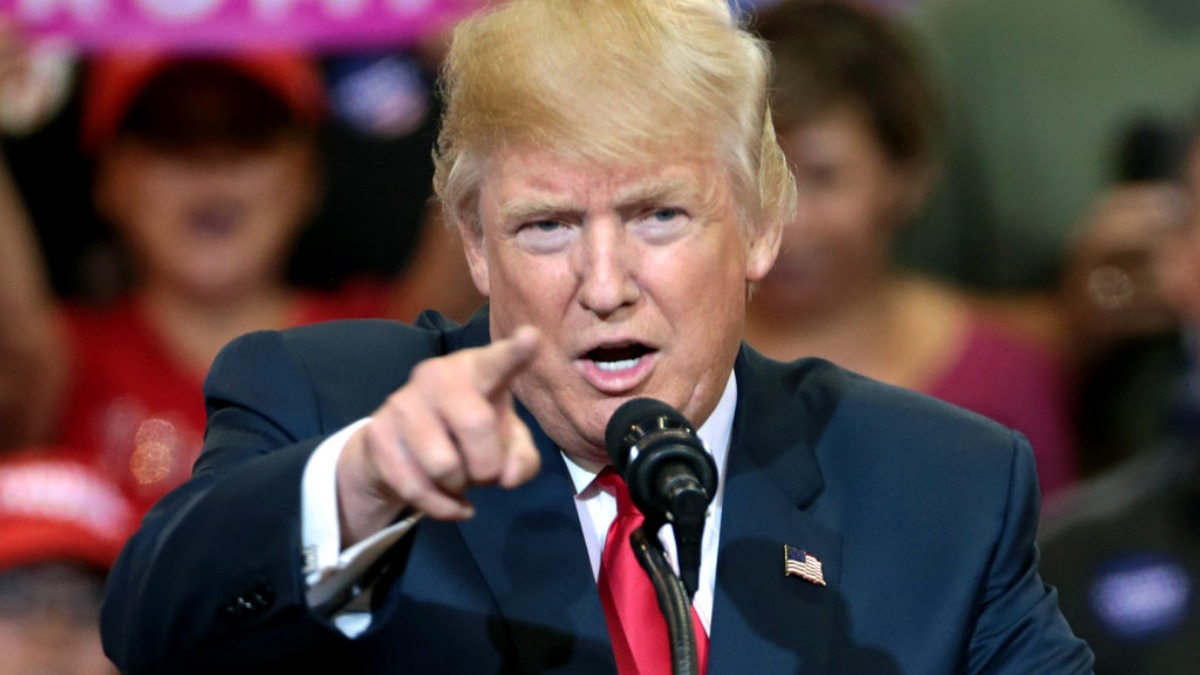

President Donald Trump signed an executive order aimed at giving him more control over federal elections, stirring debate ahead of the upcoming midterm elections. The order is a direct response to his long-standing complaints about mail-in voting, which he often calls “mail-in cheating.” This comes despite Trump, his wife Melania, and their 20-year-old son Barron all voting by mail in a Florida special election just last week.
The order is designed to create verified voter lists. The Department of Homeland Security will compile these lists using federal citizenship and naturalization records, Social Security records, and other federal databases, then send them to states to update their own voter rolls. The order also instructs the U.S. Postal Service to only send mail-in ballots to people whose names appear on a state-provided list of eligible voters, according to The Daily Beast.
Trump, joined by Commerce Secretary Howard Lutnick at the signing, told reporters he believes the order is legally “foolproof.” He said, “I think this will help a lot with elections. We’d like to have voter ID. We’d like to have proof of citizenship, and that’ll be another subject for another time. We’re working on that. You would think it’d be easy.” Despite his confidence, the order is already widely expected to face legal challenges on constitutional grounds.
This executive order is likely heading straight to court, just like the last one
The Florida special election that Trump’s family voted in by mail was for a House seat covering his Mar-a-Lago resort, and a Democrat won it, even though Trump had carried that district by 11 points in 2024. This is not the first time Trump has tried to use executive power to influence election administration.
A previous executive order, which attempted to withhold election funding from states that refused to change their voter registration forms, was blocked in September. U.S. District Judge John Chun ruled it was an unconstitutional attempt to pressure states, noting that the president does not have the power to control how states run their elections.
Democratic Legislative Campaign Committee President Heather Williams responded sharply, saying, “Trump’s latest attack on mail-in voting should alarm everyone who believes in free and fair elections.” She described the order as “a blatant attempt by the President to undermine states’ control over election administration for his own benefit, which is a direct attack on the Constitution and our democracy.”
She called it an example of “voter suppression” and “a desperate move by Trump to steal the next election.” Meanwhile, Trump’s approval rating continues to slide, with critics also pointing to how Trump spends on golf while cutting cancer research as further evidence of misplaced priorities.
According to Slate, David Becker, founder of the nonpartisan Center for Election Innovation & Research, predicted, “This will be blocked by the federal courts before the ink is dry.” The broader legal community appears to share that view, given how similar the order is to the one already struck down in court.
Trump’s actions come amid growing pressure within the Republican Party. His net approval rating has hit a new low of -20, and recent Democratic wins in traditionally Republican areas suggest the November midterms could be difficult for the GOP. A wave of Republican retirements from the House of Representatives has added to concerns within the party. Tensions within his own circle are also growing, as seen in how Trump distanced himself from Tulsi Gabbard on Air Force One.
Separately, Trump has been pushing his SAVE America Act, a rebranded version of last year’s Safeguard American Voter Eligibility Act. The proposed legislation calls for extensive proof of citizenship, strict voter ID requirements, and would require states to hand their electoral rolls over to DHS.
Its website states, “American citizens, and only American citizens, should decide American elections.” The act is currently stalled in the Senate due to Democratic opposition and the legislative filibuster, which may partly explain Trump’s turn to executive action.



Published: Apr 1, 2026 02:46 pm