


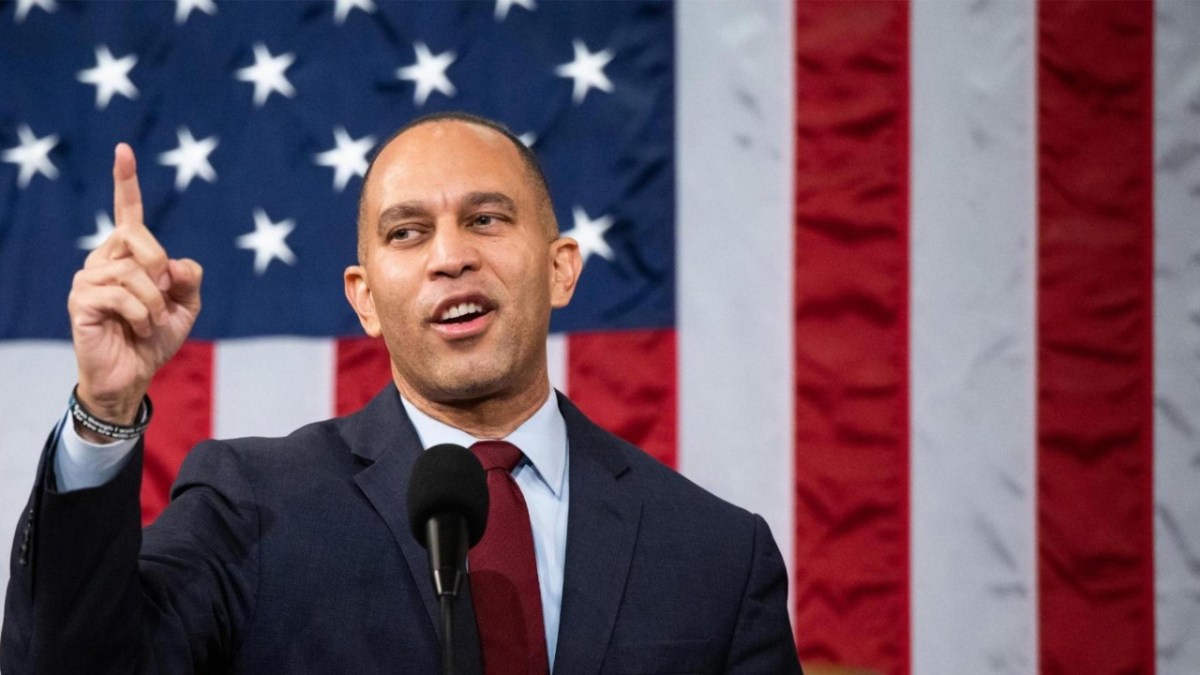

A CNN pundit labeled a recent claim by House minority leader Hakeem Jeffries a “straight up lie” on Friday. This comes as Jeffries faces a difficult spotlight regarding his financial ties to the Israel lobby just before the House Democratic leadership election this week.
During a broadcast hosted by Audie Cornish, the panel examined why Jeffries continues to deal with public pushback despite having strong support inside the House Democratic caucus. The discussion centered on a clip from the talk show #RonaldMartinUnfiltered that aired last Wednesday.
In that clip, Jeffries told the audience, “AIPAC announced, like three weeks ago, that they were out of the political fundraising business — that they were going to shut down their PAC, which has the ability to give members of Congress $5,000 a year.” He went on to say, “They were going to shut that down, they were going to stop making endorsements, and stop raising money.”
Luke Thomas, a sports podcast host and political commentator who served as a panelist, pushed back on those statements
Thomas said, “What he said in that interview was just a straight up lie.” He explained that AIPAC is simply rerouting its financial influence through other channels. According to Thomas, the organization is sending money through pass-through groups and its super PAC, known as the United Democracy Project, often.
AIPAC did announce in late October that it would stop making direct PAC contributions or candidate endorsements. This move is widely viewed as a public relations strategy because the organization still intends to influence elections by using individual donors to give to candidates. It also keeps directing funds to candidates via the United Democracy Project. This structure allows the group to mask its contributions through a less visible entity.
Jeffries has repeated similar claims before, but they remain misleading. While he frames the situation around a $5,000 contribution limit per cycle, that figure ignores the millions of dollars AIPAC routes through other methods. Thomas noted that while the group is reducing its public visibility, the idea that they are not involved in campaign donations in serious ways is untrue.
The panel also addressed an incident from last week where 11 members of the House Democratic caucus missed a vote to impeach Secretary of Defense Pete Hegseth. Those members were attending a meeting held by Elect Democratic Women. This group has faced accusations of acting as an AIPAC pass-through, especially after its PAC received $1 million from the United Democracy Project this spring. AIPAC often funnels money through various groups that remain unknown to the public.
Thomas expressed his frustration with the current state of party leadership. He said, “As a progressive, I was radicalized by the Iraq War. I was radicalized by Donald Trump. I have been absolutely radicalized by the failures of Chuck Schumer and Hakeem Jeffries. And I doubt that I’m the only person on the left who feels that way.”
Both Jeffries and Senate minority leader Chuck Schumer face criticism for relying on dark money groups that represent corporate and industry interests. Data from an analysis by Sludge shows Jeffries is the second-highest House Democratic recipient of corporate PAC fundraising for this cycle.
Jeffries has collected $1.32 million from donors across the finance, military, and tech industries. He currently sits behind House Democratic Caucus Chair Pete Aguilar, who received $1.42 million, while Democratic Whip Katherine Clark ranks fourth with $1.11 million.






Published: Nov 18, 2026 05:00 am