


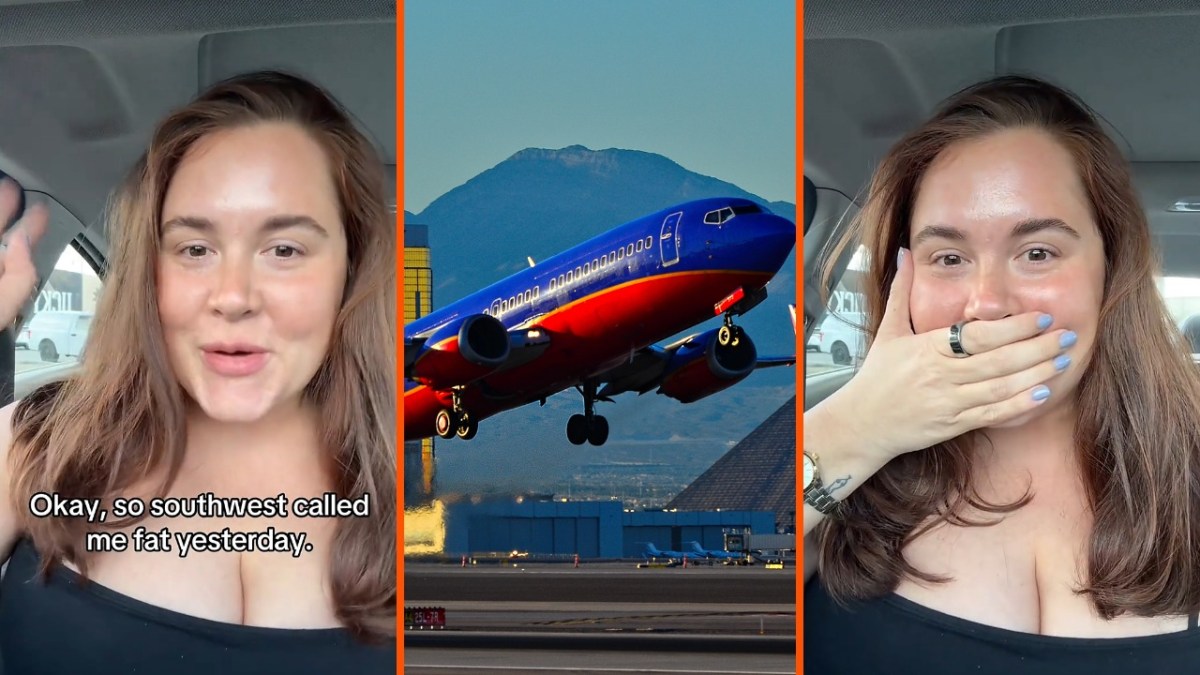

A recent Southwest flight turned into an “absolutely diabolical” experience for one woman who says she was moved from her pre-paid front-row seat due to the airline’s “customer of size” policy, leaving her feeling publicly shamed, BroBible reports.
TikTok user Sarah (@saraharasarah) shared her story, openly stating, “OK, so Southwest called me fat today.” She admitted to feeling incredibly embarrassed to make the video, but felt compelled to share after seeing similar experiences from others on TikTok.
Sarah explained that she was traveling direct from Nashville to Long Beach, California. She checked in a full 24 hours before her flight and even paid extra to upgrade her seat to D, a first-row aisle seat. Her goal was to be one of the first people off the plane. However, everything changed when she attempted to board.
As she scanned her boarding pass, a staff member informed her that her seat had been changed to 24F
When she questioned this, the staff member told her it was part of the “customer of size” policy and that they wanted her to be comfortable. Initially, Sarah thought they were referring to another passenger. She told the staff member that if she paid for a specific seat, she needed that specific seat. After being given a customer service number that wasn’t helpful, she went down to the jet bridge and spoke with an attendant who gave her a seat in Row 16.
Sarah again brought up the “customer of size” issue, emphasizing that while she wanted everyone to be comfortable, she had paid for her own seat. The attendant then explained that the armrests in the original front-row seats were unmovable, making them unaccommodating for a person of size. It was at this moment, seeing other “normal”-looking people in her original seats, that it dawned on Sarah: she was the customer of size. She felt the airline wasn’t direct about it, instead repeatedly saying the move was for her own comfort.
Sarah questioned how she was “tagged” by the airline. “Like, I’ve seen them eyeball people and say you have to buy an extra seat, but clearly my profile must be tagged with like ‘big b**** coming through,’ so I don’t know,” she continued. She later discussed with her seatmate that she wasn’t “spilling over” anyone.
She felt that Southwest must have, at some point, decided she was “a little big” and shouldn’t sit in those seats, yet they still let her book them online. Sarah shared that her friends, who are not plus-size, were shocked by her experience, highlighting how different people face different challenges.
This wasn’t about “body-checking” for Sarah; she noted she isn’t “the biggest person that’s ever flown on an airplane.” She asked for a refund or compensation, questioning, “how do you start your vacation being called fat and then still have a good time?” She described the entire ordeal as “absolutely diabolical.”
Sarah, who works in luxury fitness and is athletic, noted she wears an L on top and XXL on bottom, believing she’s not “absolutely outside” the size of an average American. She concluded by advising, “If you respect yourself, Don’t fly Southwest.” Many commenters on her video expressed confusion, asking how Southwest could have known her size before seeing her. Others defended her, pointing out that she appeared to be an average size and deserved the seat she booked.
Southwest’s “customer of size” policy states that if passengers “encroach on neighboring seats,” they might need to occupy two adjacent seats. The airline “strongly recommends” that these customers purchase an additional adjacent seat ticket to guarantee availability. If a customer doesn’t do this and no adjacent seat is available, they may be rebooked on another flight.
The policy defines a seat’s armrest as the “definite boundary” between seats. Southwest also reserves the “sole discretion” to decide if an additional seat is necessary for safety. If an extra seat is deemed necessary and wasn’t pre-purchased, the airline might provide an additional adjacent seat free of charge. In such cases, the policy explicitly states that “your seat assignment may change, including a lower seat category, to provide adjacent seating.”
Other options include rebooking or deplaning the passenger.






Published: Nov 24, 2026 04:45 pm