


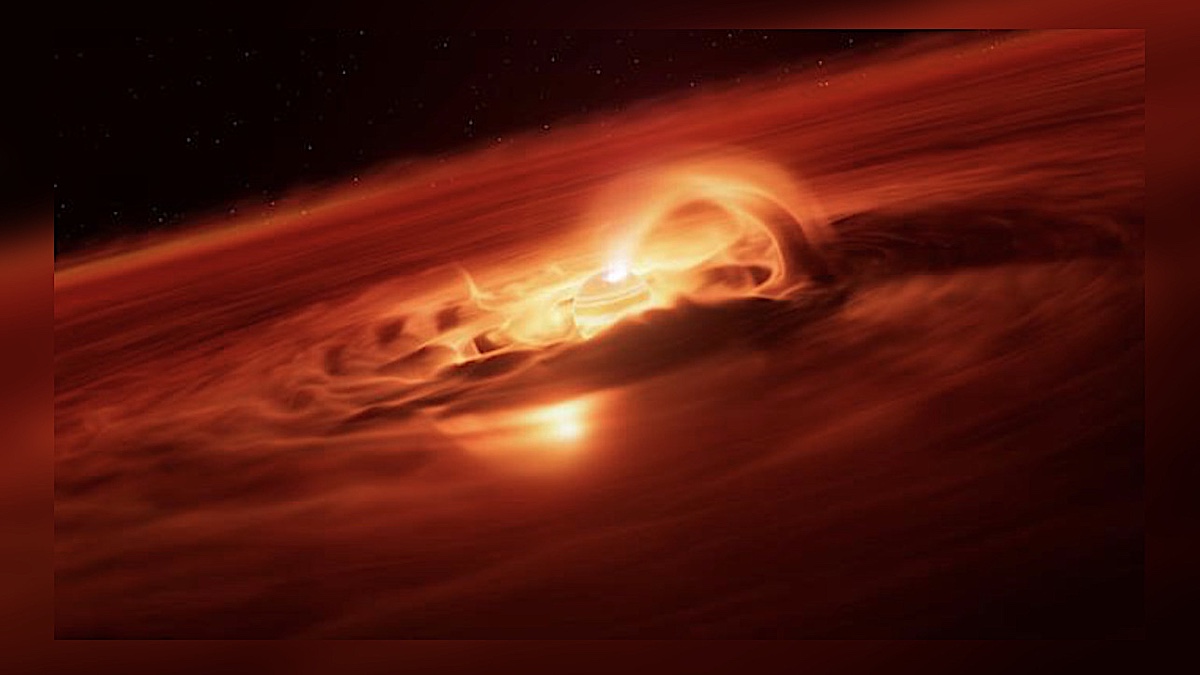

Astronomers have identified a cosmic heavyweight unlike anything seen before: a free-floating “rogue planet” that is devouring gas and dust at a record pace, challenging long-held ideas about the line between planets and stars.
The object, officially named Cha 1107-7626, lies about 620 light-years away in the constellation Chamaeleon. It has a mass estimated to be as much as 10 times that of Jupiter, making it enormous by planetary standards. Unlike the planets in our solar system, Cha 1107-7626 does not orbit a star. Instead, it drifts through space on its own, feeding on a surrounding disk of gas and dust.
Rogue planets are rare, starless worlds that either form in isolation or are ejected from their original solar systems, leaving them to wander the galaxy untethered.
Record-breaking growth spurt: Six-billion tons per second
Using the European Southern Observatory (ESO’s) Very Large Telescope (VLT) in Chile, astronomers observed the planet consuming material at a staggering rate of six billion tons per second, which is the fastest growth spurt ever recorded for a planetary-mass object
“People may think of planets as quiet and stable worlds, but with this discovery, we see that planetary-mass objects freely floating in space can be exciting places,” lead author of the study and an astronomer at the Astronomical Observatory of Palermo, Italy, Víctor Almendros-Abad, said, in an ESO press release.
Blurring the line between planet and star
The observations, published in The Astrophysical Journal Letters, also involved data from the James Webb Space Telescope and ESO’s earlier SINFONI instrument. The findings revealed that Cha 1107-7626’s feeding rate wasn’t steady: It surged by a factor of eight within just a few months in 2025. That variability mirrors behaviors seen in young stars, blurring the line between stellar and planetary formation.
“The origin of rogue planets remains an open question: are they the lowest-mass objects formed like stars, or giant planets ejected from their birth systems?” a study co-author from the University of St Andrews, Aleks Scholz, said. “This discovery blurs the line between stars and planets and gives us a sneak peek into the earliest formation periods of rogue planets.”
The team found additional evidence that strengthens the star-like comparison. The outburst appeared to be linked to powerful magnetic fields funneling gas toward the planet’s surface, creating bright, hot spots. That’s a phenomenon previously observed only in stars.
They also detected water vapor in the surrounding disk during the accretion burst, marking the first time such a chemical shift has been spotted in a planet.
Free-floating planets like Cha 1107-7626 are notoriously difficult to detect because they emit very little light. But astronomers expect future instruments, such as ESO’s Extremely Large Telescope, to uncover many more. “The idea that a planetary object can behave like a star is awe-inspiring and invites us to wonder what worlds beyond our own could be like during their nascent stages,” ESO astronomer Amelia Bayo added.
For now, Cha 1107-7626 stands as a rare example of a planet-sized body caught in the act of dramatically reshaping itself while swallowing billions of tons of cosmic material each second and defying the categories astronomers once thought were clear.









Published: Oct 3, 2025 07:35 pm