


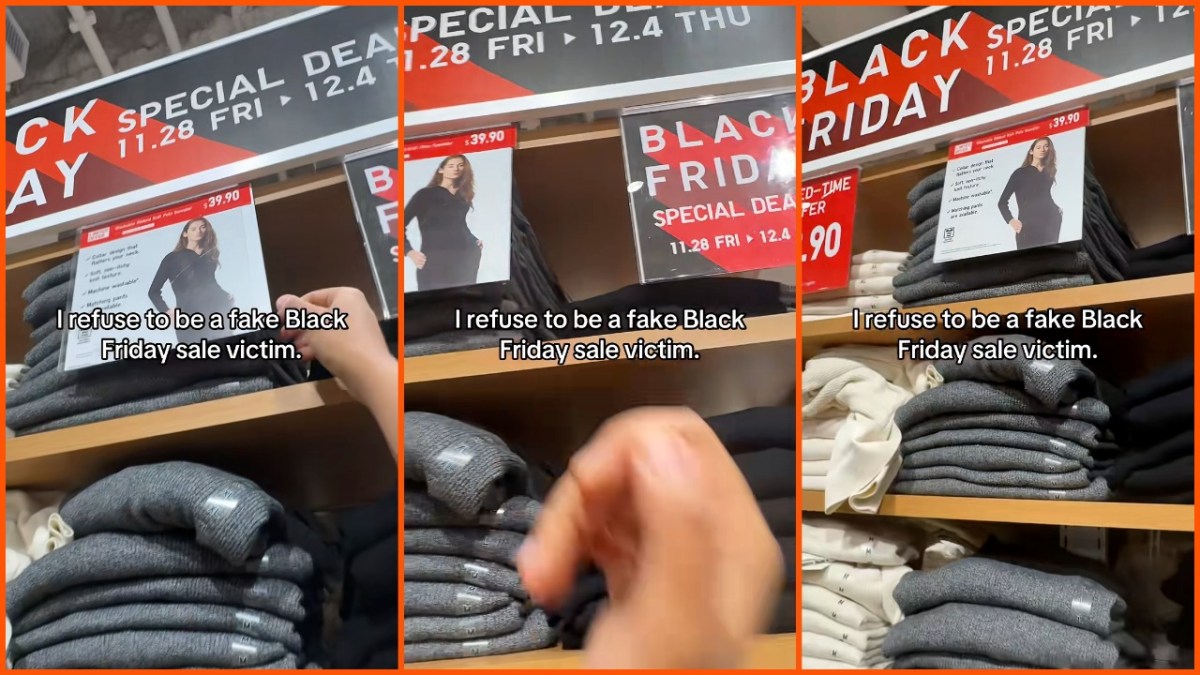

A clothing store display under a Black Friday banner offered a sweater at $39.90 with a “LIMITED OFFER” tag that a shopper said matched the regular price underneath. Milu Negusu shared the clip on TikTok with on-screen text that read, “I refuse to be a fake Black Friday sale victim.”
Negusu’s TikTok caption read, “They are playing in our faces.” After exposing the matching price tags, she replaced the “LIMITED OFFER” card and ended the clip. In the video, she stood in front of folded grey, cream, and black sweaters beneath a banner that stated “BLACK FRIDAY SPECIAL DEALS 11.28 FRI 12.4 THU.” She pointed her camera at a product placard for a “Washable Ribbed Knit Polo Sweater.”
The placard showed a red “LIMITED OFFER” badge and a listed price of $39.90. Negusu then slid the top card aside, revealing the store’s standard card underneath with the same garment details and the identical price of $39.90. She slid the promotional card back into place and lowered her hand.
Researchers have documented similar sale practices at major retailers
According to a 2025 Consumers’ Checkbook report, researchers spent six months tracking prices at 25 major retailers and concluded that most advertised markdowns were not special savings. The study found that products were offered at supposed discounts more than half the time at most stores.
For 12 of the 25 companies, more than half the tracked items appeared at false discounts every week or almost every week. Checkbook’s researchers stated that constantly listing sale prices while rarely showing regular prices amounts to deceptive advertising.
The report indicated that only Apple, Costco, and Dell consistently conducted legitimate discounts during the tracking period. Walmart was described as a borderline case, with tracked items on sale 48 percent of the time overall.
A separate analysis by the Groundwork Collaborative, as reported by The Guardian, claimed that about 30 percent of products Amazon highlighted for its Black Friday and Cyber Monday campaigns were priced the same or lower in the month before the sale. That share rose to 60 percent when looking 60 days prior, and median sale prices were nearly 20 percent higher than pre-sale offerings.
Amazon disputed the findings in a statement, saying the Groundwork Collaborative published “deeply flawed and false claims” and “cherrypicked” data. The company stated that 98 percent of the products in one year and 99 percent in another were at the same price or lower over the prior 30 days. Sale events can leave shoppers frustrated in other ways too, like when a Whole Foods shopper fumed over a sale after an employee allegedly did something upsetting.
Viewers in the comments section pointed out the unchanged price and shared related experiences. One wrote, “Okay but instead of $39.90, it’s $39.90.” A different commenter highlighted the color of the tag with, “39.90 ….BUT RED.”
Another dismissed the holiday event outright, stating, “Black Friday is a scam. That’s why I don’t bother anymore.” A third claimed to have paid less recently and wrote, “I got it for 29.90 earlier in the week lol.” One viewer focused on the store’s handling of the cards, commenting, “the way they don’t even throw away the old card like at least try not to make it OBVIOUS.”
A person who said they used to work retail described other tactics: “I use to work retail another trick is they lower the price allll year but then up it that same week. OR they will lower the price, make it higher weeks before then lower it to the original price on Black Friday, you could’ve gotten for like 4 weeks before.” Money disputes over sales come up outside big retailers as well, such as when a craft market seller was asked for 25% of candle sales by a friend.

Published: Nov 29, 2026 08:30 am