


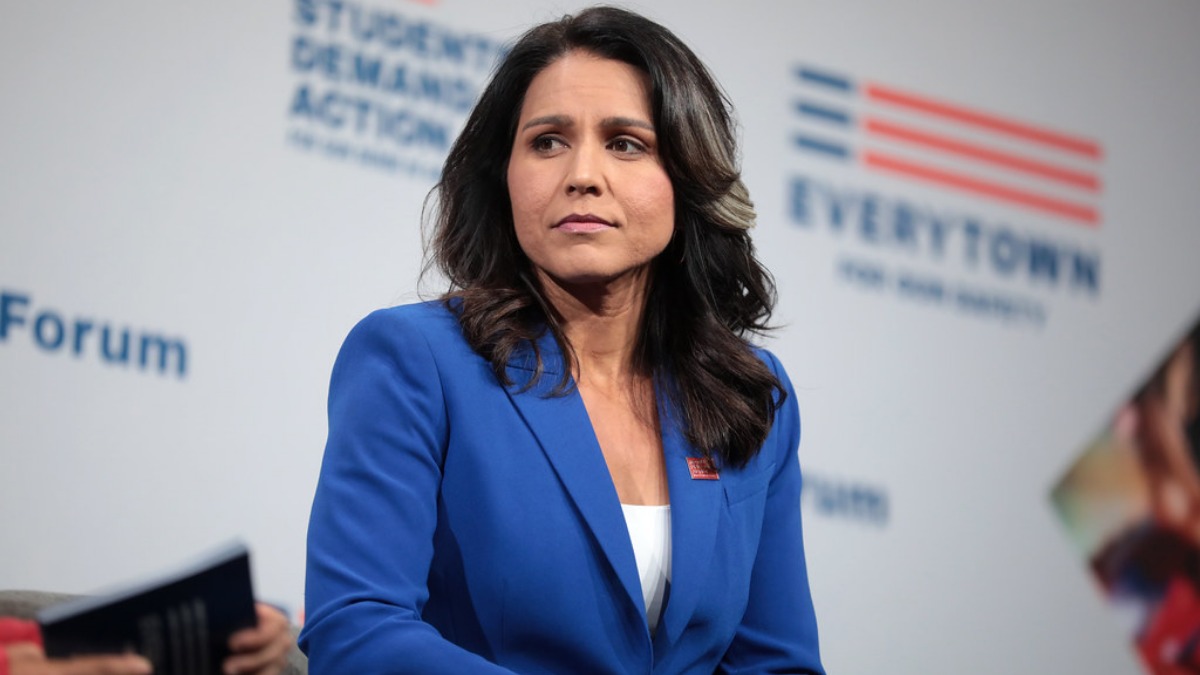

Director of National Intelligence Tulsi Gabbard has placed Pakistan on a list of countries whose advancing missile capabilities could eventually threaten the US homeland. The list, part of her 2026 Annual Threat Assessment, also includes Russia, China, North Korea, and Iran.”
According to Al Jazeera, Gabbard’s written assessment added that Pakistan “continues to develop increasingly sophisticated missile technology that provides its military the means to develop missile systems with the capability to strike targets beyond South Asia, and if these trends continue, Inter-Continental Ballistic Missiles (ICBMs) that would threaten the US.”
This claim is hard to support when looking at the actual numbers. Pakistan’s longest-range operational missile, the Shaheen-III, has an estimated range of about 2,750km, which is enough to cover all of India. An ICBM is generally defined as having a range exceeding 5,500km, a capability Pakistan does not currently have. The distance between the US and Pakistan is over 11,200km, which only a few major global powers can currently reach.
Experts widely agree that Pakistan’s nuclear program is India-focused, not a global threat
Many specialists are pushing back hard on this assessment, pointing out that Pakistan’s missile program is primarily focused on India. Tughral Yamin, a former army brigadier and arms control expert, noted that Pakistan has always maintained its deterrence, both conventional and nuclear, is aimed at India.
Jalil Abbas Jilani, a former Pakistani ambassador to Washington, said on social media that Gabbard’s assertion is “not grounded in strategic reality,” emphasizing Pakistan’s nuclear doctrine is India-specific for regional deterrence, not global power projection. This is not the first time Gabbard has drawn scrutiny over her intelligence assessments, as a whistleblower alleged she shut down a major NSA report on a Trump-linked foreign spy call.
Abdul Basit, a former Pakistani high commissioner to India, called the comparison “self-serving and groundless assertions” that “only betray Gabbard’s incorrigible biases.” Nuclear security scholar Rabia Akhtar argues that Gabbard’s statement reflects “a persistent flaw in US threat assessments.” Akhtar insists Pakistan’s deterrence posture is India-centric and that folding it into a US homeland threat narrative is misleading, ignoring decades of evidence.
The US has been closely monitoring Pakistan’s missile program for some time. In December 2024, the Biden administration sanctioned Pakistan’s National Development Complex, the main body behind its ballistic missile program, along with three private companies.
Pakistan called these sanctions “biased and politically motivated,” arguing Washington relies on “mere suspicion.” Separately, a mysterious Gabbard whistleblower complaint locked in a safe has kept Congress in the dark, raising further questions about her conduct as DNI.
This assessment comes at a complicated time in US-Pakistan relations. The two countries had a diplomatic reset during 2025, partly driven by a four-day conflict between India and Pakistan in May. President Trump has repeatedly claimed credit for brokering the ceasefire, with Pakistan even nominating him for the Nobel Peace Prize.
Relations appeared to warm further when President Trump hosted Pakistan’s army chief, Field Marshal Asim Munir, for a private White House lunch in June, a first for a US president hosting a Pakistani military chief who was not also head of state. Trump even described Munir as “my favourite field marshal” at the Sharm el-Sheikh summit in October.






Published: Mar 19, 2026 02:59 pm