


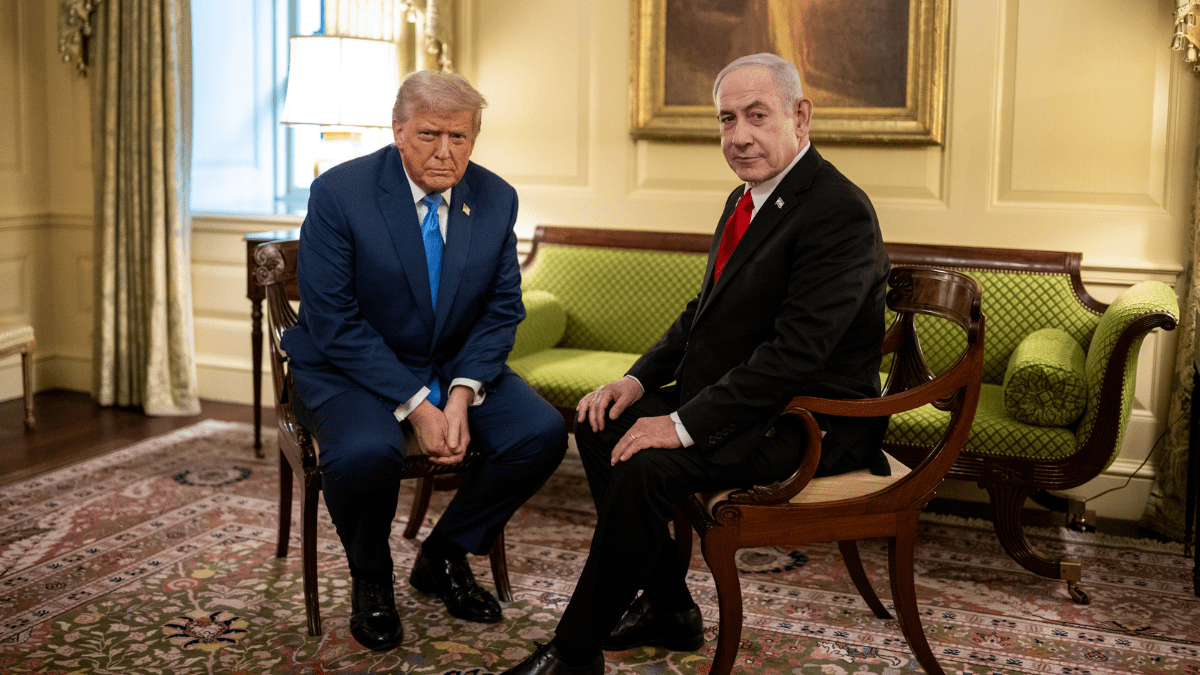

Benjamin Netanyahu just held a press conference to, first of all, disprove the rumors that he’s dead — which is never a great sign of how things are going. The Israeli prime minister also used the moment to assure the world that his relationship with Donald Trump’s administration is stronger than ever, and revealed that he’s working on a plan that would, in his view, make the costly war in Iran “worth it.”
Trump, for his part, has struggled to stick to a single, coherent justification for the war. Since about day three, he’s been on Truth Social doing the political equivalent of talking out of both sides of his mouth — declaring victory while simultaneously asking NATO members for help. And despite all that, not a single official explanation has fully clarified why the US joined Israel in the conflict in the first place. Netanyahu, however, may have just offered the clearest glimpse yet of what a “best case scenario” looks like from his perspective.
A central issue in any conflict involving Iran has always been control over the Strait of Hormuz — that narrow but crucial passage through which a significant portion of the world’s energy supply flows. Trump has repeatedly downplayed its importance, suggesting concerns about the waterway are overstated and don’t meaningfully affect the United States. That’s a comforting argument… right up until you look at the global economy.
The Gulf Cooperation Council (GCC) countries — Bahrain, Kuwait, Oman, Qatar, Saudi Arabia, and the United Arab Emirates — are deeply intertwined with the American economy. Oil transactions are largely conducted in dollars, and these nations are also major investors in sectors like artificial intelligence, which Washington sees as the future of economic dominance. If the GCC’s oil economy takes a hit, even temporarily, Silicon Valley won’t be insulated from the shock. And once that ripple starts, it doesn’t exactly stop at the California state line.
That’s before even factoring in what rising oil prices would do to the already strained cost of living. So while the origins of the war may still feel murky, the stakes at this point are becoming painfully clear. Whether necessary or not, Trump now finds himself in a position where anything short of a “win” carries serious consequences — politically and economically.
Netanyahu’s recent actions, particularly the gas-related attacks, haven’t helped de-escalate tensions — which is why even Trump has, at times, called for restraint. But according to Reuters, Netanyahu is already looking beyond the war. In his remarks, he outlined a vision that would fundamentally reshape global energy logistics. “Just have oil pipelines, gas pipelines, going west through the Arabian Peninsula, right up to Israel, right up to our Mediterranean ports and you’ve just done away with the choke points forever,” he said. “I see that as a real change that will follow this war.”
For critics who have grown increasingly wary of Netanyahu’s influence over Trump, this sounds less like a post-war idea and more like the plan all along. On one hand, having a close ally like Israel securing energy routes could be framed as a strategic advantage for the US. On the other hand, it risks sidelining existing allies in the GCC — effectively reshuffling the board in a way that benefits some while leaving others to absorb the fallout. Robbing Peter to pay Paul, just with significantly higher stakes.
And if that outcome does materialize, it’s hard to imagine the GCC countries quietly accepting a role as collateral damage in a plan they didn’t sign up for.







Published: Mar 20, 2026 04:03 pm