


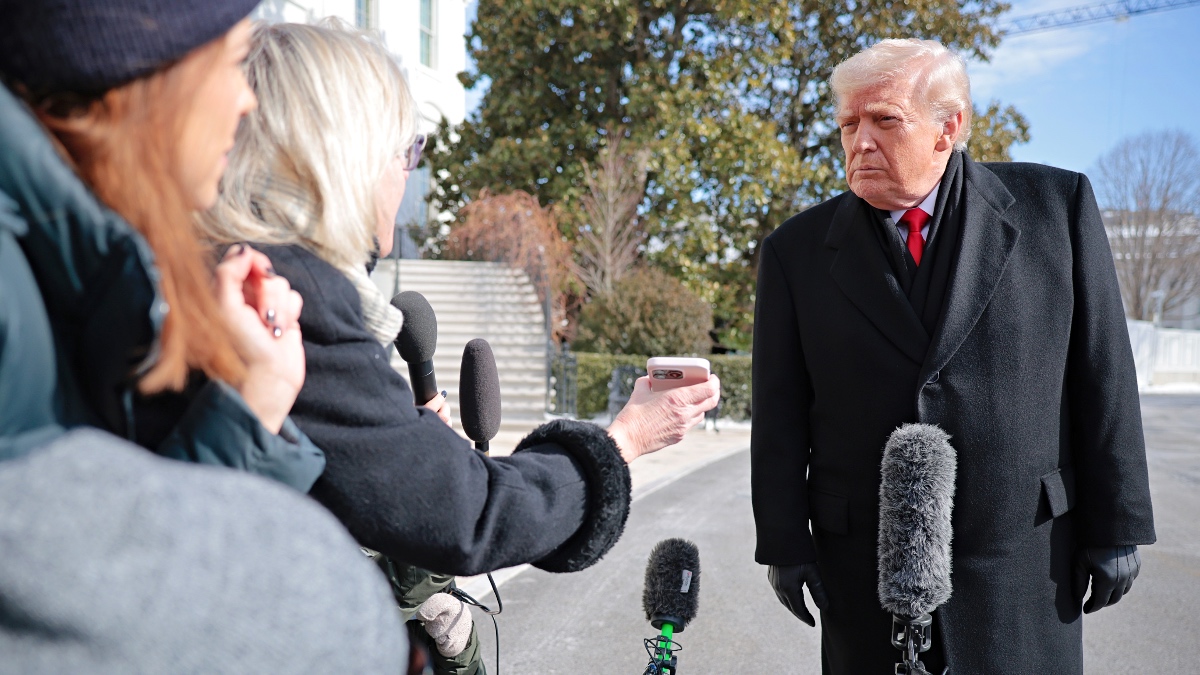

Donald Trump is back at his favorite and most infuriating hobby: bullying female reporters. Recently, a reporter asked him a policy question outside the White House. Only, it was framed against his rhetoric. So, he simply insulted the woman asking it, and told her to be quiet.
On Feb. 1, during an exchange with reporters outside the White House, Trump was asked a straightforward question. “Are you ready to go to war with Chicago?” The question referenced his recent rhetoric about federal crackdowns on cities. But Trump did not challenge the premise with facts. He challenged the reporter herself.
“When you say that, darling, that’s fake news,” Trump replied. He then cut her off mid-exchange. “Be quiet. Listen. You don’t listen. You never listen. That’s why you’re second grade.” Only after that did he move to substance. He framed his position as “cleaning up our cities” and dismissing the idea of “war” as media manipulation.
We are not going to war. We are going to clean up our cities. We are going to clean them up so they don’t kill five people every weekend. That’s not war. That is common sense.
The interaction was nothing out of Trump’s usual pattern. A female reporter asks a pointed question. Trump responds not by rebutting the question, but by diminishing the woman asking it. He attacks her tone, her intelligence, and her very right to speak. The policy answer comes later, if at all. Sadly, this was not an isolated lapse.
Over the past year of his second term, Trump has repeatedly insulted female reporters in ways that go beyond mutual hostility. He has called female journalists “stupid,” “nasty,” “ugly,” and “obnoxious” (via MS Now). And we all know about his disgusting “Quiet, Piggy” comment that the White House even justified.
Trump repeatedly mocks female reporters on their competence, comments on their demeanor, and uses infantilizing language to demean them. “Darling,” “quiet,” “you don’t listen,” all of that is not a way to express disagreement. It signals a narcissistic attempt to establish authority.
But even if it’s a pattern, the pattern matters. Trump does not generally tell male reporters to “be quiet” before answering them. He does not explain their questions away by questioning their intelligence or grade level. With women, the correction comes first and silencing is part of the response.
The exchange is also surprising for how quickly it escalated. The reporter did not cut Trump off or insult him. She asked whether his rhetoric amounted to war. Yet, Trump framed her question as illegitimate only because of who was asking it.
On top of it, calling a reporter “darling” is diminutive. And pairing it with “be quiet” and “second grade” completes the ugly message. Trump wants to assert to the reporter that she is not a serious interlocutor. A female does not get to set the terms of any conversation with him. And Trump has used this move repeatedly.
He first strips credibility, then proceed as if the substance no longer requires engagement. While MAGA often defends these moments as Trump “pushing back” on the media, pushing back requires answering the question. What Trump does instead is redefine the exchange so the reporter herself becomes the problem.
That is how silencing works without censorship. Trump does it through humiliation, then normalizes it through repetition. But the normalization is exactly what we cannot let him succeed at.




Published: Feb 3, 2026 04:37 am