


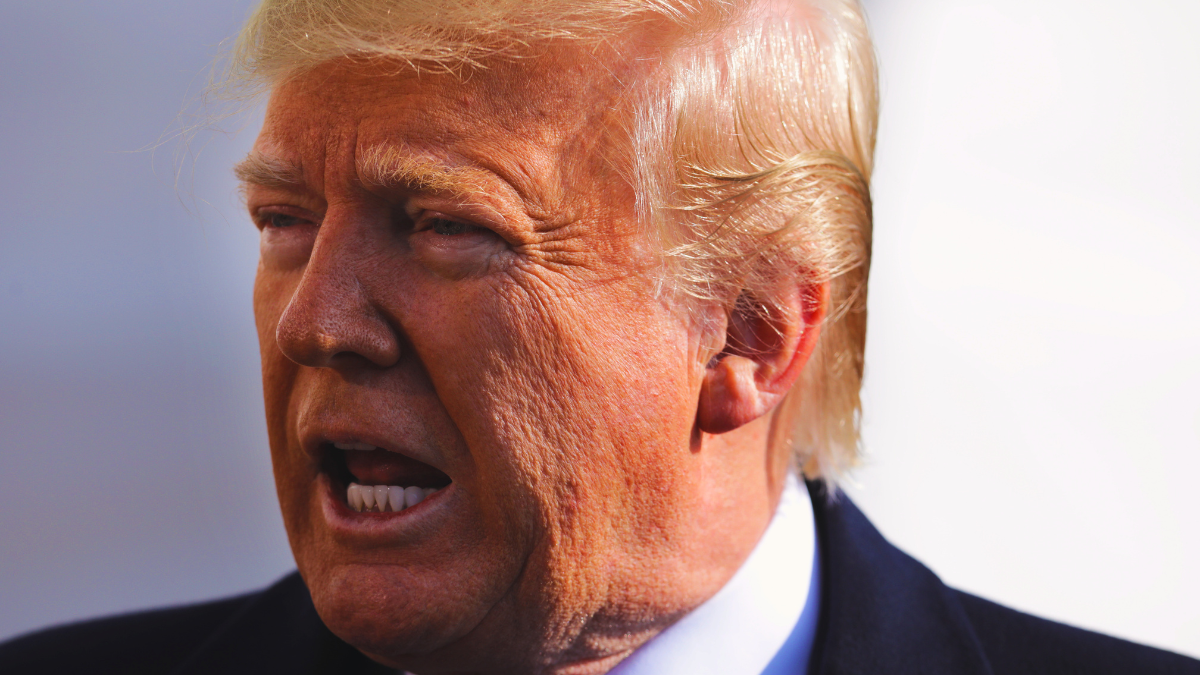

President Donald Trump recently sat for an interview in which his ongoing onslaught against Diversity, Equity, and Inclusion initiatives eventually led him to address his views on civil rights–era protections. The president conceded that those protections “accomplished some very wonderful things,” but added that they “also hurt a lot of people.”
Trump was speaking to The New York Times while explaining his administration’s multiple university funding freezes inspired by opposition to affirmative action. According to the president, these policies are rooted in his interpretation of civil rights–era reforms. “White people were very badly treated,” Trump said. “Where they did extremely well and they were not invited to go into a university or college. So I would say in that way, I think it was unfair in certain cases.”
Trump has increasingly made it a priority to frame white Americans as the primary victims of discrimination in contemporary America, backing that framing with both rhetoric and policy. In 2026, his administration removed Martin Luther King Jr. Day and Juneteenth as days when Americans receive free access to national parks. Critics viewed the move as an attempt to erroneously recast the two federal holidays as forms of preferential treatment for Black Americans.
The president argues that his policies are designed to encourage a “merit-based” society. Civil rights leaders, however, have pushed back strongly against that characterization. NAACP President Derrick Johnson said there is “no evidence that white men were discriminated against as a result of the civil rights movement, the Civil Rights Act, and efforts to rectify the long history of this country denying access to people based on race in every measurable category.”
Trump’s effort to dismantle Biden-era Diversity, Equity, and Inclusion initiatives has largely proceeded without much resistance. As part of that agenda, his administration appointed Andrea Lucas as chair of the Equal Employment Opportunity Commission. The EEOC was created in 1965 under the Civil Rights Act, but Lucas’ tenure signaled a sharp shift from the agency’s traditional posture from the outset.
In a video posted on X, Lucas outlined how the commission’s approach to workplace discrimination would take a different direction. “Are you a white male who has experienced discrimination at work based on your race or sex?” she asked. “You may have a claim to recover money under federal civil rights laws. Contact the E.E.O.C. as soon as possible. Time limits are typically strict for filing a claim.”
In the comments, some users joked that white men were now seeking reparations. Others treated the announcement more seriously, arguing that the Trump administration’s initiative was far too little and far too late. One X user claimed they had experienced “government-sanctioned racism” for the past 50 years and said they could name at least five jobs they missed out on since their early twenties.
Are you a whiny white male that wants reparations? pic.twitter.com/D273S4Jpob
— Mark Farina (@djmarkfarina) December 18, 2025
The government would go broke
— White American (@White_Amercan) December 18, 2025
We’ve been experiencing racism from government sanctioned affirmative action for 50 years
What a fucking joke. Are you going to pay me for being denied jobs from when I was in my 20s? Because I could name at least 5
The irony is that this push is happening alongside the administration’s broader crackdown on programs designed to promote equity. No policy is ever perfect in its implementation, and bureaucratic safeguards exist precisely to ensure laws are applied thoroughly and fairly. Yet Trump’s use of Civil Rights Act–era institutions to advance his agenda may ultimately underscore how significant — and well considered — those protections were in the first place.






Published: Jan 13, 2026 12:39 pm