


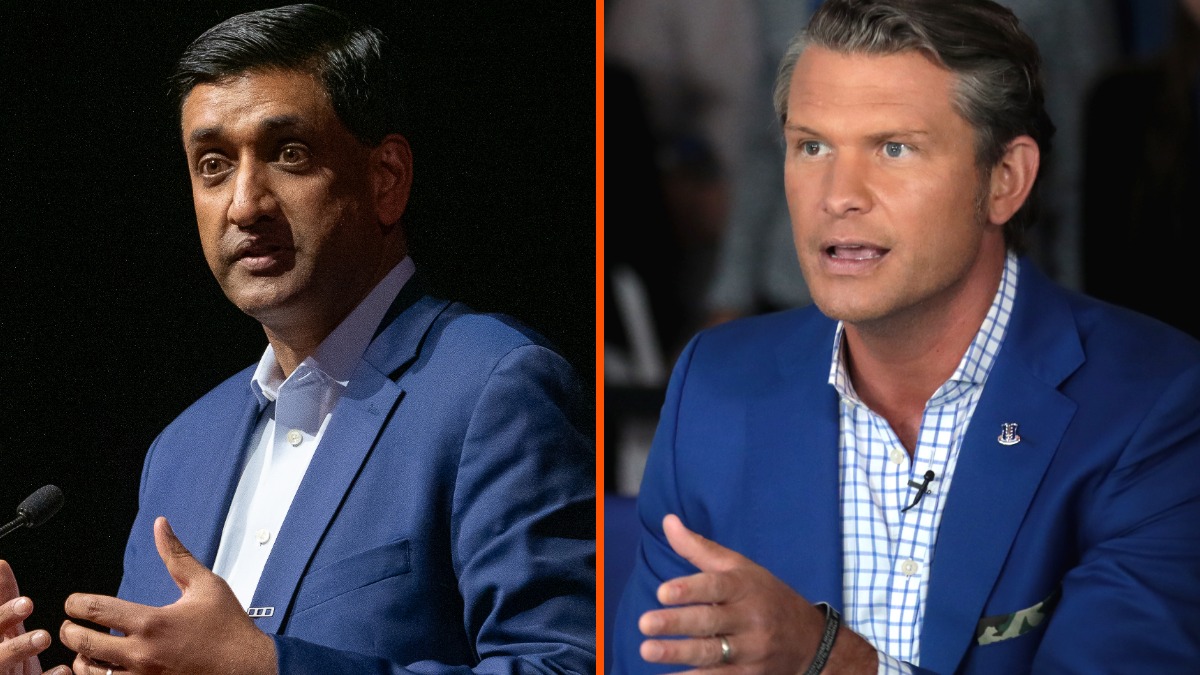

Rep. Ro Khanna took to the House floor on Thursday to provide his own assessment of the war in Iran after Defense Secretary Pete Hegseth failed to offer clear answers during a recent budget hearing. The California Democrat shared a clip of his remarks on X, where he explicitly detailed the financial toll the Iran conflict is taking on American households.
Khanna stated, “Yesterday, Secretary Hegseth couldn’t answer my question about how much the war in Iran is costing the American people. So, I am going to answer it for him. The answer is $631 billion or $5000 per American household. That’s how much it is costing because of the increase in the price of food, the price of gas, the price of electricity. We need to end this war now and help the American people reduce costs.”
His comments highlight the intense friction between Democratic lawmakers and the Pentagon regarding the ongoing conflict. Per The Hill, Hegseth clashed with Khanna during the House Armed Services Committee hearing over the same issue, with Khanna challenging the Pentagon’s official narrative. During the hearing, Khanna argued that the total cost of the war was likely well above the $25 billion figure that the Pentagon’s comptroller provided earlier in the day.
He, like all the other questioners, wanted to know the number that included all damages, as well as rising costs
“Do you know how much it will cost Americans in terms of their increased cost in gas and food over the next year because of Iran?” Khanna asked. Instead of providing data, Hegseth dismissed the inquiry as a gotcha question and countered by asking, “What would you pay to ensure Iran does not get a nuclear bomb?”
Khanna remained focused on the economic impact, asking, “Will you acknowledge that there is an economic cost to the American people for doing what you believe is necessary to make Iran denuclear?” Hegseth’s response was to claim that the administration has an incredible economic team managing the situation better than the previous administration, a comment that caused Khanna to cut him off.
The exchange grew more heated as Khanna pointedly remarked, “You don’t know what we paid in terms of the missiles that hit the Iranian school. You don’t know what we’re paying in terms of gas. You don’t know what we’re paying in terms of food. Your $25 billion number is totally off.” These concerns are backed by broader economic pressures. Iran’s control over the Strait of Hormuz has pushed average U.S. gas prices to approximately $4.18 per gallon.
According to The Washington Post, the six-hour hearing, meant to be a discussion on the $1.5 trillion defense budget request, quickly devolved into pointed and often personal barbs between committee members and the Pentagon’s leader. Hegseth opened the hearing by stating, “The biggest challenge, the biggest adversary we face at this point are the reckless, feckless and defeatist words of congressional Democrats and some Republicans.”
The hearing covered a wide range of controversial topics beyond just the war budget. Lawmakers questioned Hegseth on his justification of the war, the firing of senior military leaders, the lack of planning for U.S. bases, and even the involvement of his civilian lawyer in military matters. Throughout the session, Hegseth frequently resorted to attacking the motives of those questioning him, often labeling their concerns as partisan.
Khanna did not hold back in his criticism of the administration’s shifting priorities. He pressed Hegseth on Iran’s nuclear enrichment, noting that Iran had significantly less enriched uranium when the previous administration pulled out of the nuclear deal compared to current levels. Hegseth ignored his questions entirely and instead pivoted to criticize gas prices in California, blaming what he described as horrible policies pursued by Democrats.
Khanna concluded his remarks at the hearing by suggesting that the administration has lost credibility with its own base. “You know what? I’m sad. I’m sad for all the people who voted for Trump, I’m sad for them, because you betrayed them. You betrayed a lot of that MAGA base,” Khanna said. “And you know, who knows that? JD Vance knows that.”
This sentiment aligns with reports that Vice President Vance has expressed skepticism regarding the Pentagon’s transparency about the costs and damage incurred during the war. As the administration continues to bet on a blockade of Iran’s energy exports to force regime change, the disconnect between the Pentagon’s official figures and the reality felt by American households remains a major point of contention.
With 67 percent of Americans disapproving of the handling of the war in Iran, the pressure on the Pentagon to provide honest answers will likely only grow as the conflict continues.






Published: May 2, 2026 11:49 am