


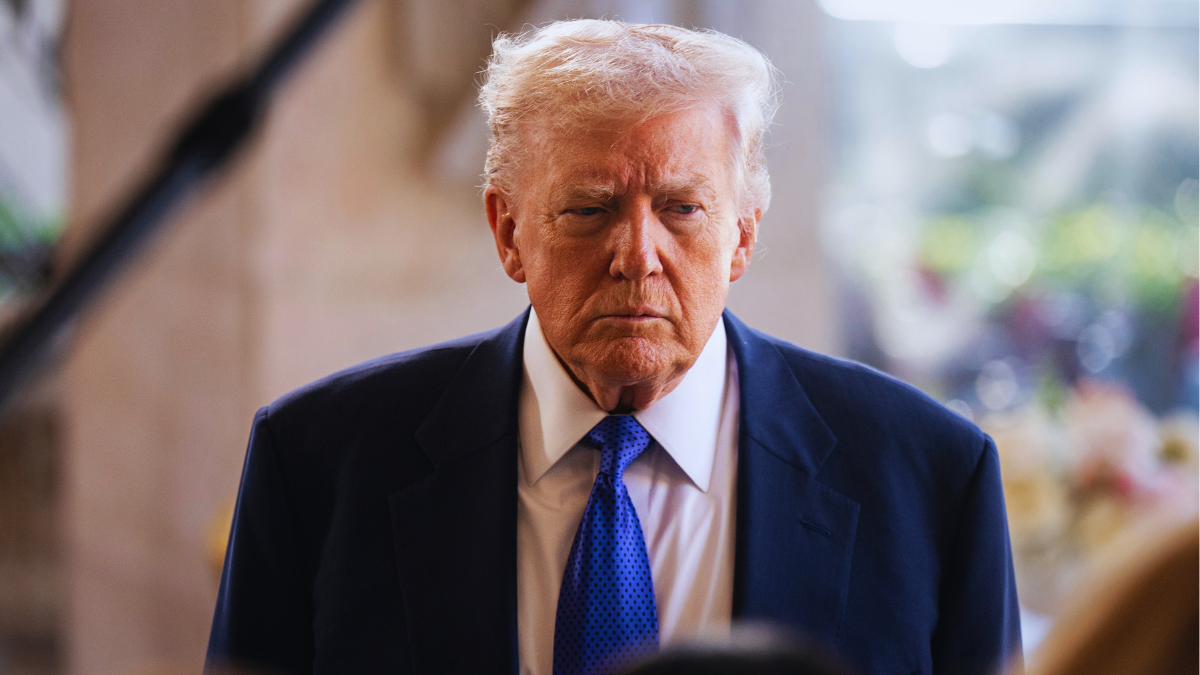

Last month, Donald Trump’s administration sent work crews to the President’s House Site in Philadelphia. The goal was to remove all display panels that showed signs of slavery from the former home of presidents George Washington and John Adams. But the city sued the administration and won in such a resounding fashion that even the Trump federal judge called the move nothing short of dystopian.
CNN reports that US District Judge Cynthia Rufe said in her ruling, “As if the Ministry of Truth in George Orwell’s 1984 now existed, with its motto ‘Ignorance is Strength,’ this Court is now asked to determine whether the federal government has the power it claims — to dissemble and disassemble historical truths when it has some domain over historical facts. It does not.” The ruling came hot on the heels of Trump once again scrambling to find creative ways to prove that he’s not racist, following his latest gaffe involving the Obamas.
Early in his second term, the administration made it clear that its goal was to clamp down on any federal support for analyzing systemic racism, starting with defunding critical race theory in schools. In Philadelphia, Trump cited Joe Biden–era “corrosive ideology” in an executive order, calling on the Interior secretary to remove content “disparaging Americans’ past.”
The Interior Department has since revealed that it plans to file an appeal, claiming the administration is more interested in “historical accuracy and completeness.” The statement continued, “If not for this unnecessary judicial intervention, updated interpretive materials providing a fuller account of the history of slavery at Independence Hall would have been installed in the coming days.”
The Trump administration has not stopped at Philadelphia or critical race theory. Its next stated target is the Smithsonian museum, where top members of the administration have said it is time to remove what they describe as anti-American propaganda. The White House released a statement that read, “The American people will have no patience for any museum that is diffident about America’s founding or otherwise uncomfortable conveying a positive view of American history, one which is justifiably proud of our country’s accomplishments and record.”
On the other side of the coin, the Trump administration has also pushed to change the official name of the Department of Defense to the Department of War, arguing that the former is too “politically correct.” Insiders claim the change would better represent the traditions set by Henry Knox and George Washington.
Many critics opposed the move, noting that it fundamentally alters what the armed forces represent to the American public. But Trump has argued that it’s better to represent things as what they are, not what people want them to be. In the same breath, Black history is American history — even the parts that frame the founding fathers as beneficiaries of violence against enslaved and indentured people. That’s what happened, regardless of whether Trump chooses to acknowledge it or not. What the federal judge refused to allow, however, was forcing the residents of Philadelphia to follow him down that path.
Ultimately, Trump may be desperate to distance himself from accusations of racism, but if he truly wants to get that monkey off his back, he might start by not calling slavery “anti-American propaganda.”






Published: Feb 18, 2026 01:21 pm