


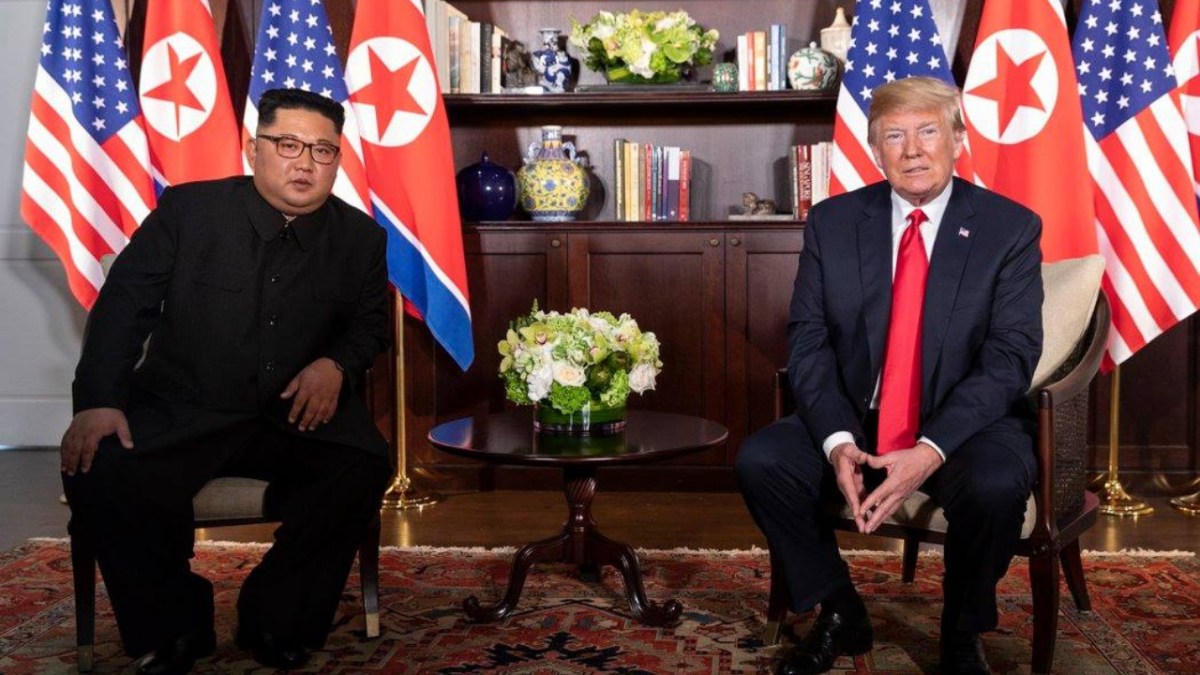

North Korean leader Kim Jong Un has toured facilities that produce nuclear materials and called for the construction of mroe nuclear weapons, days after he seemingly ignored Donald Trump’s offer to meet during his trip to Asia. Kim inspected two nuclear materials production factories, one newly opened and the other undergoing expansion, according to North Korea’s official Korean Central News Agency (KCNA).
As reported by NPR, KCNA photos showed Kim and senior military officials walking through what looked like dense rows of centrifuges, which are used to produce weapons-grade uranium, and halls displaying what appeared to be warheads. Some of the images were blurred, as is common with sensitive material. KCNA also said Kim visited a nuclear-powered equipment production base and a nuclear research institute.
Kim framed the inspection as part of North Korea’s efforts to strengthen its defenses against what he called “variable nuclear threats approaching the Korean Peninsula moment by moment.” He also said deploying low-yield battlefield nuclear weapons across multiple domains was crucial and urgent because North Korea is “facing the border with the most dangerous enemy state,” a reference to South Korea.
Experts think Kim is sending a message
Kim also accused the US of encouraging its regional allies to possess nuclear-powered submarines and committing to share its nuclear weapons with them, according to KCNA. “The validity and substantiality of our possession of nuclear weapons and the trend of bolstering up its nuclear capability in quality and quantity are an irreversible reality,” Kim said. North Korea has focused on developing tactical nuclear weapons amid heightened animosity with its southern neighbor.
Experts believe Kim is likely showing off his evolving nuclear arsenal, which is the backbone of his authoritarian rule, and reaffirming his rejection of any future talks about dismantling his nuclear program. Moon Seong Mook, an analyst at the Seoul-based Korea Research Institute for National Strategy, said that while Trump has talked about a willingness to meet Kim, the basic US position that North Korea must denuclearize remains unchanged.
Moon said Kim likely wants to say, “Look at how powerful we are. Don’t talk about denuclearization if you want to meet us.” He also suggested the visit was meant to check on the nuclear program’s progress and set future goals before a year-end Workers’ Party conference.
Pyongyang has not publicly responded to Trump’s overture, but Trump reiterated his eagerness to restore diplomacy with Kim while visiting China for the Asia-Pacific Economic Cooperation summit. In an interview with the New York Post, he dismissed any suggestion that Kim had rebuffed his outreach.
“No, he didn’t ignore it. You know, we had many leaders there … There’ll be a time when we meet … It was just not really the right time. It was a very busy two-day period,” Trump said. He also claimed he could revive diplomacy with Kim at any time by restarting the exchange of letters they kept up during his first term, though he acknowledged they hadn’t corresponded “recently.”
South Korea’s Defense Ministry said it takes Kim’s comments on battlefield nuclear weapons seriously and maintains firm military readiness against Pyongyang’s nuclear threats under its alliance with the US. South Korea’s Joint Chiefs of Staff declined to share an analysis of the facilities reported by KCNA, calling it confidential information for South Korea and the US.
The visit followed an assessment from International Atomic Energy Agency Director General Rafael Grossi, who said North Korea has been expanding its original uranium enrichment facility at Yongbyon. Grossi told the IAEA board of governors, per Euronews, that the expansion of North Korea’s enrichment program “remains a cause for serious concern.”
Grossi said a further extension to the facility had been under construction since mid-September and was externally complete by late October. The IAEA has not had access to Yongbyon or other North Korean sites since the country expelled its inspectors in 2009, and it instead monitors the program through satellite imagery and open-source information.
North Korea calls its Yongbyon complex “the heart” of its nuclear program, and it has facilities there to produce both highly enriched uranium and weapons-grade plutonium, the two materials used to build nuclear weapons. Last year, South Korea’s Unification Minister Chung Dong-young said North Korea was operating four uranium enrichment facilities and that they were running every day.
Kim has previously said he could return to talks if the US drops its “hostile policy” toward North Korea and respects what he calls the country’s status as a nuclear state. Experts say Kim wants international recognition as a nuclear state so he can demand the lifting of international sanctions.








Published: Nov 27, 2026 10:30 am