


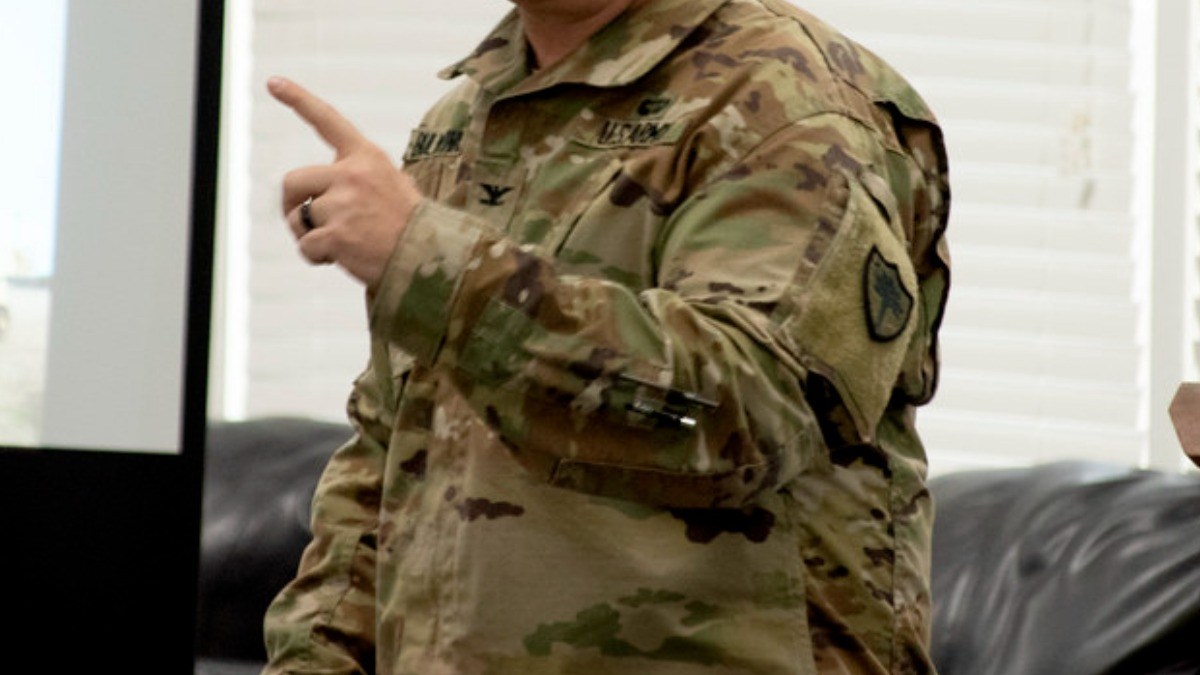

On Sunday’s 60 Minutes, a U.S. weapons systems officer identified only as Bravo for security reasons described being shot down over Iran in April. The U.S. armed forces launched one of the largest search and rescue operations to extract him beyond enemy lines. He spoke about living through what he called a catastrophic parachute failure.
He said the parachute was damaged during the initial attack. Bravo stated that he later looked up and realized there was no parachute above him.
“My parachute was damaged in the initial attack. At one point, when I looked up and saw no parachute, that was the most – that was the most terrifying thing I’ve ever seen,” he said, growing emotional.
Bravo said he prayed after the parachute failed and then struck mountain terrain at high speed
“So, I paused right then and I prayed, ‘Lord, your will be done. But if I’m getting through this, I need help,’” Bravo said. Norah O’Donnell asked, “While you’re in the air?” He answered, “Yeah.”
He described the feeling as free-falling. Bravo said he did not focus on how fast he was dropping. He stated he instead worked to fix the problems in front of him and tried to unfurl the parachute or pull loose pieces of it.
He estimated his speed at 70 to 100 miles per hour when he struck rugged mountain ground. O’Donnell asked how he survived that impact. “A modern-day miracle,” Bravo answered.
“I believe that it’s a testament to God’s provision in my life to bring me through that moment in a way that didn’t prevent injuries, but prevented any catastrophic injuries that would have affected my ability to survive,” he said.
In a voice-over, O’Donnell said the fall broke Bravo’s back. She said he also had a broken arm, a broken shoulder, a sprained ankle, and bleeding from cuts and scrapes on his head and face.
“I had injuries, but we all train to adapt and overcome the things that are – that we’re faced with,” Bravo said. He stated that he still left the landing site as fast as he could despite those injuries.
He told 60 Minutes the safest option then was a 7,000-foot ridgeline he would have to climb with a broken back. The incident highlights ongoing tensions, as Iranian strikes reportedly damaged multiple American military aircraft overnight. O’Donnell asked how he found the strength to climb given those injuries.
“Let a lack motivation put you on an Iranian TV,” Bravo answered. O’Donnell asked whether that was what he was thinking. “Absolutely,” he said. High-stakes negotiations involving the U.S. and Iran have occurred before, such as when a peace deal was reached hours after an Israeli strike on Beirut.
Bravo was one of two U.S. Air Force officers extracted from Iran during a daring search-and-rescue operation in April. The other officer was referred to as “Alpha” during the interview. He ejected safely from the aircraft after an Iranian shoulder missile hit it, and was rescued before Bravo.


Published: Sep 14, 2026 06:20 am