


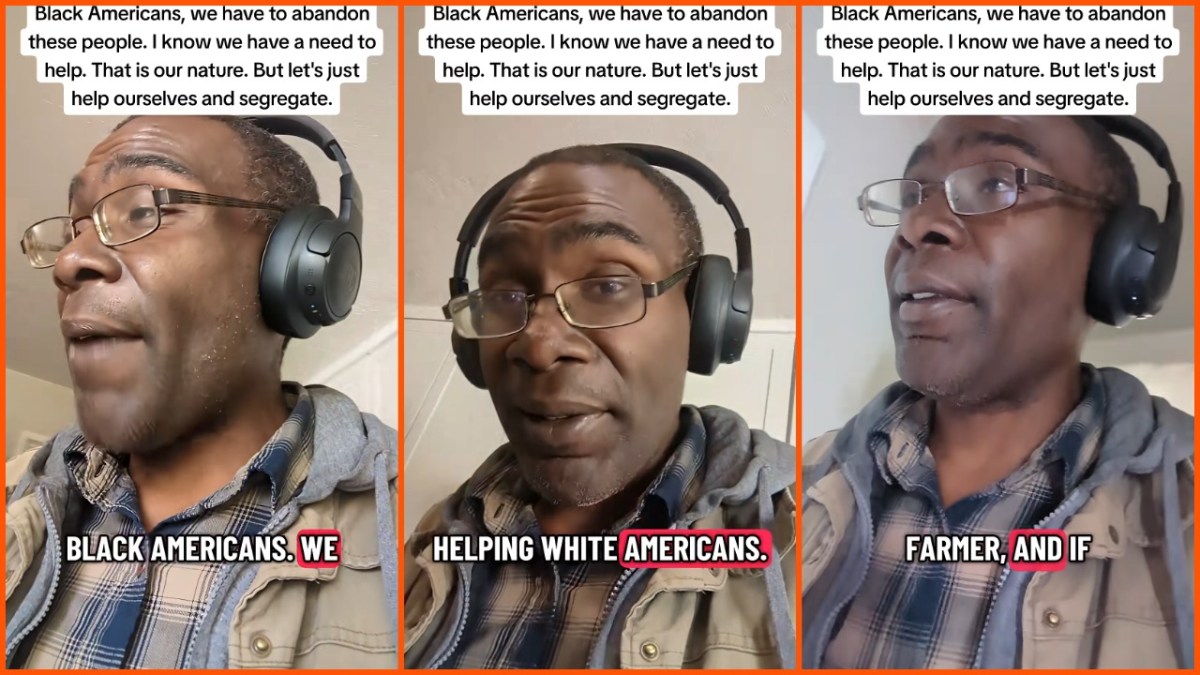

A TikTok video posted by a Black man in Oregon has drawn tens of thousands of views after he said he is finished helping mostly white neighbors and is now calling for segregation. The creator, who posts as Black Man in the Wilderness (@fatheracab), described himself as a Black farmer who donated large amounts of meat from his pigs. He claimed the help did not change anything in his town.
In the caption, he wrote, “Black Americans need to delineate from White Americans. They haven’t changed in centuries. I’ve lost all faith.” He addressed Black Americans and urged them to abandon white people and focus on their own community.
He gave an example from Roseburg, Oregon. He said he is a Black farmer and he has been donating 300 or 400 pounds of pork sausages in one day, and the local Salvation Army would back up his claims. He stated he had been feeding mostly poor white people in the town, which he said has a 22 percent poverty rate.
Research links residential segregation to lasting disparities
The man said the donations did not make the recipients any less racist. He stated, “Stop helping them. Stop trying to integrate. At this point, I’m calling for segregation.” He added that “MLK was wrong” and claimed that Martin Luther King Jr. later realized that “There’s no living amongst them.”
A 2021 report from UC Berkeley’s Othering and Belonging Institute examined residential segregation across the United States. Stephen Menendian, the institute’s director of research, said the racial identity of a neighborhood and whether it is segregated correlate with negative outcomes. The research found that 81 percent of metropolitan regions were more segregated in 2019 than in 1990, and that neighborhoods remain as segregated as they were in 1940.
According to the report, segregated communities of color have neighborhood poverty rates three times higher than segregated white communities. Household incomes and home values in white neighborhoods are twice as high. Black and Latinx children raised in integrated neighborhoods earn nearly $1,000 more annually as adults, and $4,000 to $5,000 more when raised in white neighborhoods, compared with those raised in segregated communities of color.
Menendian said outcomes track the race of the community more than the race of the individual. White people living in highly segregated communities of color fare poorly, while people of color in highly segregated white neighborhoods do better than their counterparts in segregated communities of color.
He described residential segregation as the mechanism that sorts people into high-opportunity or low-opportunity environments and called it the taproot of structural racism. Questions about who belongs in a neighborhood have also surfaced in a Black woman’s neighbor letter in California.
The institute’s findings also linked segregation to higher rates of police brutality in highly segregated Black communities and when Black people enter white neighborhoods. Menendian noted that segregation today is more regional and multiracial than the urban-suburban pattern of the 20th century, yet segregated communities of color remain under-resourced. He said the Kerner Commission warned of two unequal societies in the late 1960s, but its recommendations were not followed.
Some viewers in the video’s comment section appeared to support the message in the comments. One commenter shared a similar experience of rejection after trying to help. They wrote, “Went to donate shoes to some homeless, they looked at me with disgust and didn’t want them.” Another commenter focused on expectations of change. They wrote, “The problem is THINKING that they are going to change.”
A third commenter from the South described a personal stance against using resources for others. They wrote, “Oh I wouldn’t never help them ever, they don’t help anyone not even their own, I’m from the south and I would never use my farm to feed them.”
One more commenter supported focusing inward. They wrote, “We have to abandon everyone and start focusing on ourselves. They don’t deserve our magic.” Debates over racial separation in everyday spaces aren’t new, as seen in a Texas Roadhouse’s racially divided seating.







Published: Oct 29, 2026 01:00 pm