


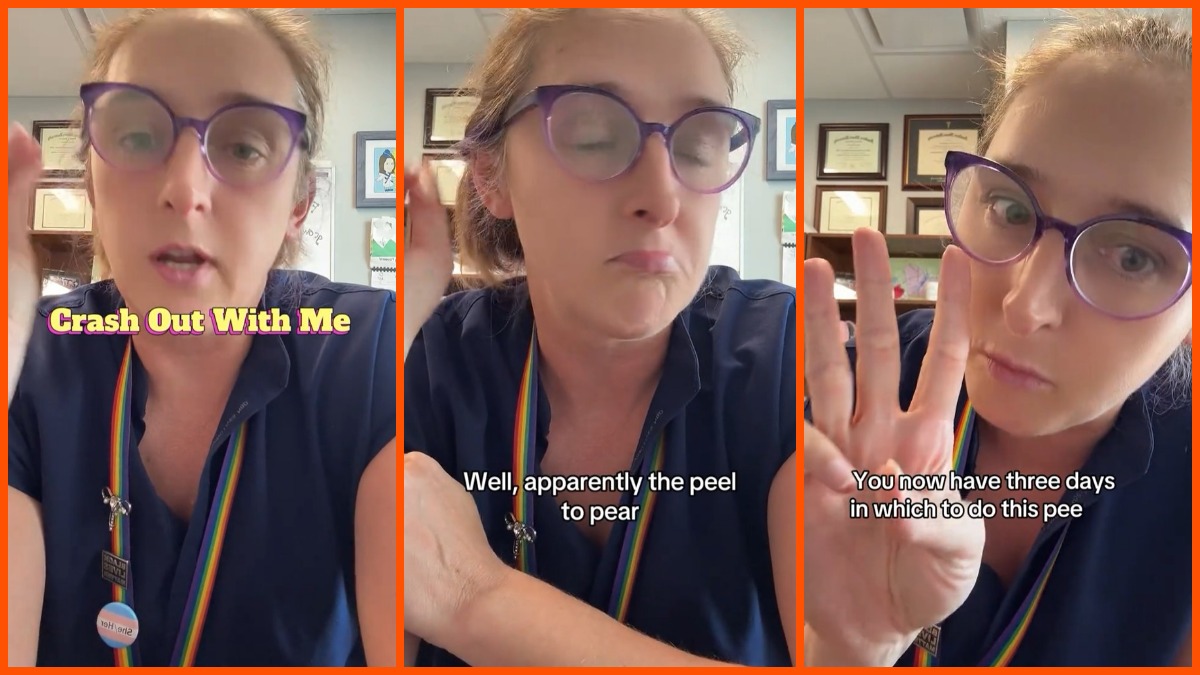

Dr. Holly Hoefgen, a Missouri Pediatric and Adolescent Gynecologist, recently took to TikTok and Instagram to vent about a situation many medical professionals know all too well. She found herself in a maddening loop with an insurance company while trying to secure necessary medication for a patient. It is the kind of administrative nightmare that makes you feel like the healthcare system might be working against you.
The trouble started when Hoefgen requested a medication for her patient, only for the insurance company to allegedly deny it. According to Hoefgen’s video, the company insisted the patient had to take a different medication first, even though she knew that wouldn’t work. She claimed, “So I said, yes. I would like the peer-to-peer after you denied my appeal based on the really long, extensive note I wrote.”
This is a process where an ordering physician talks to a reviewer at the insurance company to argue for the necessity of a treatment. The hurdles were immediate. She explained that these requests have to be completed within 10 days of the denial, and since she was returning from a week-long vacation, she only had three days to make it happen. Still, Hoefgen found the time one afternoon and gave three available afternoon time slots to the insurance company.
At their convenience
“You know where I was this morning at 9:00 am when they called? Because … they just felt like it? I was in the OR with a patient because I’m a surgeon. That’s why I wasn’t available until 12:30,” Hoefgen ranted. She returned to her phone to find a voicemail saying they were calling for the scheduled peer-to-peer. She assumed they would call back during one of the other provided time slots, but they didn’t.
She claimed that when she got in touch with them later, the insurance company allegedly told her it was too late to reschedule. “How is this okay?” she raged, “ How is this okay? It’s just not okay. What the actual,” she asked.
Her frustration resonated deeply with others online. One user on TikTok commented, “So wildly frustrating. What a colossal waste of time, energy, and resources.” Another user on Instagram added, “Diabolical. Malicious. Intentional.”
In a follow-up video, the situation somehow got worse. Dr. Hoefgen revealed that when her staff tried to fix the scheduling error, they were told the peer-to-peer process could not be rescheduled. The company claimed that requested times are not a guarantee and that if the 10-day window passes, the doctor has to start the entire prior authorization process from scratch.
Then she described the most flabbergasting part of the update, the insurance company’s interpretation of their own policy. They informed the office that the doctor must be available at any time during 24 hours to take the call. “I’m sorry. You want a physician and a surgeon to be readily available, doing nothing else, to just be able to answer your phone call anytime you decide to call in a 24 hour period?” her nurse allegedly asked.
Per her post, the insurance company confirmed that this was the expectation. According to the AMA, prior authorization has evolved into a standard utilization management tool that frequently delays or denies care. In one case, a Redditor shared that their insurance company denied his wife diabetic medication and sent her a scale instead.
The AMA notes that these hurdles exist outside of simple prior authorization, often involving inadequate peer-to-peer reviews where the person on the other end of the line may not even be a physician, let alone a specialist in the relevant field. In another case, United denied a stroke surgery even though every other doctor believed it was needed.
In a 2024 survey of 1,000 physicians by the AMA, only 16 percent of doctors said the insurance plan’s peer-to-peer reviewer often or always had the appropriate qualifications. Dr. Debra Patt, an oncologist, shared her own experience with the AMA, noting that a patient of hers ultimately passed away after a week-long delay in care caused by these processes.
“It’s really challenging. I think that the peer-to-peer review process would have approved the treatment, but the problem was we couldn’t get that in a timely fashion,” Dr. Patt told AMA. The AMA continues to push for reforms, including policies that require reviewers to have clinical expertise in the condition being treated and that insurance companies accommodate the physician’s schedule.
As Dr. Hoefgen noted in response to a follower who suggested the system is designed to trigger compliance through exhaustion, “I will swear for life that the Peer to Peer process is just built to frustrate us into compliance of their made up protocols.”






Published: Aug 17, 2026 08:12 am