


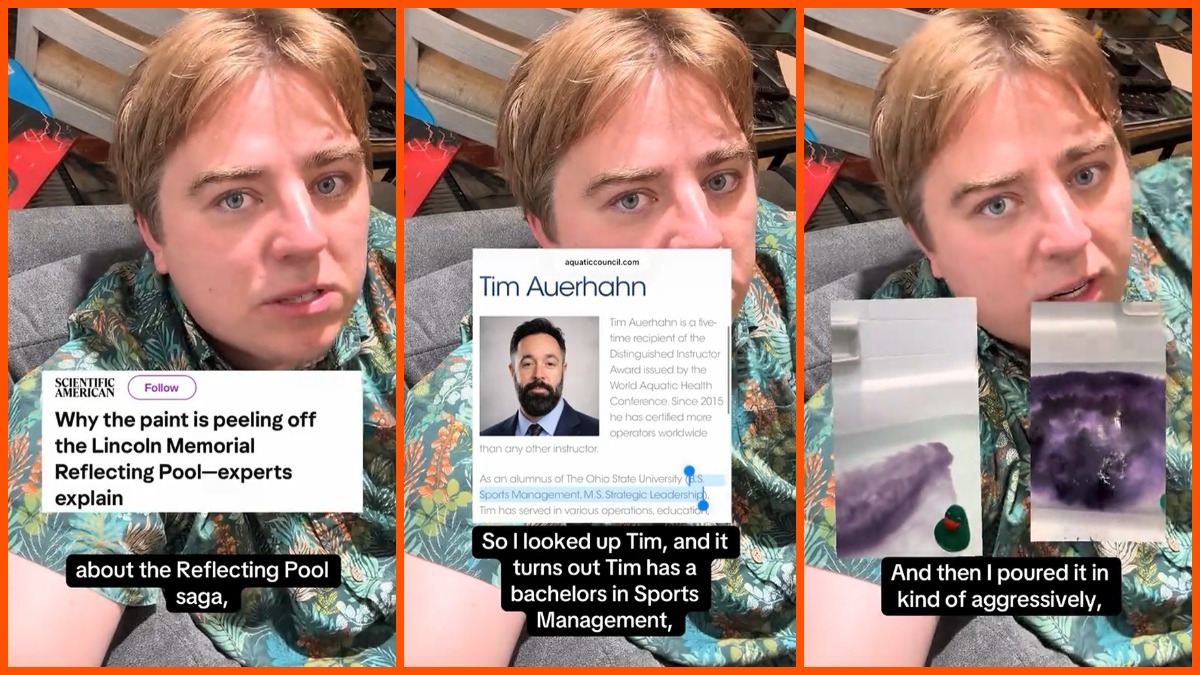

When you see someone presented as an expert in a field you understand, in a major outlet like Scientific American, it can be pretty frustrating. That is what happened to Southern California resident Greg (gregfromvideo1). The piece was written to explore the paint peeling off the base of the Lincoln Memorial Reflecting Pool. Greg noticed that the article’s science and the cited expert didn’t add up. So he ran his own experiment to prove his concern on TikTok and Instagram.
Greg noted that the expert cited was Tim Auerhahn. He is the chairman of the Aquatic Council and also a sports manager, according to Greg’s research. According to the article, Tim said that the Hydrogen peroxide used by the National Park Service would have been diluted very quickly and was unlikely to damage the paint. Greg didn’t agree, stating, “Hey Scientific American, if you’re going to talk about physics, maybe ask somebody who’s taken a physics class to chime in.”
In between wondering how a sports manager managed to ‘schmooze’ himself into Scientific American, Greg was particularly bothered about density. He noted that a 12% hydrogen peroxide solution is actually denser than water. So, he looked up the information, did the math, and mixed a solution to mimic the specific gravity of the Hydrogen Peroxide mixture. Then he dyed the mixture and poured it into his bathtub to record and observe the results.
Greg Recreates the Reflecting Pool in His Bathtub
Greg noted, “I was pouring [the mixture] into a shallow, stagnant body of water. And if anything, it would actually be more turbulent than the reflecting pool because it’s a smaller body of water than the reflecting pool, right! Pouring in the stuff will add more turbulence than it would in the reflecting pool. And you know what happened? It just sunk to the bottom, and it just stayed there.” Even an aggressive pour had the same result, contradicting Tim’s claims of dilution.
If you don’t remember, a few weeks ago, President Trump’s no-bid contract to renovate the Lincoln Memorial pool ran into a new controversy. After a giant algae bloom, the paint began to peel, triggering accusations of vandalism. This is when people and news outlets were discussing the science.
Greg’s experiments drew over 1 million views combined, and his audience was tickled by his commitment. One Instagram user commented, “This is the level of nerdiness we need keeping peeps accountable. Well done, good sir. YOU’RE the scientific American!” Another TikTok user echoed this sentiment, saying, “You know what else is denser than water? Tim.”
Others appreciated the practical perspective. As one user noted, “Do pools for a living, family has done it my whole life. Never heard of anyone using hydrogen peroxide for algae in the first place. Chlorine guys, come on. Metric f**k tons of chlorine.”
In a follow-up video, Greg ran the experiment again, but this time with the same brand of hydrogen peroxide to recheck his findings. Again, the chemical settled to the bottom. “So what’s my point here? My point is that Scientific American wrote this article about the reflecting pool where they billed it as experts explaining it.”
Greg does admit that Tim likely has “very deep fragments of knowledge about scientific subjects related to his industry.” However, he thought that, considering it is a science journal, the article needed “comprehensive scientific knowledge to assess a novel situation with.” To him, it was the necessary difference between a Buzzfeed and a Science Journal.
In a comment on the first video, he had stated, “To clarify, the point at the end is that the coating being exposed to the 12% peroxide that sunk to the bottom of the pool likely experienced something more corrosive than what’s typically seen in a swimming pool.” It seemed like Greg felt that a scientific voice, who could logically assess what the corrosive influence could mean, would be valuable.
Currently, the situation at the Reflecting Pool remains complicated. According to a Washington Post analysis, the lining of the pool peeled away in at least seven places along seams created during the application process. Experts told The Post that the failure pattern strongly indicates errors in how the material was installed.
The pool has since been drained in preparation for repairs.





Published: Jul 18, 2026 10:45 am