


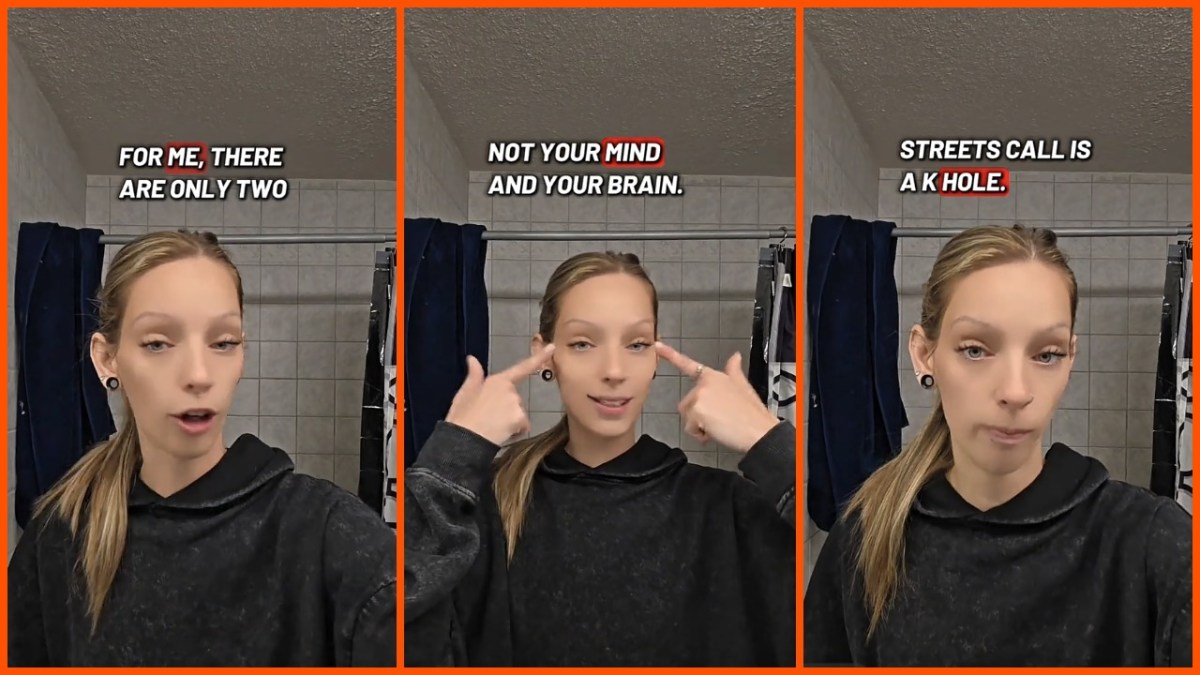

The conversations about the Cornell 7 case have been difficult for many people to process. As a recovering addict, Jess Dennison (bringjesssthehorizonn) found the allegations about ketamine in the case especially terrifying because of her own harrowing experience with the substance. So, she took to Instagram and TikTok to talk about how ketamine actually functions and what she believes it could mean for the seven-hour period described in Jane Doe’s lawsuit.
In a post that has gained over 383K views, Dennison noted in the caption, “the Cornell 7 situation has me more livid than most bc i know what it feels like to be on ketamine. I know what she could feel and couldnt. I know how long it lasts and its NOT 7 hours…. they had have given it to her continuously to keep her in that state. keep having uncomfortable convos!!” In the video, she said, “The only time that I’ve ever done ketamine, it almost killed me, and I was terrified enough that I never touched it again.”
She claimed that when she did the substance, she immediately slipped into a K hole. “It quite literally will tranquilize you. But the problem is it tranquilizes your body, not your mind and your brain. So as soon as I did the substance, I was sitting on the edge of the pool chair towards the pool, did it, and then fell straight into the pool. No motor skills, can’t yell, can’t scream, can’t swim.”
She says the drug left her body frozen but her mind awake
This distinction between physical paralysis and mental awareness was a big part of the struggle. Dennison said that as the substance hits, people start to hear what she called the “wan wans,” where everyone sounds like Charlie Brown. “You can’t really understand them, but you can see everything that’s going on. But you can see, you can hear, you can’t speak, and you can’t move.” In her view, that experience contradicts the idea that someone in such a state is simply unconscious.
According to FRANK, the effects of snorted ketamine typically take about 15 minutes to kick in, and the buzz lasts for 30 minutes to an hour. Since the drug’s effects are relatively short-lived, Dennison argued that the seven-hour timeframe described in the lawsuit suggests the drug would have had to be given repeatedly. Those allegations have not been tested in court.
“I don’t think people are realising that the lasting effect of this substance, it doesn’t last seven hours. Nobody wants to talk about that part. That they probably had to reapply and reapply and reapply the substance to Jane Doe to keep her in what I am considering a K hole for seven f—ing hours.”
According to The Guardian, the Cornell 7 case involves a former student who alleged in a civil lawsuit that she was gang-raped at a fraternity house party after being given ketamine. The lawsuit came after an investigation in 2024 didn’t result in any criminal charges. None of the seven men named in the suit has been criminally charged, and at least two of them dispute her account.
Per the outlet, the woman said she felt as though her eyes were looking in different directions and that she became “completely numb to the whole situation.” The case has reignited intense scrutiny of New York’s voluntary intoxication laws.
Currently, these laws make it difficult to secure convictions if a victim was voluntarily intoxicated, as prosecutors must prove they were physically helpless. The Guardian reported that many advocates, as well as Gov. Kathy Hochul, argue this framework needs to be changed. The criminal investigation has since been reopened, and a special prosecutor has been appointed to handle it.
Experts support the idea that ketamine’s effects are highly complex. Joseph Palamar, a professor at NYU Grossman School of Medicine, told The Guardian that even experienced users can be overwhelmed by the drug. “You might have something you want to say but the words just don’t come out,” Palamar said. He noted that this impacts the user’s ability to consent or end an interaction.
At higher doses, users may enter a dissociative state, which Prof Celia Morgan of the University of Exeter described as appearing like “zombies, wide-eyed but conscious.” Morgan told the outlet, “That’s not conducive to consent.”
Many commenters on Dennison’s posts said they hadn’t understood the drug’s effects before. One Instagrammer wrote, “This seems like it would qualify as torture. For so many reasons, but the details of what street ketamine does to you makes it that much more grotesque.”
Dennison hopes her testimony encourages people to have difficult conversations. “This should trigger you. This should make you uncomfortable, and this should make you wanna talk about it. So please keep having these uncomfortable conversations with your kids. With your children. With your children that are getting ready to go to college, because this s–t is scary and it’s very, very real.”



Published: Oct 4, 2026 11:00 am