


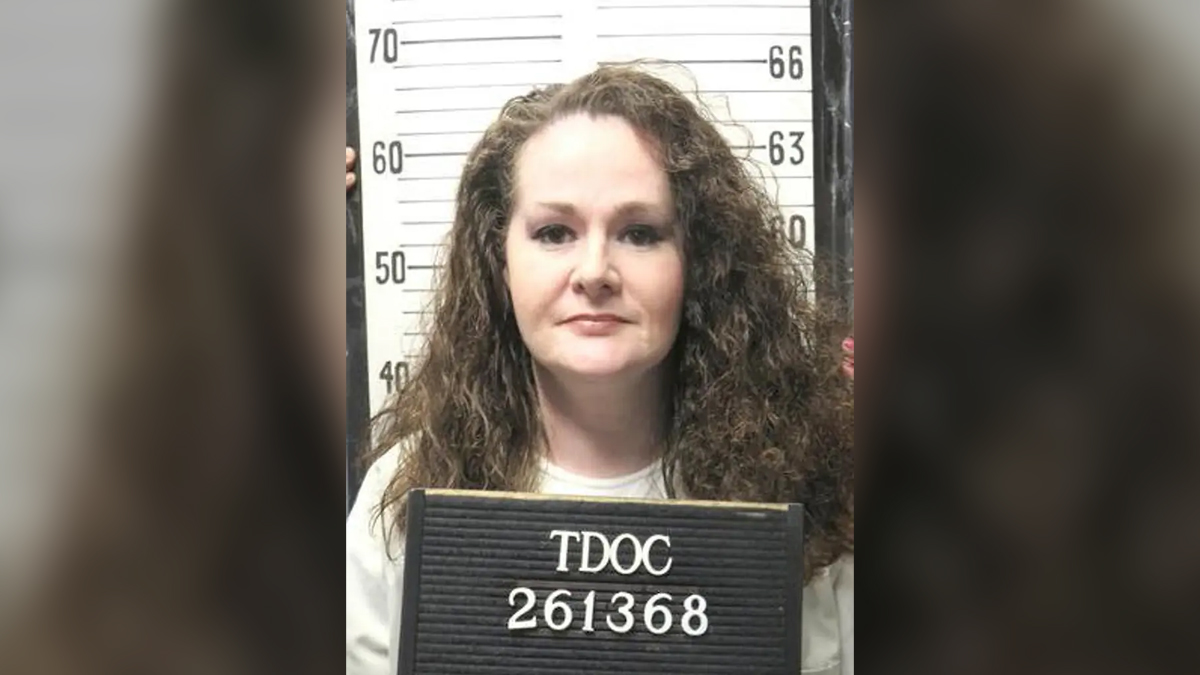

Christa Pike, the only woman currently on Tennessee’s death row, is fighting to stop her scheduled September 30 execution by suing the state and arguing that its lethal injection protocol is unconstitutional. As the date of her execution approaches, Pike is asking the Tennessee Supreme Court to intervene, citing a variety of medical and psychological factors that she claims would turn her execution into a torturous event.
According to The Tennessean, Pike’s legal team filed a motion on June 12 asking the state’s highest court to appoint a special master to investigate her claims. Her attorneys, Luke Ihnen and Stephen Ferrell of the Federal Defender Services of Eastern Tennessee, argue that the state’s current procedures are fundamentally flawed.
The legal filing states:
“[D]espite their protestations and bald assertions, the Respondents do not know how to carry out an execution that comports with either the United States Constitution or the Tennessee Constitution; they do not have the qualified and trained medical personnel to ensure that prisoners do not experience superadded pain, terror, disgrace, or lingering death; and they refuse to admit it.”
A big part of the argument ties into reported problems with procedures followed by the Tennessee Department of Corrections
VT reported that Pike, now 50, was convicted for the 1995 killing of 19-year-old Colleen Slemmer. The case, known as the Job Corps Murder, involved Pike, her boyfriend Tadaryl Shipp, and their friend Shadolla Peterson. Both Pike and Slemmer were students in a Knoxville job-training program for troubled adolescents when Pike orchestrated a brutal attack.
Prosecutors established that Pike lured Slemmer to the University of Tennessee Agricultural campus, where she struck her with a piece of asphalt, tortured her, and ultimately slit her throat with a box cutter. Pike also reportedly kept a piece of Slemmer’s skull as a souvenir.
Shipp was sentenced to life in prison because he was a minor at the time. Peterson received probation after testifying for the prosecution, and Pike received a death sentence. If the state carries out the execution as planned, VT noted that Pike would be the first woman executed in Tennessee since 1820.
Pike’s attorneys argue that she has a few unique medical conditions. This includes small veins and a blood disorder known as thrombocytopenia, make the standard lethal injection process particularly dangerous.
Her team claims that the use of pentobarbital could cause flash pulmonary edema, which they describe as a condition where the lungs fill with a bloody, frothy fluid. According to WBIR, the lawsuit claimed, “This is death by drowning on one’s own blood,” and that the process is highly likely to cause unnecessary pain and suffering. Pike’s lawyers also highlighted her history of severe trauma.
Pike was reportedly diagnosed with bipolar disorder and post-traumatic stress disorder by the Tennessee Department of Corrections, conditions her attorneys link to the sexual abuse she suffered from a young age. They argue that the isolation preceding her execution, combined with the fact that she would be forcibly removed from her cell and restrained by male guards, would trigger her past trauma.
Her legal team noted, “Because of Christa’s medical condition and the historic difficulty medical professionals have had finding a suitable vein for blood draws, locating a suitable vein for the lethal injection IV line will be especially challenging. Christa will likely be repeatedly stabbed all over her body in an attempt to insert the two IV lines required for the execution.”
The concerns regarding Tennessee’s execution procedures aren’t new. Per WSMV, the Federal Public Defenders’ Office claims that the state has failed to maintain safe and competent protocols. In May, there was a failed execution attempt for Tonu Carruthers. He was reportedly poked multiple times over 90 minutes because of improper staff. Ohio had a case where the protocol failed the same way, resulting in 18 attempts over two hours.
Kit Thomas, deputy chief of the Capital Habeas Unit, stated, “That failure wasn’t unforeseeable. It was predicted. And TDOC went ahead anyway.” Previous incidents have fueled these concerns, including the 2022 reprieve of Oscar Smith due to missing drug testing results and the execution of Byron Black in August 2025, where witnesses reported that Black groaned in pain and said, “Oh, it’s hurting so bad.”
In 2022, the governor ordered an independent investigation, which reportedly revealed pervasive non-compliance by TDOC with its own procedures. When its 2025 protocol was revealed, attorneys for death row inmates argue that the newer protocol simply conceals problems behind vague rules and weak safeguards, rather than fixing them.
As pharmaceutical companies deny the use of their drugs for lethal injections, some states, like Alabama adopted the controversial nitrogen hypoxia, or inert gas asphyxiation.









Published: Jun 15, 2026 10:34 am