


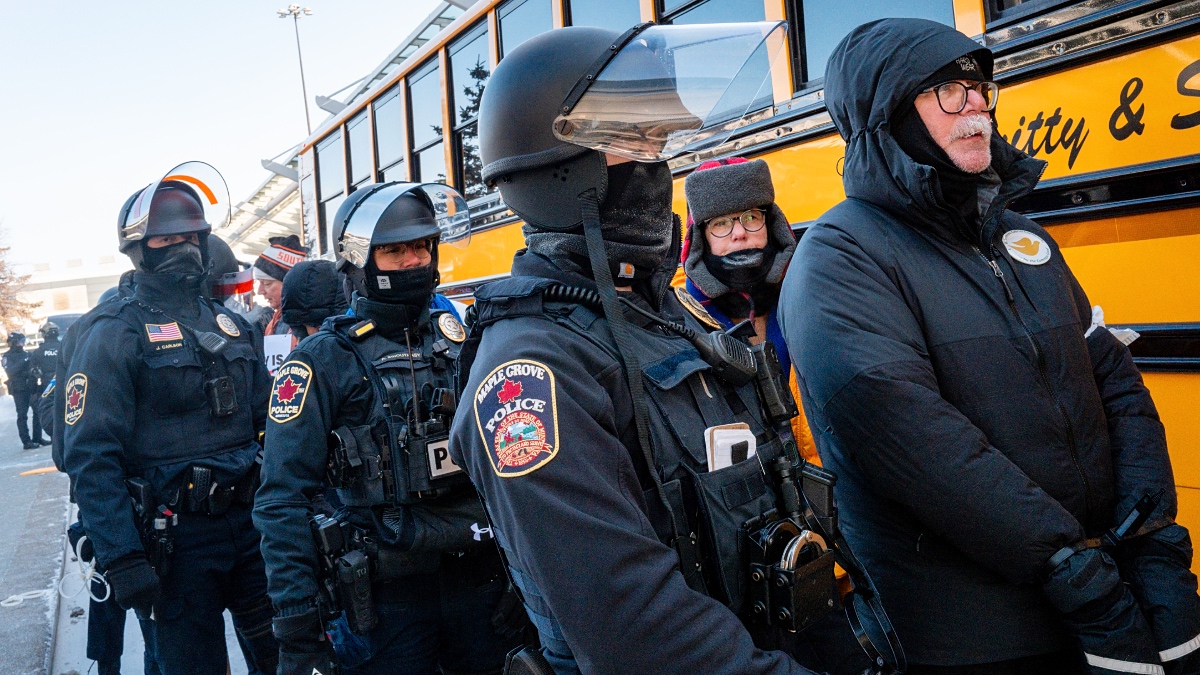

A chilling video is coming out of Portland, Maine, involving another concerning incident with an Immigration and Customs Enforcement (ICE) officer. Apparently, you can be labeled a domestic terrorist in the U.S. for simply existing and exercising your constitutional rights. Great going, America.
In the video widely shared on X, a woman is calmly filming an ICE agent’s actions on a public street, well within her limits. She wasn’t interrupting any operation or posing any threat at all. However, the officer soon moves and begins taking pictures of the woman’s vehicle as the woman tells him, “It’s not illegal to record.”
The agent replies, “Exactly, that’s what we’re doing.” The woman then confronts him, asking “Why are you taking my information down?” And the agent responds:
“Because we have a nice little database, and now you’re considered a domestic terrorist.”
The woman, stunned, laughs and responds, “For videotaping you? Are you crazy?” Because you cannot be in your right mind and call someone a terrorist for recording you. Recording law enforcement in public is broadly protected under the First Amendment. And no statute allows designation as a terrorist simply for filming an agent as part of peaceful observation.
Federal officials have occasionally attempted to paint those who monitor ICE activities as threats under broad “obstruction” or “domestic terrorism” rhetoric. Regardless, courts nationwide have repeatedly upheld the right to record public officers.
The ICE keeps posing as authoritarian enforcement
This incident is just the most recent in a string of viral exchanges showing the brutality of ICE and other federal officers. They have threatened or attempted to deter civilians from recording or following their actions repeatedly since their deployment on the streets. The officers even sometimes cite potential arrest, or, in the worst cases, actually detain citizens unlawfully.
Videos from multiple states have shown agents warning that filming or monitoring could lead to arrest for “impeding operations.” Civil rights advocates say these interactions are part of a broader climate of intimidation that risks chilling constitutional rights.
Similar clashes have drawn scrutiny in Chicago, Oregon, and other locations where federal immigration agents confronted civilians who were recording or observing their activities.
Public reaction
The public reaction to the Maine video was swift and intense. Social media users expressed outrage not just at the officer’s words, but at the broader message such a threat sends. One user wrote that ICE constitutes an “organized white supremacist cult with the full backing and support of the white supremacist Trump administration.”
They argued that most people aren’t treating the threat seriously enough. Others focused on the constitutional implications, insisting that “recording law enforcement is one of our most fundamental rights and it should never be infringed.” They bluntly labeled ICE “fascist” for threatening a peaceful observer.
Another expressed shock and disbelief, writing, “Holy shit! So now they are calling anyone who videotapes ICE a domestic terrorist!?!” The user compared the incident not to modern America but to authoritarian states like “Nazi Germany… Communist Soviet Union or China!!!”
People call for action against ICE
Many also called for collective action, arguing, “We need mass lawsuits. These are civil rights violations,” emphasizing that federal agencies should not be permitted to weaponize vague labels to deter lawful documentation. Some shifted the blame directly back onto the agent, writing, “The domestic terrorist is the ICE agent.”
Other reactions underscored the disconnect between federal authority and local concerns, with one user asking, “How the f—k do you look at this and tell us this has anything to do with immigration enforcement?” And logically, the confrontation was clearly unrelated to any legitimate immigration objective.
The ICE video is more than an isolated exchange. It reveals an enforcement culture in which federal agents appear willing to threaten constitutional rights to deter scrutiny. By calling a civilian a “domestic terrorist” for recording, the officer transformed a routine act into a supposed security threat. That too, without citing any legal basis. This is not policing, it is intimidation. And it is unfolding in broad daylight.






Published: Jan 25, 2026 01:02 pm