


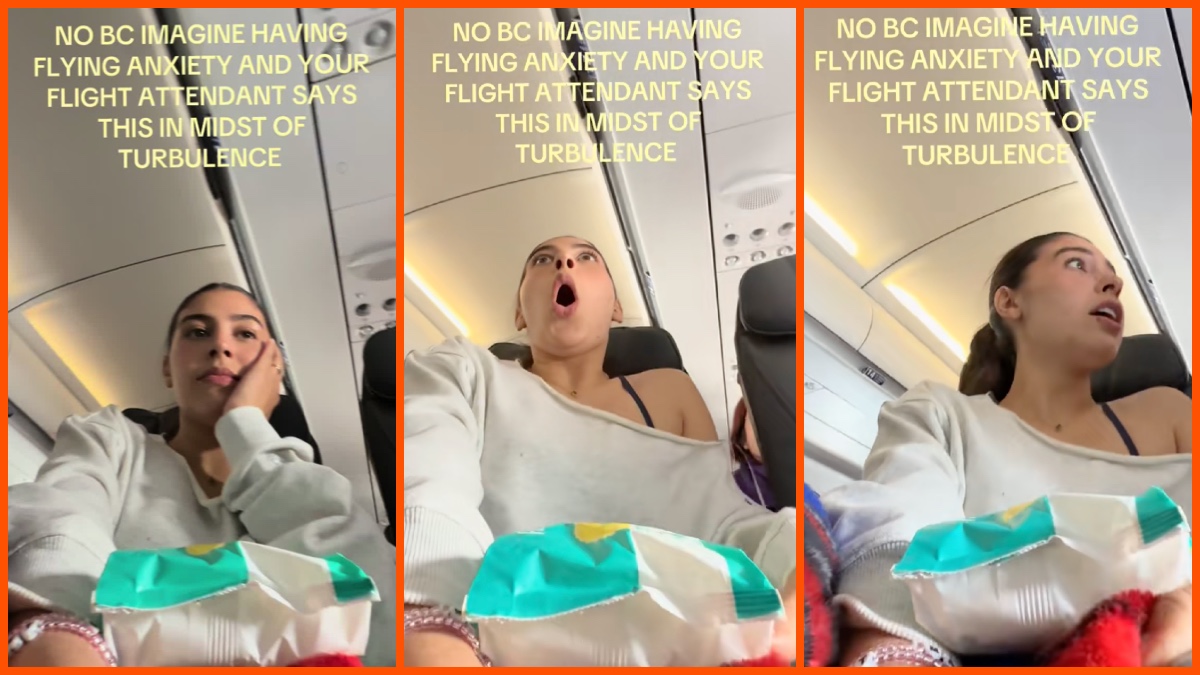

Commercial airline turbulence has become more intense in recent years, according to multiple climate and aviation studies that link warming temperatures to stronger atmospheric instability and changes in the jet stream. That anxiety is behind a viral TikTok posted by creator Brenda Madden (@Brenda_Madden), who recently shared a tense moment aboard a JetBlue Airways flight.
Madden’s clip highlights a flight attendant announcement. The video’s text overlay reads: “No BC imagine having flying anxiety and your flight attendant says this in the midst of turbulence.” On the bumpy ride, Madden heard the aircraft’s “double chime,” which means the aircraft began its final descent.” Then the flight attendant addressed passengers over the intercom.
“Ladies and gentlemen, we’re not coming through,” the attendant said. “We are not getting up, we’re not coming through. Buckle your seatbelts, bring your seatback upright, put your tray tables up, make sure that your carry-ons are put away, and just do what you know you’re supposed to do. We’re not coming.” Madden captioned her post, “I thought I was going to meet Jesus today.”
What “not coming through” likely meant
The attendant’s repeated warning likely meant the crew would not move through the cabin to personally check seatbelts, tray tables, or stored carry-on bags before landing. Instead, passengers needed to follow the instructions on their own as the aircraft continued through turbulence.
The wording startled viewers online, especially nervous flyers who interpreted the repeated phrase “we’re not coming” as ominous during an already turbulent descent.
During heavy turbulence, flight attendants swap hospitality for direct “command language.” This specific phrasing sounds worrisome, but crews are trained to be blunt over the PA to ensure passengers secure themselves immediately when flight attendants cannot physically check the cabin.
Why is turbulence getting worse?
The short video drew attention because many passengers associate turbulence with a loss of control, even though aviation experts consistently describe it as common and rarely dangerous to aircraft. Airlines routinely suspend cabin service during rough conditions to protect crew members from injury.
Climate researchers and aviation experts have also spent years studying whether turbulence is becoming more frequent or severe. A 2023 study published in Advances in Atmospheric Sciences found significant increases in several categories of clear-air turbulence as atmospheric conditions change.
Another study published in Nature Climate Change linked climate-driven atmospheric changes to intensified turbulence along transatlantic flight routes.
News coverage has amplified those concerns following several highly publicized turbulence incidents in recent years.
Still, the JetBlue clip appears to show a standard safety procedure rather than an emergency. Flight attendants commonly stop walking through the cabin during moderate or severe turbulence. Crew members often remain seated and suspend service to avoid injuries caused by sudden aircraft movement.
The viral moment resonated with many viewers because the wording sounded abrupt and unsettling without additional context. But aviation crews frequently use direct instructions during turbulent descents to quickly secure the cabin and reduce risks for both passengers and flight attendants.







Published: May 22, 2026 03:51 pm