


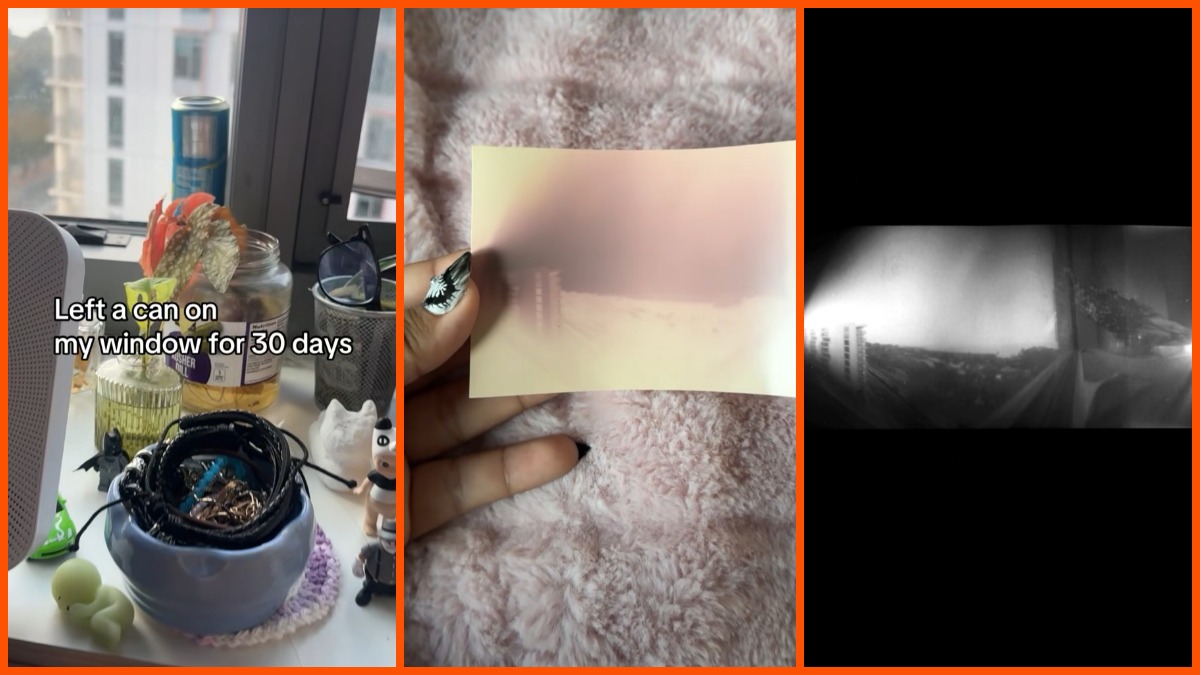

Kelly Tapia, a student at the University of California, San Diego who posts on TikTok as Starstudio, recently shared an art project that has completely captivated the internet. In a video that has racked up over 10 million views, she reveals what happens when you turn a piece of trash into a functional camera. She had set up a pinhole camera made from a Schweppes can on her windowsill.
The video starts with the can sitting on her window ledge, accompanied by the on-screen text, “Left a can on my window for 30 days.” After retrieving the can, she first takes a moment to show us the view. Then, she retrieves the photographic paper hidden inside the can. Once she scans and inverts the capture, we get to see a perfect, low-detail, black-and-white version of her view. It is a stunning example of a solar graph, and the internet definitely noticed.
Commenters were quick to share their amazement. User blairbitchproject commented, “WHAT THE FREAK THIS IS AWESOME,” while Amber Z noted, “I thought we were just being sentimental about the [can] being able to see the world. This is better.”
It is an old trick that still captivates
Others were impressed by the ingenuity, like Maddy 🤍, who wrote, “Omg im literally useless,” and Rhetta, who added, “i stg i never would have invented ANYTHING.” Tiana Mae asked, “Wait, what’s the science to this? I’m very intrigued.”
The science behind what Kelly created is known as a camera obscura, which is Latin for “dark room.” According to HowStuffWorks, a pinhole camera is the simplest camera possible, consisting of a light-proof box, some sort of film, and a tiny pinhole.
According to the website, you don’t even need a lens. Light enters through that small hole, creating an upside-down image on the opposite side of the box. The pinhole acts exactly like a lens, forcing every point emitting light in the scene to form a small, crisp point on the film.
This optical phenomenon has been around for centuries, long before modern cameras were a thing. As HowStuffWorks points out, the Chinese philosopher Mozi described the projection of an image through a small opening as early as the 5th century BCE. Later, scholars like Alhazen described its applications in astronomy, and even Leonardo da Vinci studied it in his Codex Atlanticus.
The site stated that there is even historical debate about whether Johannes Vermeer used a camera obscura as a drawing aid. Venetian nobleman Daniele Barbaro once said, “There on the paper, you will see the whole view as it really is, with its distances, its colors and shadows and motion, the clouds, the water twinkling, the birds flying. By holding the paper steady, you can trace the whole perspective with a pen.”
HowStuffWorks noted that making a camera obscura is very doable at home. You just need a cardboard box or a light-proof container, some black duct tape or aluminum foil, a piece of cardboard or thick paper, and some tracing paper. You essentially create a small hole, roughly 1 to 2 centimeters in size, on one side of your box to act as an aperture.
After you construct a translucent screen inside, you position the box so the aperture faces a well-lit scene. It is a slow process, as pinhole cameras require long exposures because the hole lets in so little light, but the results are clearly worth the wait.
It is fascinating to see such an ancient principle still capturing people’s imaginations today. As Ouyeahhhhh put it, “why doesn’t school ever teach such cool things.”
Frankly, for one photographer, his art is the thing that connected him back to the world when a TikToker got a text from a wrong number. Another photographer uses his camera to capture his world, recently capturing his daughter’s first experience on a horror ride, only to realize she probably didn’t realize what she was getting into.









Published: Jul 3, 2026 08:34 am