


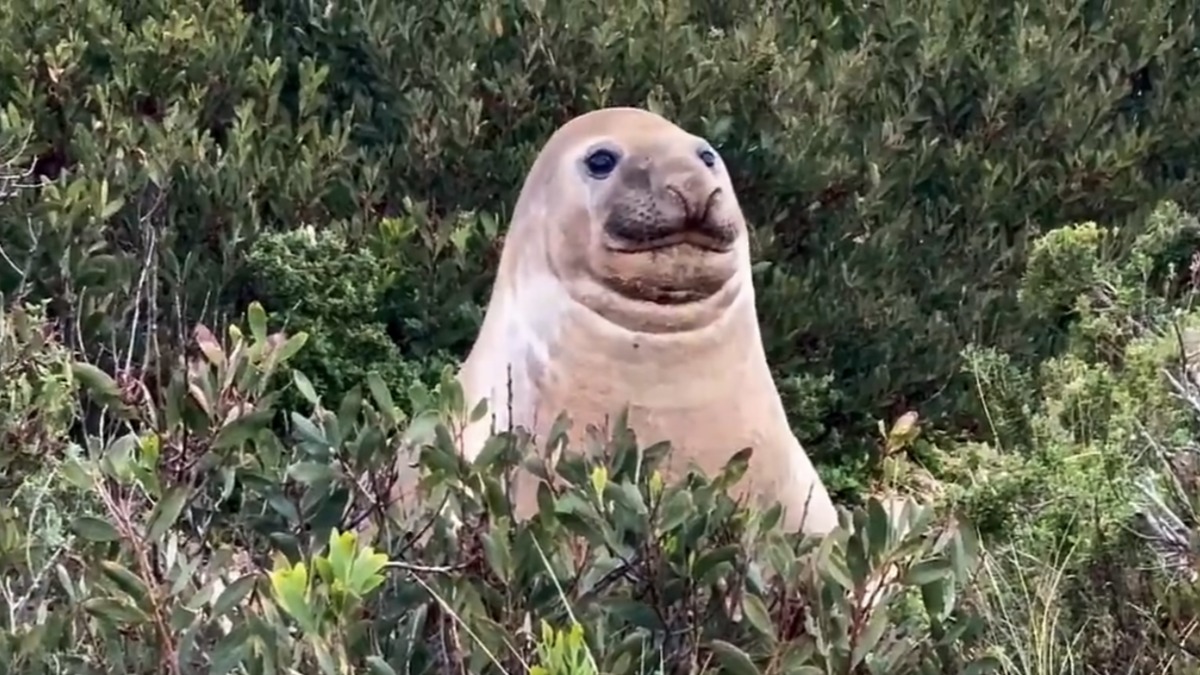

Neil, the boisterous young elephant seal, has finally departed Tasmania. In his wake is a trail of flattened traffic cones and a whole lot of questions about his future.
The story of this Australian mammal is a complex situation involving conservation, public safety, and a whole lot of viral fame. Considering his current trail of destruction, CNN reports that scientists are worried about what will happen when the five-year-old seal gets even bigger.
Neil was reportedly born in 2020 off the southeast coast of Tasmania, which is highly unusual. Most southern elephant seals are born on the uninhabited Macquarie Island, about 1,500 kilometers south of Hobart. SBS notes that, per Clive McMahon, a research ecologist at the Sydney Institute of Marine Science, an elephant seal’s biological drive is to return to the place where it was born. Unfortunately for Neil, that’s on human-inhabited land.
The problem now is that Neil can’t find the other seals. CNN reports that he has never gone that far south. This means that as he gets older, bigger, and more ready to breed, he is likely to spend his life alone. After all, within the asphalt roads and beaches of Tasmania, there are no females for him to fight for.
The seals live a life of routine
The southern elephant seals’ routines reportedly revolve around the seasons. This, in turn, informs when they breed and shed their fur. CNN notes that from April to August, the winter months in Tasmania, these seals participate in a haul-out period where they gather and interact. For young males, this is a crucial time to learn how to spar and compete. McMahon stated that this is the period when they learn to compete with each other to build their harems.
As there are no other seals around for him to joust with, “poor old Neil … is making do with all the other things that he’s ‘playing’ with, so big bollards, the traffic cones, potentially cars, all sorts of other things,” McMahon said. He has developed a reputation for rocking vans and smashing into street signs. Often, he becomes a menace by rolling into and blocking roads and traffic.
As Dr. Kris Carlyon, head of wildlife health and marine at the Department of Natural Resources and Environment, confirmed to SBS, “At the moment, there’s a number of bollards that he likes interacting with. He’s got no other seals to play with, to joust with, to test his strength with — like he would be doing normally, so he chooses things to interact with.”
Rebecca Thomson, a local who has had her own run-ins with the 2,200-pound animal, described the experience to CNN as both exciting and a bit intimidating. “It’s like this giant slug coming at you,” she said. Despite the chaos, the community is incredibly protective of him. Dr. Sophia Volzke, a marine and Antarctic ecologist in Hobart, told the outlet that everyone knows Neil. He even earned a spot in her PhD thesis.
The problem is that his fame is reportedly growing just as fast as he is. Southern elephant seals can eventually reach up to 8,000 pounds and grow to five meters long, essentially the size of a pickup truck. Officials asked tourists to stay away. They are concerned that the public’s desire for the perfect photo is putting both the people and the seal at risk.
Sam Thamman, a wildlife biologist, told CNN that euthanasia is not the approach they want to take. However, for that, the public must stop trying to get close for selfies. Some people have even been spotted carrying small babies up close to him just to get a shot for Instagram. Per SBS, Dr. Carlyon warned that people need to remember that Neil is a “wild seal, not a pet.”
SBS noted that Neil has now returned to the ocean to rebuild his blubber reserves after his annual molt. He will likely return next winter. In the meantime, the community is already rallying to protect him. An online petition has gathered nearly 79,000 signatures to implement non-lethal management plans and restricted access zones.
As McMahon noted, “As a community, we’re just going to have to adapt as well.” “The infrastructure that we built isn’t designed to withstand a 1,000-kilogram animal bashing into it … we’re going to have to rethink some stuff.” It is a tricky balance, but as Dr. Carlyon mentioned, his presence is actually a great sign for the recovery of a threatened species.

Published: Jul 13, 2026 03:46 am