


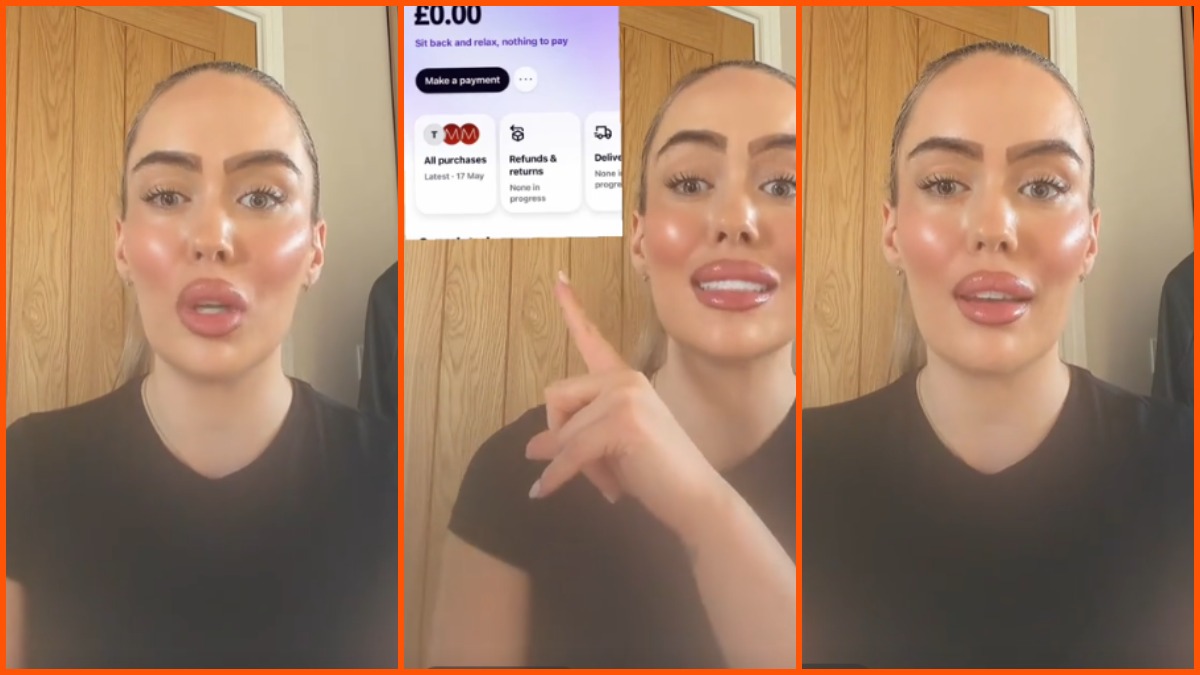

A UK woman said in a TikTok video that she has cleared her Klarna balance and does not plan to use the buy-now-pay-later service again. Sarah Outridge, who posts under the username @sarahouttridge680, shared the update in a video where she also discussed her wider effort to pay off more than £30,000 in debt.
Outridge said in the video that her Klarna balance had been over £1,000 just a few months earlier. She said the balance came from what she described as random clothing purchases that she did not need.
The caption on the video read, “My Klarna balance is finally £0! Why I won’t be using Klarna anymore who’s trying to pay off over 30k debt.”
She said Klarna makes purchases feel more affordable than they are
Outridge said in the video that Klarna is one of the easiest ways to buy things a person does not need. She said this is because the payment plans are structured, and marketed, in a way that makes purchases feel more affordable.
“Although you’re not paying any interest on top, you think, okay, that’s only £10 a month, that’s only £50 a month for the next 3 months, that’s really affordable,” Outridge says. “But you keep doing it and it can get addictive, and you don’t realize how much it accumulates to when, you know, you go on TikTok Shop or you go on, um, anywhere, clothing shops, and you split the payment in 3.”
She said a payment of about £20 a month for three months can feel affordable in the moment, which she said leads to buying items that are not needed. Social media users have described confusing experiences like this with personal finances, including a federal student loan payment jump.
Outridge said she will be avoiding Klarna going forward as someone working to pay off more than £30,000 in debt. She clarified in the video that she does not consider Klarna a bad tool in general, and said it can be useful when used with intention.
She gave the example of a larger, planned purchase, such as a washing machine, as a case where splitting payments could make sense if someone could not cover the full cost that month. She described this type of purchase as intentional.
Outridge said her issue is with smaller, frequent purchases made mainly because the payment plan makes them feel cheap. She said she is stepping away from that pattern going forward. Small, unnoticed charges have caused problems for other account holders too, such as nearly $20,000 disappearing from a joint account after a minor charge went unchecked.
The debate over whether payment plans like Klarna are harmful is not new. In a discussion on the Reddit forum r/NoStupidQuestions, one user wrote that a “true 0% payment plan” is not inherently a problem if the buyer already has the money to cover the purchase outright, but noted that such plans “can make expensive purchases feel cheaper than they really are.” Another commenter in the same thread said missing a payment can result in being hit with “20 + percent interest and fees,” adding that such services “make a lot of money preying on people overstretching finances then getting trapped.”
Other individuals have described similar spending patterns tied to buy-now-pay-later apps. In an October 2025 profile published by The New York Times, a woman named Elysia Berman said she accumulated $50,000 in debt over several years by using services including Klarna and Affirm, describing the experience as “like throwing gasoline on a burning fire.” Berman told the outlet she eventually paid off her balance in April 2024 and later deleted the apps from her phone.
Research cited in the same New York Times report, conducted by University of Leeds professor Dionysius Ang and Imperial Business School’s Stijn Maesen, found that shoppers were about 9 percent more likely to complete a purchase when a buy-now-pay-later option was offered, and tended to spend roughly 10 percent more overall when using it.
Klarna is a buy-now-pay-later service that allows customers to split purchases into installments, often without interest, depending on the plan selected. The service is widely used by retailers in the UK and elsewhere for online purchases, including clothing and other retail goods.
Outridge’s video reflects a broader discussion among some social media users about buy-now-pay-later services and their role in spending habits. Her comments in the video were limited to her own experience and did not include claims about other users of the service.
The video drew a range of comments. One user wrote, “Just make sure you get rid off them after you pay.” Another commented, “It’s an addiction,” to which Outridge replied, “It is 😔.” Other commenters described their own struggles with shopping apps, with one writing, “I really need to delete all the shopping apps, etc.” Another said, “I blocked myself on it and deleted the app!” while a third wrote, “Such a slippery slope for me.”






Published: Jul 22, 2026 04:34 am