


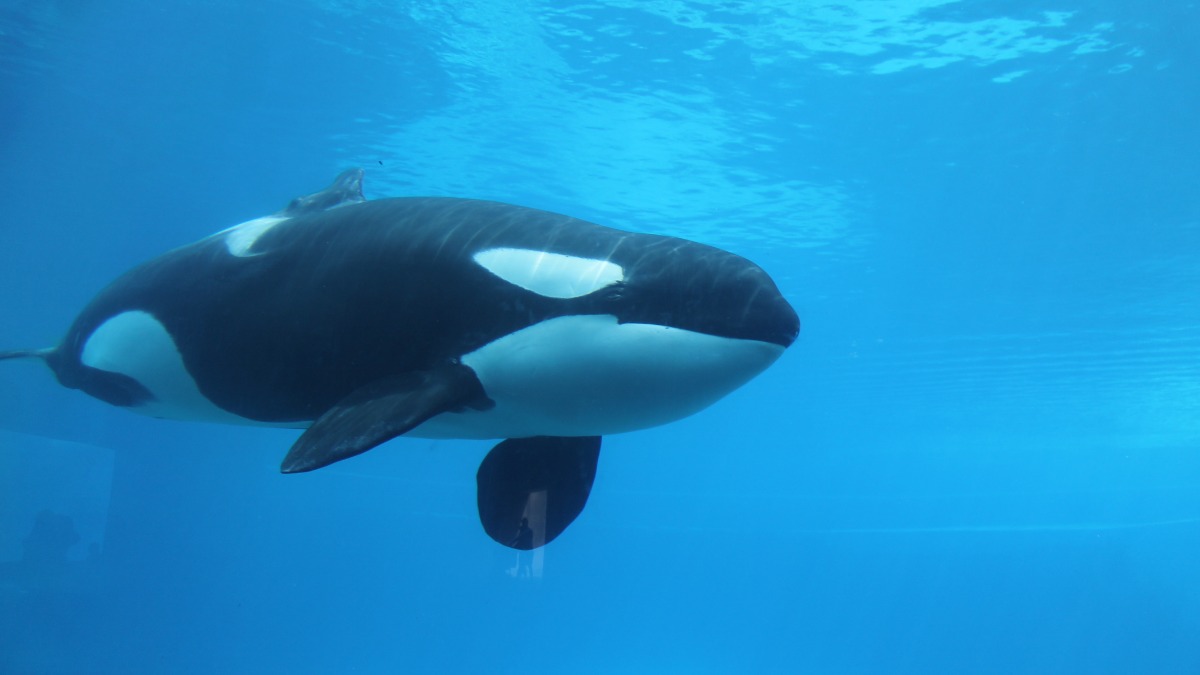

Scientists have recently documented surprising behavior where orcas ram into prey with such force that it literally explodes into thousands of pieces. According to The Washington Post and The Guardian, this phenomenon has been recently observed off the coast of Mexico in the Gulf of California.
Per reports, the targets of these high-speed collisions are sharp-tail sunfish. These fish are massive, bony, and slow-moving creatures that hang out near the surface to rest or remove parasites. They can reach up to 6 feet in length and weigh several hundred pounds. It makes them look like giant, swimming bullets. Orcas have been known to hunt these fish by boring into their sides to reach fatty organs and “dismantling” them. This, however, is new..
In the recorded footage, one orca typically holds the sunfish, likely dead, in place. Then a second whale accelerates and slams into the prey nose-first. The result is an audible crash that sends fish parts flying. As Erick Higuera, a marine biologist and wildlife cinematographer at the Mexican non-profit Conexiones Terramar and co-author of the research, noted, “Exploding large vertebrae into thousands of fragments through kinetic impact alone is entirely unique.”
It all might tie to the Orca social structure
According to The Guardian, the researchers published their findings in the journal Frontiers in Ethology. However, they are still debating the exact purpose of this behavior. One theory is that it is a practical hunting strategy, designed to break down the sunfish’s tough, rubbery skin into smaller, manageable bites for younger orcas.
The first recorded event was in July 2024. In the footage, young orcas were observed snacking on the floating bits of flesh while the adults finished off the main carcass. The footage was recorded on a GoPro camera by Dr. Kathryn Ayres. She’s a scientist at the non-profit organization Beneath The Waves and could be heard shrieking in shock on the audio.
Per the report, Higuera described the intensity of the scene, saying, “When you see a multi-ton apex predator charge a massive fish at that speed right next to your boat, the sheer acoustic thud and the resulting explosion of tissue are overwhelming.” It is a stark reminder of the sheer power these animals possess. In fact, recently, a whale breaching capsized a fireboat in seconds. A tourism operator captured the second instance of orcas in September 2025.
However, there is another school of thought: this might just be for fun. The Guardian noted that Orcas are incredibly social, intelligent creatures known for their complex play. They have been seen carrying dead salmon on their heads like hats. They are also recorded surfing in boat wakes and tossing kelp at one another.
Higuera emphasized this, stating, “Play is a core pillar of orca society.” Per the Post, he further noted that “Adult females use these events as crucial teaching tools. It is a primary mechanism for practicing complex motor skills, strengthening team coordination.” Dolphins, who are just as intelligent and social, have been rumored to be part of a special Iranian military program to take down US naval ships.
The outlet noted that just as humans pass down recipes or specific habits through generations, orcas seem to sustain their own unique hunting cultures. “Because this extreme fragmentation has not been documented in sunfish predations elsewhere, it is likely a culturally learned tradition unique to these specific parts,” Higuera stated. He stated that this could only be confirmed by further study on other areas.
Eco-tour operators are using more underwater drones and cameras. Per The Guardian, that gives us a front-row seat to these mysteries. Higuera remains optimistic about this trend. He said, “If we can maintain a respectful distance and protect these animals, continuing this collaboration with tour operators will allow us to safely document mysteries of ocean life that would otherwise remain completely hidden from science.”









Published: Jul 24, 2026 03:55 pm