


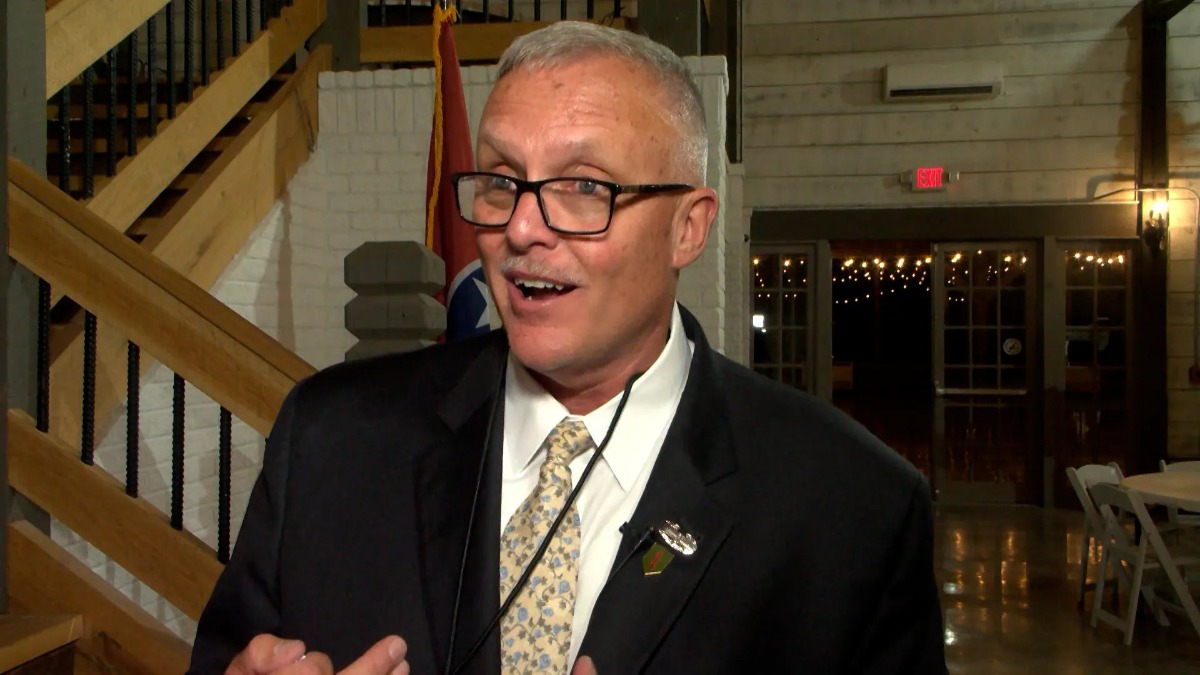

State Representative Monty Fritts is running for governor of Tennessee with a campaign platform that includes a goal to ban mosques and what he refers to as pagan religions, including Islam, Buddhism, and Hinduism. The 63-year-old Republican candidate made these comments while on the campaign trail with just four days left in the state’s early primary voting period. The primary election is scheduled for August 6.
According to WSMV4, Fritts’ views on Islam specifically are rooted in his claim that the faith is not a religion but rather a political movement. “Islam is a little different story than perhaps other religions are, in that it’s not necessarily a religion; it’s a political movement,” Fritts said in an interview. “It’s that movement that, if you don’t submit, you perhaps are executed. I feel that Islam is incongruent with both our U.S. and Tennessee Constitution.”
When asked how he would legally justify banning non-Christian houses of worship, Fritts reportedly argued that the First Amendment restricted the powers of the Federal government. He stated, “I think that what we miss oftentimes in the First Amendment is the first word: Congress. That’s the only one of the Bill of Rights that specifically starts with that word. And it limits that power of Congress.”
Fritt believes the amendment doesn’t prevent States from restricting religion
Legal experts and the U.S. Courts offer a different perspective. According to the outlet, the U.S. Courts explain that “The Free Exercise Clause protects citizens’ right to practice their religion as they please, so long as the practice does not run afoul of a ‘public morals’ or a ‘compelling’ governmental interest.”
WSMV4 reported that Fritts served four years as a state representative. The candidate claims he entered the Governor race after a spiritual calling that he described as a persistent, urgent whisper. He noted that he began waking up at 3:00 AM and had encounters with strangers who approached him with what he called a word, eventually leading him to seek the governor’s office.
The American Muslim Advisory Council has strongly pushed back against Fritts’ claims. In a statement shared with WSMV4, executive director Sabina Mohyuddin said, “Unfortunately, Monty Fritts’ ideas are incompatible with the US constitution which guarantees freedom of religion for all religions.”
She wrote, “If he studied US history, he would know that Thomas Jefferson, one of our founding fathers, wrote that the Virginia Statute for Religious Freedom (1786) was written ‘to comprehend, within the mantle of its protection, the Jew and the Gentile, the Christian and the Mahometan [Muslim], the Hindu, and infidel of every denomination.’ Fritts’ narrow view of Christianity and whose religion is acceptable is dangerous and should worry everyone.”
This is not the first time Fritts has made such statements. In a May interview with NewsChannel5, he explicitly called himself a Christian nationalist. He acknowledged that his extreme positions might alienate voters, but he emphasized that he has no intention of softening his rhetoric. Interestingly, some Republican strongholds have already flipped blue in the face of divisive rhetoric.
“We’ve found ourselves all too often in America today that we’re willing to compromise just to get a vote or to say something that might be less offensive. And I’ve just decided I’m gonna try to finish strong and not behave that way,” Fritts told NewsChannel5. It’s a strong statement in an already turbulent election environment where politicians like AOC are calling for speeches not to be aired on television.
If enacted, the proposal from Fritts would have a significant impact on the state’s population. WSMV reported that data from the World Population Review indicates that nearly 40,000 people in Tennessee practice Islam.
Furthermore, according to PEOPLE, research from the Pew Research Center highlights that the U.S. South is home to high concentrations of Buddhists and Hindus. Specifically, about one in three Hindus in the United States resides in the South, and the region also hosts about 32% of the country’s Buddhist population.
The outlet noted that other Republican candidates for governor have distanced themselves from Fritts’ rhetoric. A spokesperson for Senator Marsha Blackburn noted that she “supports the religious freedom our country was founded upon and is grateful that Tennessee has already made it clear that no foreign law, including Sharia law, can override our Constitution or the laws of our state, and that Tennessee is a Christian state.”
Meanwhile, U.S. Representative John Rose reportedly stated: “Generations of Tennesseans fought and died for our Constitutional rights, including the first amendment. I took an oath to protect and uphold the Constitution. I held my hand on our family Bible when I took that oath. I’m secure enough in my faith that I can bring others to Christ without trampling on their rights.”








Published: Jul 30, 2026 01:43 pm