


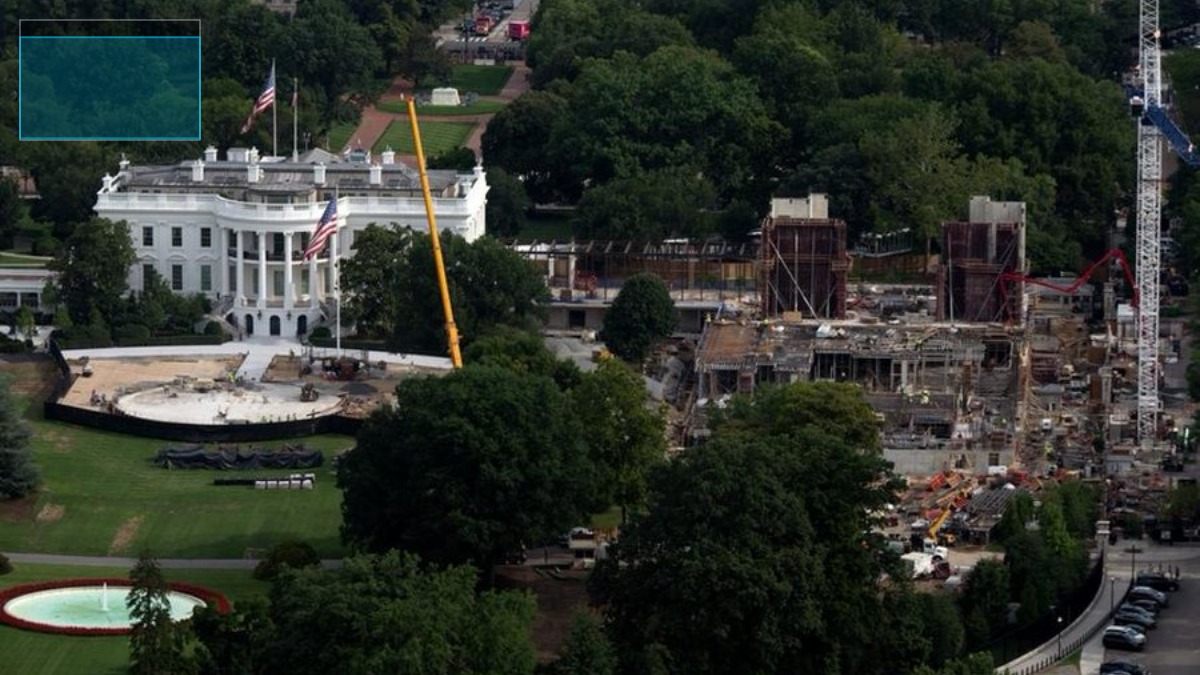

A federal appeals court has officially blocked further construction on the planned White House ballroom. Per the NY Post, the DC Circuit judges ruled that the massive project requires explicit congressional approval before it can move forward, and that the executive branch doesn’t have unilateral power to reshape the White House for a president’s desires. It is a major legal hurdle for a project that has already seen the demolition of the historic East Wing.
The legal battle stems from a lawsuit filed by the National Trust for Historic Preservation in December of last year. Per AP News, the nonprofit argued that President Trump and the National Park Service lacked the authority to destroy the historic structure or build a new one without a green light from Congress.
While the court has stayed its ruling for two weeks to allow time for an appeal, the message from the bench is clear. As the court noted, “Whether or not a massive ballroom should be constructed is for Congress to decide and is not a matter for Executive self-help.”
A long battle that began with something irreversible
In the majority opinion, judges Patricia Millet and Bradley Garcia reportedly wrote, “We are aware of no instance in American history in which a President unilaterally and using privately collected funds demolished substantial portions of the White House that Congress authorized to be built and American taxpayers paid for. Until now.”
The outlets noted that they further emphasized that the Constitution grants Congress plenary control over all real property belonging to the United States. It’s a pretty significant check, especially considering the scale of this project.
According to the Associated Press, the planned 90,000-square-foot ballroom is a massive undertaking, with costs estimated to reach upwards of $600 million. President Trump has consistently prioritized the project, arguing that it’s necessary for hosting large-scale dinners with enhanced security measures, as he did following the shooting at the White House Correspondents’ Dinner.
Per the outlet, the administration has even suggested the facility would include bomb shelters, a hospital, and other sensitive military installations. Government lawyers have maintained that these upgrades are essential to protecting the president, his family, and staff from threats like drones and biohazards.
The NY Post noted that despite that, the court isn’t buying the argument that this gives the president free rein to bypass the legislative branch. “Congress has not ceded unfettered authority to the Executive Branch to dramatically redesign, reshape, and reconstruct the White House — the People’s House — to fit a particular President’s desires,” the judges wrote.
They reportedly clarified that this ruling isn’t about the desirability of the ballroom itself, but rather about the legal requirement for congressional authorization. However, not everyone on the bench agreed with this outcome. Trump-appointed Circuit Judge Neomi Rao dissented. She argued that the district court had no jurisdiction because the National Trust for Historic Preservation lacks the standing to stop construction.
Per the NY Post, she claimed that the ballroom falls under the president’s authority to make improvements to the Executive Residence. According to Rao, the district court “elevated the aesthetic displeasure of a single passerby over the government’s security interests in the ballroom and the security risks of leaving an open construction site at the President’s home and office.”
The outlet reported that Trump took to Truth Social on Friday to express his frustration with the ruling. He called it “horrendous, politically motivated, and unlawful.” The president also stated that he would immediately appeal the decision to the Supreme Court. In his post, he argued that the Military and Secret Service view the ruling as a national security threat since, according to the president, “the entire Complex is being built for the protection of our Country.’
“The Circuit Court’s decision, which is totally wrong on the vital subject of STANDING, of which the plaintiff has none, severely jeopardizes the lives and welfare of the people who work, and will be working, at the White House — including all future Presidents of the United States, and their families, as well as the lives of all those visiting, such as Heads of State and other Dignitaries, and all Americans who wish to visit the historic, beautiful Executive Mansion,” he wrote.
The battle over the ballroom has been ongoing since the demolition began. A few months ago, Senior US District Judge Richard J. Leon heard the case. While he initially criticized DOJ arguments to justify the ballroom, he eventually ruled that aboveground construction must stop. However, he allowed work on underground bunkers and other security facilities to proceed.
The National Trust for Historic Preservation expressed satisfaction with the latest ruling. The president and CEO, Brent Leggs, stated, “From the beginning, our position has been clear and consistent: the law states that only Congress can authorize the construction of a ballroom at the White House.”









Published: Aug 8, 2026 06:46 am