


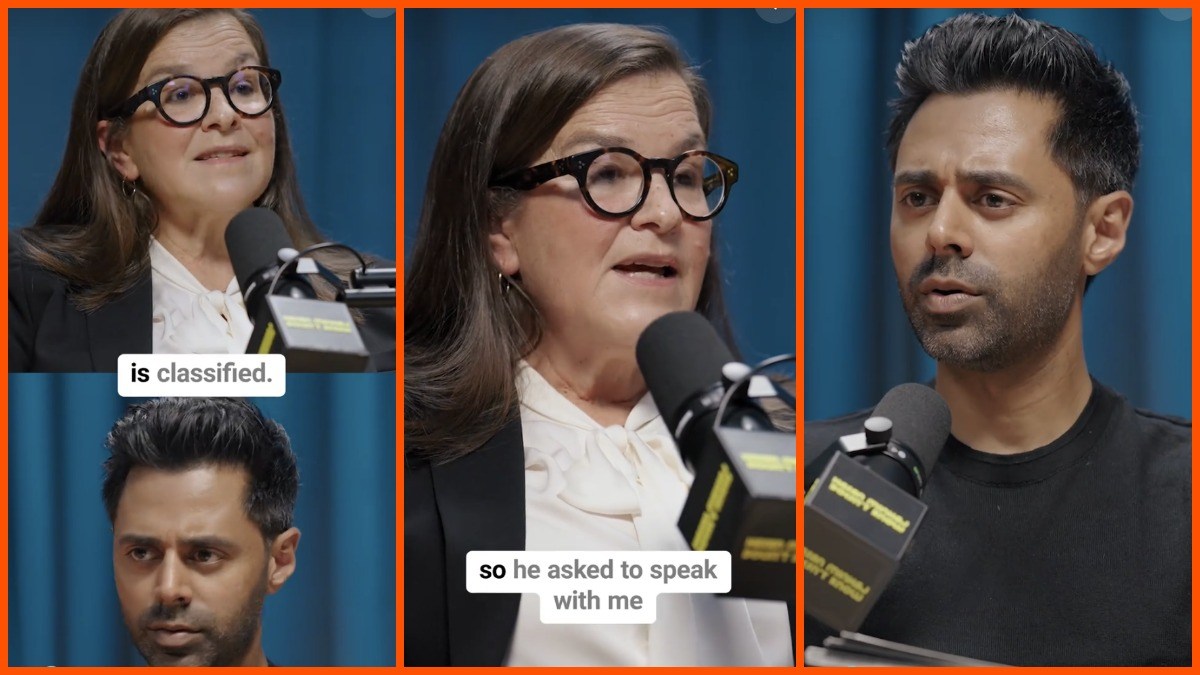

The internet holds everything, or at least more information than anyone planned. Something a conversation between Hasan Minhaj and investigative journalist Annie Jacobsen put into perspective. Jacobsen was on the Hasan Minhaj Doesn’t Know podcast to talk about her book Biological War: A Scenario and the threat of weaponized pathogens. However, when they spoke about the Strategic National Stockpile, Jacobsen revealed a secret.
“The location of the Strategic National Stockpile is classified,” Jacobsen declared in a post on Instagram and TikTok with over 1.3 million views. She then claimed, “So I had ChatGPT tell me where it was.” Minhaj was shocked and asked her, “What? So, it was able to just scrub the internet?” Jacobsen told Minhaj, “If you just try to make it do that, it will say, ‘No, you can’t know where that is. It’s classified.’”
This is why her claim is so shocking. The Strategic National Stockpile, as defined by the Administration of Strategic Preparedness and Response, is a massive federal medical response infrastructure. It holds critical supplies like vaccines, medicines, and other countermeasures needed to protect the public from chemical, biological, radiological, and nuclear threats. It is essentially a safety net for when local resources are tapped out during a pandemic or emergency.
Writing the correct prompt
On the podcast, Jacobsen explained how she was able to coax the answer out of ChatGPT. She alleged, “I have a little bit more nomenclature in me, and I know sort of some keywords to use. And I really pushed ChatGPT hard and found the actual location in Los Angeles.” Then she claimed she mentioned it to friends with connections to Sam Altman, which then led to a conversation with him.
“So he asked to speak with me about this, and we had a discussion, and one of the questions he asked me was, uh, ‘how do you know that that’s the right location?’” Jacobsen alleged. “Well, I told him that it’s a location with a big perimeter fence around it, but more importantly, it has a rail track that goes in and doesn’t come out. That’s how you bring the supplies in.”
She claimed, “And the reason that ChatGPT was able to locate it was because a government official, by accident, on page, like, I can’t remember, it was like 434 of some document…” Minhaj tried to guess, asking if the information was on a government site. Purportedly, per Jacobsen, it was in an emergency earthquake notice. Of course, this is all based on Jacobsen’s claims and isn’t verified.
When Hasan asked if by “pushed” she bullied the chatbot, Jacobsen admitted that she suggested “that it isn’t as smart as it thinks it is,” she said. Minhaj joked that she “negged” it, to which Jacobsen replied, “I negged it. Yeah.” Her use is a far cry from the crime planning some people use ChatGPT for.
Many commenters weren’t surprised. One user noted, “The thing is that it has access to EEEEVVVVVERRRYTHING. It just has been told to LIMIT what it gives US. So if you change its perimeters… it will shift its perspective.” Another commenter shared how they use the chatbot, admitting, “I’ve literally told chat gpt, ‘you’re just a computer act like it’.. and my responses became more informative and less friendly and I like it that way lol.”
Understanding how something classified can be found by ChatGPT begins with understanding how these models are built. According to Scalenut, ChatGPT is trained on a massive foundation of data. This includes a broad snapshot of the internet, of countless web pages, articles, and public forums. While the model is fine-tuned using Reinforcement Learning from Human Feedback to align with safety expectations, it processed a vast amount of information.
Scalenut points out that while standard versions have a “frozen” knowledge base, they are still built on this diverse dataset. When the browsing feature is enabled, the model can perform targeted searches to pull fresh data, though it doesn’t index the web as Google does. Instead, it synthesizes information from news sites, reference pages, and community discussions. So, an accidental or even intentional upload of sensitive data then becomes fair game.
A user wrote, “The only way ChatGPT could have that information in a typical chat thread, btw, is if it was trained on that information. God only knows what other government secrets and classified info they’ve grabbed that could be negged out smfh.”
In conversations about security, one user shared, “Some guy in the Netherlands found a US nuclear weapon in a local [military] bases because one of the service members uploaded their training to a public flash card site and found Facebook pictures geotagged on the base with the weapon. Nothing is secure while everything is put into the giant database of the internet.”




Published: Aug 30, 2026 08:50 am