


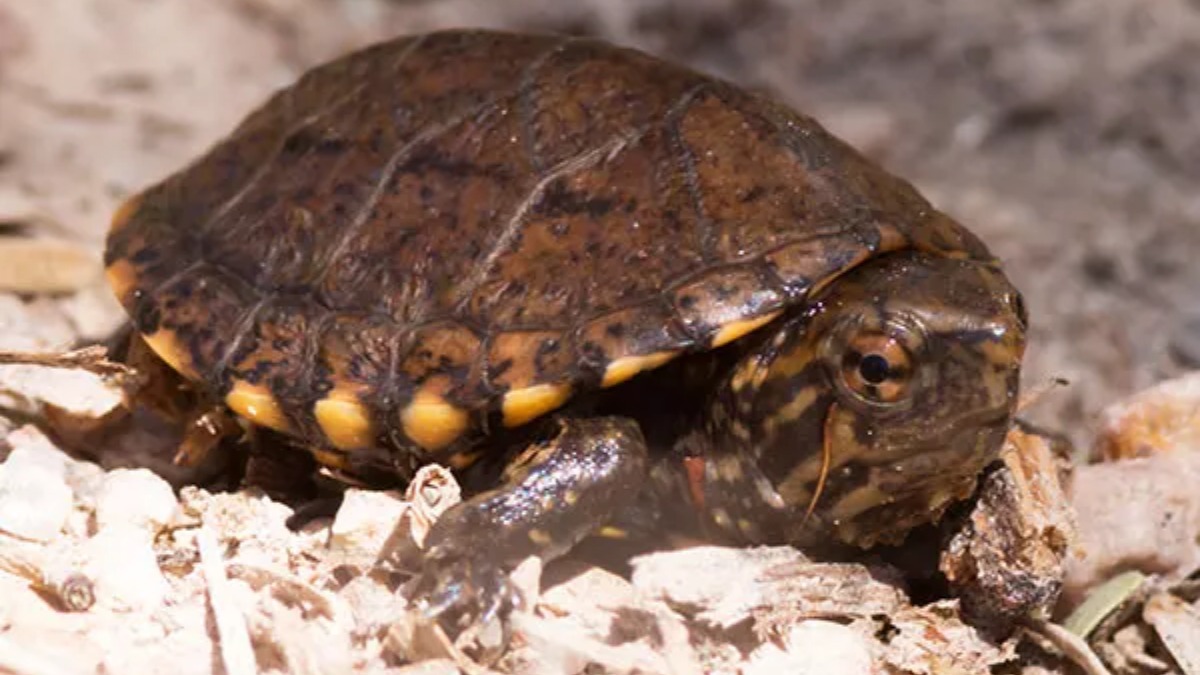

Arizona Wildlife officials are currently scrambling to put together an emergency rescue operation for the endangered Sonoyta mud turtle. The species faces the potential destruction of its final remaining habitat in the United States due to the construction of a secondary border wall. This tiny, olive-brown freshwater reptile, which was officially listed as endangered in 2017, is now under threat from federal government projects.
According to the Arizona Daily Star, researchers and wildlife experts are preparing for the worst as they draft a salvage plan to protect the turtles. It’s an incredibly stressful situation for the all-volunteer, multi-agency team tasked with the species’ recovery. PEOPLE noted that the team includes representatives from the National Park Service (NPS), the U.S. Fish and Wildlife Service, Arizona Game and Fish, the Tohono O’odham Nation, and various research partners in Mexico.
Michael Bogan, a freshwater biologist at the University of Arizona who leads the Sonoyta Mud Turtle Recovery Team, expressed his frustration by stating, “it’s insanity.” The team was originally focused on a long-term strategy to change the turtle’s endangered status. That goal has now been sidelined. “There’s potential that whatever turtles we salvage from Quitobaquito may not be able to go back there for a long time — or, worst-case scenario, ever,” he said.
According to the NPS, the habitat, Quitobaquito Springs, is partially man-made
According to the NPS, Quitobaquito Springs is the habitat for the Sonoyta mud turtle. A remote desert oasis located about 170 miles southwest of Tucson within the Organ Pipe Cactus National Monument, it’s a vital location because it’s the only place in the world where three specific species can be found.
In addition to the mud turtle, the springs are home to the Quitobaquito tryonia, a tiny snail currently being considered for endangered status, and the Sonoyta pupfish. According to reports, the pupfish actually went extinct in the wild in Mexico back in 2025, making the springs the last refuge for that species as well.
The timeline for potential construction is what has everyone on edge. Officials have been told to expect survey work to begin fairly soon, with a contract for the secondary wall potentially coming as early as this summer. This accelerated pace is linked to the $46.6 billion in funding provided by the One Big Beautiful Bill Act, which initially faced some roadblocks.
Bogan noted the difficulty of planning under such pressure, saying, “In an ideal world, we would wait until the (secondary wall) contract was issued, because then we’d know what the specs are of what we’re dealing with. But those contracts could be issued, and they could be out there a week later bulldozing, so we can’t wait until then to come up with a salvage plan.”
U.S. Customs and Border Protection has stated it is working to avoid the springs and minimize impacts, even promising that no groundwater will be pumped within five miles of the site. However, experts like Bogan remain skeptical that these measures will be enough.
He pointed out that even if the water levels in the pond are somehow maintained, the physical disturbance of building a wall or an access road could destroy the mesquite thicket downstream. The turtles move there for shelter during the winter months.
The team’s emergency plan is reportedly comprehensive, covering various scenarios from increased traffic to the total failure of the earthen dam that creates the pond. If a catastrophic event occurs, the team would need to evacuate the entire population of roughly 250 turtles.
“Under the worst-case scenario, we’ll have twice as many turtles as we’ll have homes for,” Bogan said. To address this, the team is looking at unconventional holding sites, such as the University of Arizona’s Campus Agricultural Center.
Other organizations are stepping up as well. The Arizona-Sonora Desert Museum has successfully bred these turtles in captivity since 2007 and is ready to assist. Meanwhile, the Phoenix Zoo is currently caring for a population of the tiny Quitobaquito tryonia snails.
Tara Harris, the zoo’s director of conservation and science, emphasized the fragility of their current situation. “Obviously, emergency salvage is a temporary solution,” she said. “We’d much rather see a solution that would spare the pond.”
Despite the grim outlook, Bogan remains pragmatic about the turtle’s needs. “This is actually one of the easiest endangered species to manage. They’ll literally live in raw sewage,” he said. “They’re not that hard to keep happy. They just need water, and they just need to not be run over by a bulldozer.”
This isn’t the only endangered species facing habitat damage because of administration policies. Recently, the “God Squad” removed protections that were key to the safety of the Rice Whale in the Gulf of Mexico.








Published: Jun 2, 2026 01:06 pm