


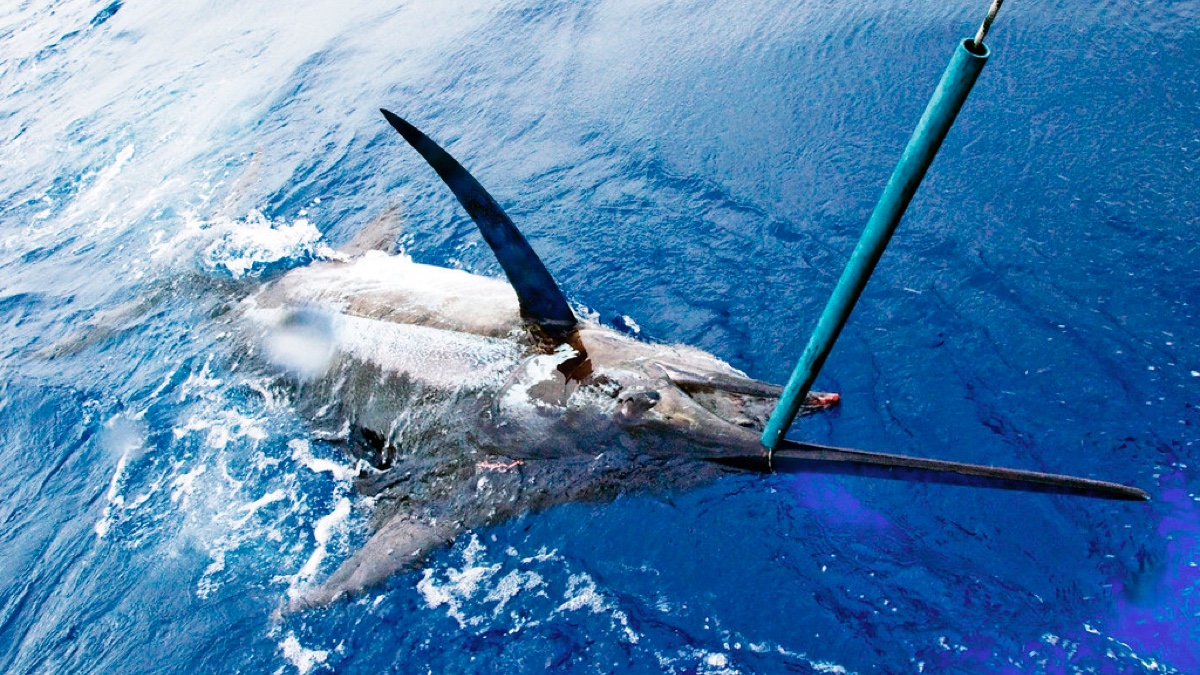

North Carolina State University scientists made an unusual discovery examining a record-breaking blue marlin after North Carolina’s 68th annual Big Rock Blue Marlin Tournament in Morehead City, North Carolina. Inside the nearly 1,000-pound fish, researchers found multiple billfish.
Blue marlin are themselves a type of billfish, and so finding multiple billfish inside a giant blue marlin provides a rare documented example of a top ocean predator feeding on closely related species. This information can help researchers better understand billfish behavior and predator-prey relationships.
The exact contents inside the marlin’s stomach included a sailfish skeleton and another billfish, plus multiple bill tips physically embedded in her head from prior ocean battles. Tournament weighmaster and marine biologist Randy Gregory and the NC State researchers revealed that the 919.9-pound marlin was about 20 to 25 years old.
A 2-hour battle landed the record-setting marlin
The stomach findings added another layer of intrigue to a catch that had already made tournament history. According to the official Big Rock Tournament website and reporting by WRAL, it’s the largest blue marlin ever brought to the scales at the event. The catch surpassed the previous record of 914 pounds set in 2019.
Fisherman Connor Daniel fought the marlin for roughly two hours after the crew hooked it off the North Carolina coast on June 9, 2026. When the fish arrived at Big Rock Landing in Morehead City, officials confirmed it had set a new tournament record.
After catching the fish, Team Marlin Fever secured a payout of more than $6.5 million, one of the largest prizes in the event’s history, according to comments from tournament weighmaster Gregory shared by WCTI and tournament-related social media posts. The Big Rock Blue Marlin Tournament ranks among the largest sportfishing competitions in the United States and routinely attracts hundreds of boats and millions of dollars in prize money.
The 2026 tournament featured a total prize purse of over $9 million, split by 278 competing boats. Marlin Fever caught their record-breaker on Day 2, and had to wait out four days of fishing while the rest of the fleet tried to beat them. Due to deteriorating weather later in the week, no other boat came close.
Researchers frequently examine large marlin landed during major tournaments because the fish can provide valuable biological data. Scientists use stomach-content analysis to understand feeding behavior, prey species, and offshore food webs. Previous billfish research has documented discoveries ranging from tuna and mahi-mahi to tagged fish that helped researchers track predator-prey relationships in the open ocean.








Published: Jun 22, 2026 02:00 pm