


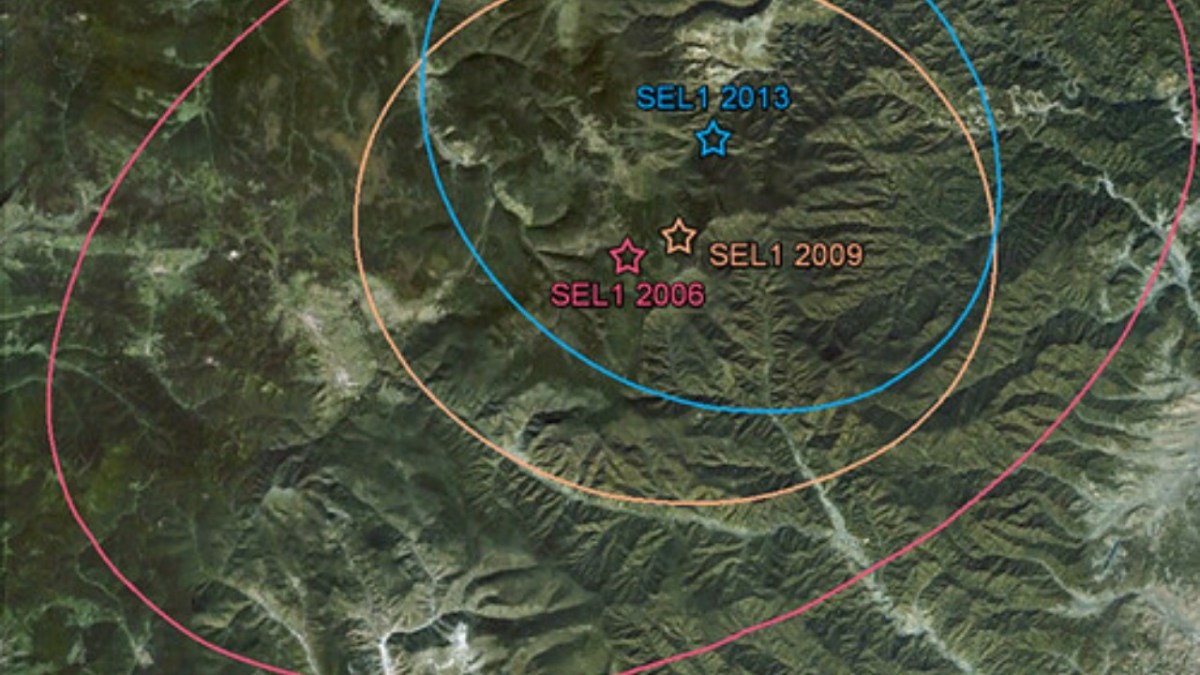

A new study in the journal Science reports that seismic activity around North Korea’s Punggye-ri nuclear test site has kept climbing for years after its sixth and most powerful test in 2017, a pattern the researchers did not expect.
According to CNN, earlier tests, such as those in Nevada during the Cold War, produced tremors that usually died down within days or weeks. At Mount Mantap, where the Punggye-ri site sits, the pattern was different.
The study analyzed seismic data from 2008 to 2025 recorded by seismographs in South Korea and China, since the team had no access to the site itself, and counted 1,399 earthquakes, with their frequency and intensity rising over time. CNN reported that most were small, between magnitude 2 and 3, and shallow.events climbing steadily over time.
The results surprised the study’s own authors Kwang-Hee Kim, a professor in the Department of Geological Sciences at Pusan National University and the lead author of the study published in the journal Science, admitted that the team was surprised by the data. “We were basically very shocked,” Kim said. “The seismic trend was so clear and linear.”
Reshaping beliefs
The South China Morning Post noted that the repeated underground explosions essentially modified the local stress field and damaged the shallow crust. This has led to the delayed reactivation of preexisting structural weaknesses.
The outlet reported that the study identified two parallel fault zones that are propagating away from the test site and heading toward the China-North Korea border. At the end of these fault lines sits Mount Paektu, also known as Changbai Mountain. This is a dormant volcano that had a massive eruption in AD 946, which was one of the largest in the past 2,000 years.
Kim told the South China Morning Post that “the short answer is that an influence on the volcanic system of Mount Paektu is physically conceivable, but it has not been demonstrated by observations.”
Sunyoung Park, an assistant professor at the University of Chicago, told CNN, “In most previous cases, earthquakes triggered by underground nuclear tests declined relatively quickly after the initial disturbance. Here, the opposite seems to be happening: seismicity has persisted and even increased over time.”
She characterized it as “genuinely surprising,” but also pointed out that this kind of long-term human-induced seismic activity isn’t entirely without precedent, though it is rare. She drew comparisons to gas extraction in the Netherlands and wastewater injection in Oklahoma, where fluid movement and pressure changes triggered earthquakes years after the initial activity.
“I think the broader lesson is that short-lived disturbances can have consequences that persist for years or even decades,” Park said. “The Earth’s crust has a long memory.” The recent flash flood in Nepal also demonstrates how water-driven disasters can have a seismic impact.
The specific mechanism here might involve water infiltrating the fractures created by the explosions. Per CNN, Park explained that water movement increases pore pressure within the rock, which pushes faults apart and makes them easier to slip. Since this process happens slowly, the seismic response can be delayed for years. CNN noted that the study itself made no mention of groundwater.
According to CNN, the discovery creates a real headache for international monitoring. The study authors noted that this intensifying activity blurs the distinction “between explosion-related and tectonic events,” making it much harder to keep tabs on what is happening at underground nuclear sites. Even though there is no evidence that further nuclear tests have occurred since 2017, the site itself remains a point of interest.
Journalists reportedly witnessed the apparent destruction of the site in 2018. However, the International Atomic Energy Agency reported that North Korea began restoring test tunnels in March 2022. In 2025, a US Defense Intelligence Agency report stated that the site had been restored. Additionally, North Korea has demonstrated an interest in continuing its nuclear development, even adding it to its constitution as a protective measure against assassination.
Kim told ScienceAlert that the findings broaden the time window that should be considered for the effects of testing, but do not lower the standard of evidence needed to establish causality.









Published: Sep 19, 2026 12:45 pm