



The documentary NAZA has made a massive impact at the Venice International Film Festival, receiving a staggering 25-minute standing ovation, as reported by Deadline. This documentary, which is currently competing for the prestigious Golden Lion award, pulls back the curtain on the secret systems the Israeli military has utilized during the war in Gaza.
Directors Yuval Abraham and Rachel Szor, who are already known for their Oscar-winning work, have put together this project. The title, NAZA, comes from an Israeli military acronym used to euphemistically refer to the number of civilians expected to be killed during a military strike. The documentary features extensive testimony from 24 Israeli military insiders, including intelligence officers and soldiers who were directly involved in the surveillance and remote killing of Palestinian civilians.
To protect their safety, the interviews were conducted at night on rooftops in Tel Aviv. The participants speak under the condition of anonymity, and their voices and appearances have been digitally altered to ensure they remain hidden. These insiders describe a system where artificial intelligence is used to identify large numbers of potential low-ranking Hamas targets. Once identified, these individuals were often bombed in their own homes at night, even when it was known that their families would be killed alongside them.
The documentary features testimony from Israeli military insiders involved in surveillance and remote killings
The film details how the Israeli military hacked into phones to track targets, often listening in on private conversations with wives and children just moments before launching a lethal strike. Beyond the technology, the documentary provides first-person accounts regarding the systematic burning of civilian homes, the destruction of entire neighborhoods, and the killing of civilians at food distribution sites. In some of these cases, the military estimated that up to 25% of the residents were still sheltering in their homes when the attacks occurred.
Abraham, speaking at a press conference in Venice on Thursday, explained the process of gathering these testimonies. He noted that they simply asked the officers to describe their actions and sketch out how these systems functioned. He observed that some interviewees expressed remorse, while others spoke with indifference or even pride.
Perhaps most notably, several of the individuals worked within a secret intelligence unit that reports directly to the office of Prime Minister Benjamin Netanyahu. One of these insiders went as far as to state that their specific mission was to thwart peace.
The team behind this film features the same group that produced the Oscar-winning film The Zone of Interest, including producer James Wilson and executive producer Jonathan Glazer. Paul Lewis, the head of investigations for The Guardian and an executive producer on the project, described the film as the culmination of “years of painstaking work” to “verify the systems used by Israeli military intelligence.” The project builds upon reporting previously published by the Guardian, +972 Magazine, and Local Call between 2023 and 2025.
The directors have made it clear that their goal is not to focus on the actions of individual rogue soldiers. Instead, they are examining the policies, the orders, the language, and the accepted practices that make such widespread destruction possible. They are looking at the system itself and the people who operate within it. As Abraham and Szor stated, they feel a sense of obligation as Israeli filmmakers to examine the systems behind the mass killing of Palestinian civilians for which their country is responsible.
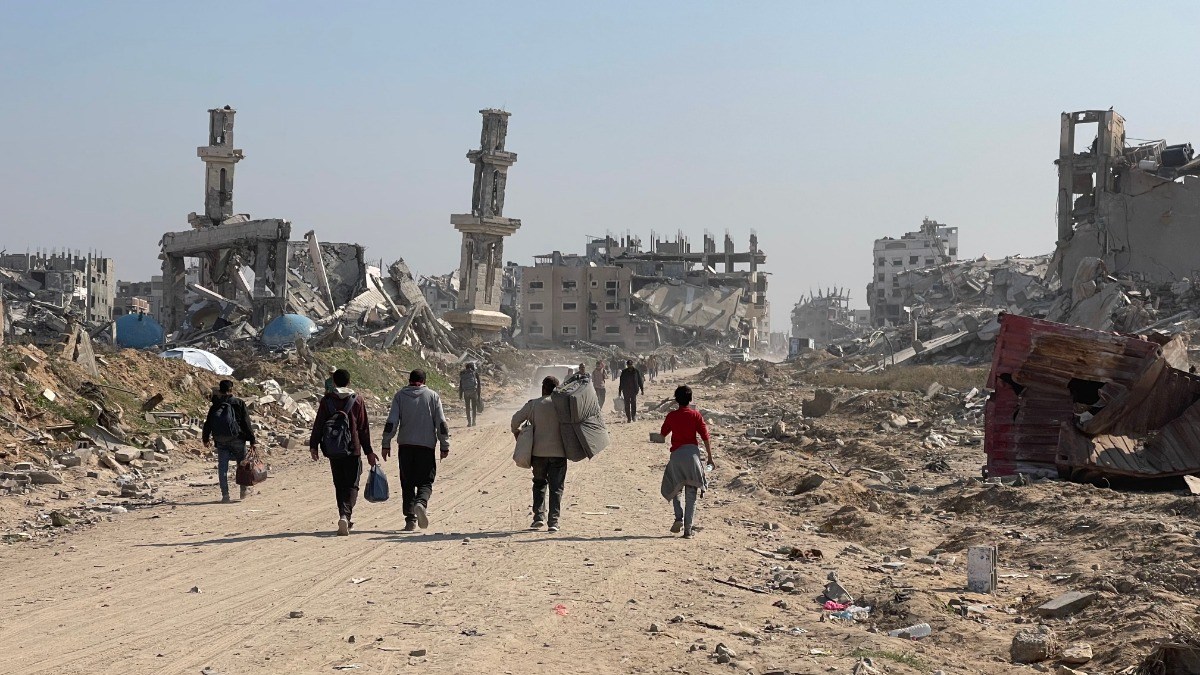
This film arrives in the context of a devastating conflict. Since the war began following the 7 October 2023 Hamas-led attacks, more than 73,000 Palestinians have been killed, with over 174,000 injured. The destruction of infrastructure has been immense, with more than three-quarters of homes in Gaza damaged or razed, leaving survivors in crowded tent camps with minimal access to basic necessities like clean water.
During the premiere, the intensity of the moment was palpable. As the lights went up, audience members began waving Palestinian and Lebanese flags. Festival artistic director Alberto Barbera, who has been vocal about the film being “a politically disruptive and cinematically interesting work,” was present and joined in the ovation.








Published: Sep 10, 2026 05:05 pm