


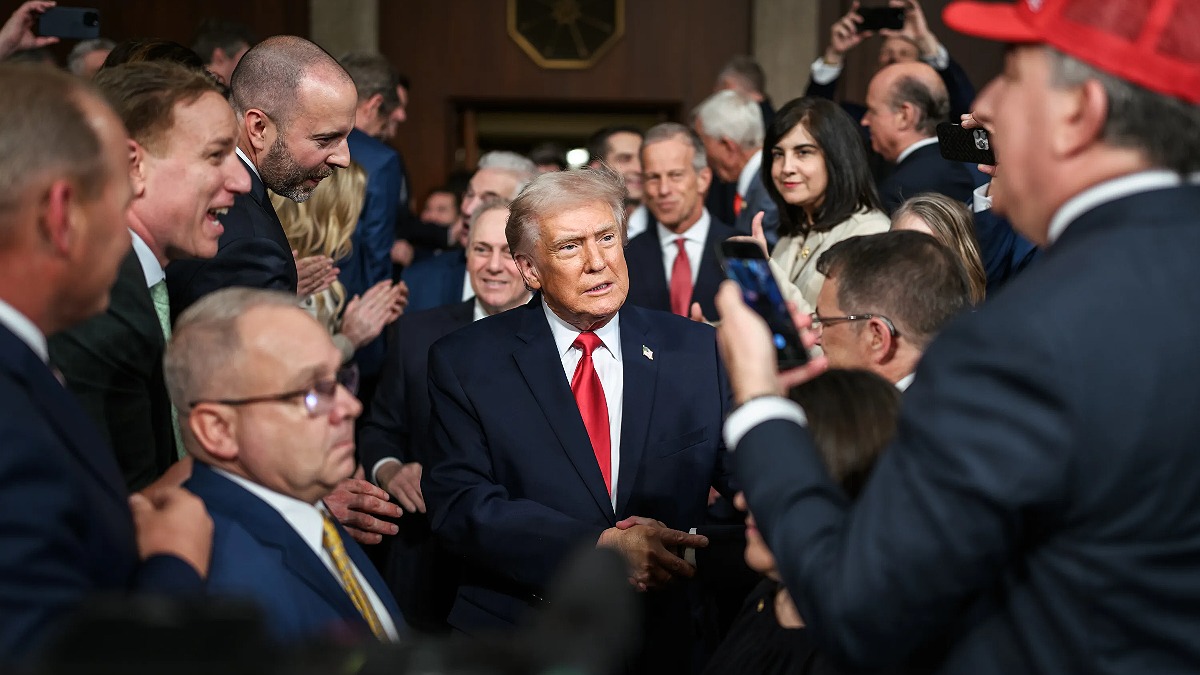

A survey by Pew International, covering 24 countries across Europe, Asia, Africa, the Middle East, and Latin America, found a widespread lack of confidence in Donald Trump when it comes to world affairs. The countries closest to the United States showed some of the lowest levels of trust. Mexico and Canada ranked among the worst, with Sweden and Germany not far behind.
According to Alternet, even the United Kingdom, historically one of America’s closest partners, showed only 37% of respondents expressing confidence in Trump, while 63% said they had none. Japan showed similar results. Meanwhile, the only five countries where Trump had a positive net confidence rating were Hungary, Kenya, India, Israel, and Nigeria – all of which are classified as hybrid authoritarian regimes or flawed democracies by the Economist Intelligence Unit.
The survey also asked people to describe Trump using various traits. More than 50% of respondents in 21 of the 24 surveyed countries labeled him as “dangerous.” An April 2025 Pew survey found that 61% of Americans now disapprove of the U.S.-Israel attack on Iran, and Trump’s overall approval rating has dropped to 34%.
America’s diplomatic structure has been quietly falling apart under the current administration
A big part of this global decline in trust is tied to how U.S. diplomacy has changed. Career diplomats have been pushed out or fired, and the country is now increasingly relying on personal envoys like Jared Kushner and Steve Witkoff, who do not have formal diplomatic experience.
When Trump warned Iran on April 7 that “a whole civilization will die tonight,” European diplomats were left completely in the dark and could not get clear answers from the State Department about whether the U.S. was considering the use of a nuclear weapon.
At least half of America’s 195 ambassadorial posts around the world currently have no confirmed leader and are being run by chargés d’affaires, which many countries view as a diplomatic downgrade. Secretary of State Marco Rubio oversaw the cutting of around 3,000 State Department employees last year and recalled dozens of ambassadors.
Reuters points out that only about 9% of Trump’s ambassadorial appointees are career diplomats, a sharp drop from the historical norm of 57% to 74%. Trump’s relationships with world leaders have also drawn attention for other reasons, including his unusual admiration for Chinese President Xi Jinping.
This has forced allied governments to change how they deal with Washington. Some have stopped using formal channels altogether and are instead building back-channel relationships. Japan, for example, used SoftBank founder Masayoshi Son as a go-between to pass messages to Trump.
Britain, France, and Germany have largely chosen not to publicly push back on Trump’s rhetoric, hoping it is just talk. As one European diplomat put it, they have learned that “every time he barks like that, he does not bite.”
The National Security Council, which used to coordinate U.S. foreign policy, was significantly cut down in 2025, leaving staff with little formal guidance. Many officials began using Trump’s Truth Social account as their main source of policy signals.
Moments like Trump appearing to peek at Xi Jinping’s private notes during meetings have only added to the sense of unpredictability surrounding his foreign policy approach. Former Ukraine ambassador Bridget Brink resigned in April 2025, citing a policy of “appeasement” toward Russia on Ukraine as the reason she left.
Some have suggested that once Trump leaves office, the U.S. may need a truth and reconciliation process, similar to the one Nelson Mandela set up in South Africa, to fully understand what happened to American diplomacy during this period. For now, traditional allies remain increasingly skeptical, and the country’s diplomatic system has been fundamentally changed.




Published: May 22, 2026 03:55 pm