


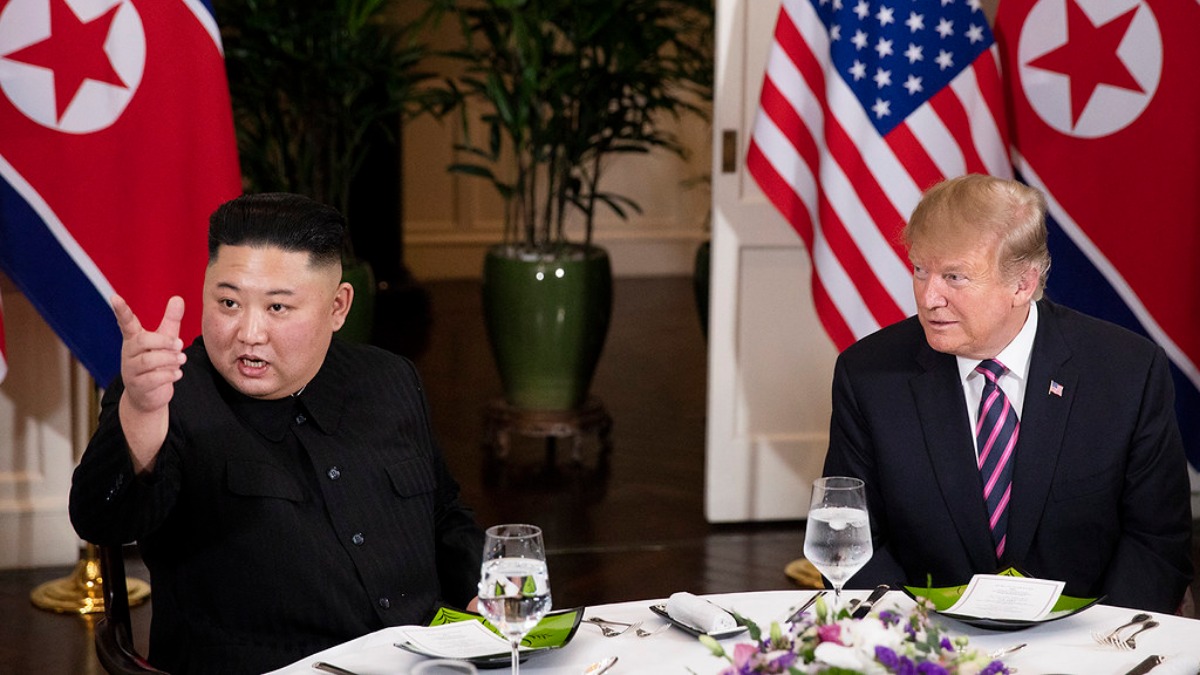

President Donald Trump announced on Sunday that the United States would reduce military exercises with South Korea. The announcement came just hours before the scheduled start of the annual training event. According to CNN, the decision appears tied to the president’s ongoing desire to reshape how the United States interacts with its allies, specifically regarding financial costs and participation in global conflicts.
Per the BBC, the president stated the United States would “substantially reduce” the joint military exercises. In his post on Truth Social, Trump cited his “very good relationship” with North Korean leader Kim Jong Un as a primary motivation for the change. He also used the platform to express his frustration with Seoul for declining to join the United States in the denuclearization efforts regarding the Islamic Republic of Iran.
The military exercises in question, known as Ulchi Freedom Shield, were intended to be a significant display of cooperation between the two nations. These drills, which were reportedly planned to run for 10 days, were designed to help forces adapt to modern security challenges, including drone threats, GPS disruption, and potential cyberattacks. According to local authorities, 18,000 South Korean troops were set to participate in the event.
Resetting an old practice
According to CNN, the exercises began as planned on Monday. However, it remains unclear how significantly the scope of the operations will be pared down following the president’s sudden announcement. On Truth Social, Trump wrote, “Based on my very good relationship with Kim Jong Un, of North Korea, I am not happy with the fact that the United States has, long ago, agreed to participate in Joint Military Exercises with South Korea.”
He continued, “These exercises are not only costly, with much of these costs paid for by the United States of America (as usual!), but send a signal that is totally inappropriate and hostile, to a Country that, as long as Donald J. Trump has been President, has been unthreatening and respectful.”
The outlet noted that Trump also addressed the issue of the conflict with Iran. He reportedly noted, “While somewhat unrelated (?), I recently asked the President of South Korea if they would like to join us in the Denuclearization of the Islamic Republic of Iran, and they said, ‘No thanks!’”
This public frustration with South Korea’s refusal to assist in the war efforts is consistent with the president’s history of lashing out at allies who do not provide the level of support he expects. Trump has previously lashed out at the UK on Truth Social. Additionally, an email revealed the president’s plan to punish NATO allies like Spain for not supporting the Iran War.
Per the BBC, South Korea has attempted to navigate this friction, stating that it has been in close communication with the United States regarding military contributions to freedom of passage in the Strait of Hormuz. The reaction from the South Korean government has been measured.
According to CNN, the presidential Blue House indicated it was reviewing the president’s comments while maintaining its focus on the “maintenance of firm combined defense posture.” Officials in Seoul expressed hope that the friendly relations between the leaders of North Korea and the United States could eventually lead to meaningful talks.
This is a delicate situation for South Korea, which has been a close American ally for over 70 years. Per the outlet, the country currently hosts Camp Humphreys, the largest overseas US military installation. Experts have also raised concerns about the potential impact of scaling back these drills.
Leif-Eric Easley, a professor at Ewha University in Seoul, noted that these exercises are essential for military readiness. “Scaling them back can damage alliance coordination, slow the process of South Korea taking on greater responsibility for its own defence, and weaken deterrence against possible conflicts in Asia,” Easley explained to the BBC. “The cost savings from downsizing drills are marginal, while the diplomatic benefits for relations with North Korea are doubtful.”
This is not the first time the president has moved to limit these joint operations. According to the BBC, during his first term, Trump suspended exercises entirely in 2018, calling them “provocative” during his negotiations with Kim Jong Un. In 2019, after a failed summit in Hanoi, he also pushed to reconfigure large-scale drills into smaller events, citing the financial burden on the United States.
Despite these past tensions, the president has recently reaffirmed his positive view of his connection with the North Korean leader, even sharing an old photograph of the two on social media.





Published: Aug 18, 2026 07:00 am