


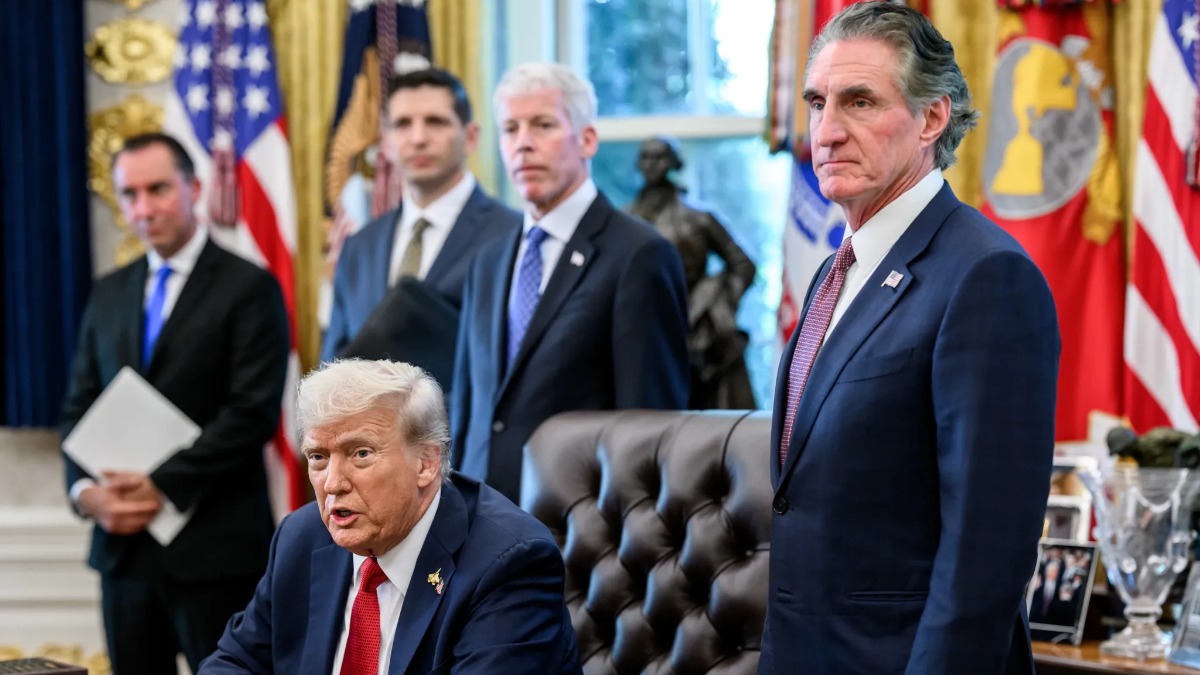

The Trump administration’s energy policy just came under fire during a recent House Natural Resources Committee hearing. Mostly because it’s become clear that the administration’s approach to renewables is built on a foundation of misunderstanding or willful ignorance. Interior Secretary Doug Burgum offered a particularly bizarre take, leaving many observers scratching their heads.
When pressed about the role of solar energy in our grid, Burgum claimed, “All of these projects you’re describing in Nevada have one thing in common—when the sun goes down, they produce zero electricity.” That singular statement brought a hilarious reaction. As highlighted by Aaron Rupar on X and The New Republic, Representative Jared Huffman, who was questioning Burgum, leaned into the moment.
He told the committee chair, “Mr. Chairman, I request unanimous consent to enter in the record this amazing new technology that apparently the secretary is unaware of: It’s a battery. China’s figured it out. That’s why they’re cleaning our clock on clean energy. But I want to enter that into the record.”
It is crazy to ignore the fact that any energy resource produces more energy than is used in the moment, hence, batteries
This exchange serves as an unfortunate example of the disconnect between current leadership and the actual state of energy technology. While Burgum, the former governor of North Dakota with deep ties to oil and gas, continues to frame solar as an unreliable, weather-dependent burden, the rest of the world is moving forward.
Burgum’s assertion that we need other forms of power because solar isn’t 24/7 is true in a vacuum. However, the Department of Energy itself stated that the integration of grid-scale batteries helps solar contribute to the supply even after sunset. So Burgum’s statement is clearly a deliberate choice to ignore inconvenient information.
The administration has been aggressively pushing a fossil-fuel-first strategy while simultaneously claiming to pursue “energy dominance.” In a press release, the Department of the Interior (DOI) boasted that the U.S. produced over 714 million barrels of oil in 2025.
Burgum stated that to meet Trump’s goals of developing abundant energy resources, the administration would provide regulatory certainty, streamline processes, and encourage development. Yet, the reality on the ground contradicts that narrative.
Per the Wall Street Journal, Democrats at the hearing pushed back hard, noting that residential electricity rates have hit a 10-year high. Huffman accused the administration of “bullying offshore wind” to drive “U.S. energy policy down a one-way street of fossil fuel dependency.” He also mentioned that the war in Iran was “crashing the car.”
Burgum argued that it wasn’t ideological and that the wind projects were a national security risk without providing reasons. He then deflected to talk about the importance of Trump’s energy goals as the key to winning the AI race with China. The republicans mostly stood with Burgum, calling Democratic action a “war against fossil fuels.”
Burgum’s arguments all fell apart, for me at least, during his heated exchange with Rep Dave Min (D-Ca). Min pointed out that the administration’s refusal to approve hundreds of wind and solar permits blocked nearly 577 gigawatts of potential energy. Min noted that a District Court even issued a preliminary injunction against the DOI for “slow walking” these permits.
When Min asked Burgum if he knew how much energy China put online last year, the Secretary struggled to provide details. Min stepped in with the facts: China added 543 gigawatts of new energy, with 434 gigawatts (80%) coming from renewables. In stark contrast, the U.S. added only 53 gigawatts under the current strategy. Burgum tried to dismiss China’s production by stating that it only happens “when the wind is blowing.”
Min then asked Burgum if it made sense that instead of following through with an investment, they decided to pay French power giant TotalEnergies $1 billion to abandon its offshore wind projects. Burgum attempted to frame the payment as a refund, but Min wasn’t having it.
He retorted, “You gave them a billion dollars to stop producing energy.” He also pointed out that, refund or not, it came from a fund reserved for legal settlements.
The administration clearly views wind and solar through a lens of skepticism, if not outright hostility. Whether it’s the Pentagon holding up over 250 onshore wind projects or the President’s own public disdain for windmills, the path for clean energy remains obstructed. Especially when you consider the narrow, Luddite view that comes with Burgum’s insistence that we must prioritize “power that runs 24 hours a day.”





Published: May 14, 2026 03:24 pm